Data Science

How to create a heat map on R programming?

How to create a heat map on R programming? Heat maps are a graphical representation of data that uses color coding to show the values of a matrix. They are useful for visualizing large amounts of data and identifying patterns and trends. This article will show you how to create a heat map in R programming. To create a heat map in R, we will use the heatmap() function, which is part of the base R package. We will also use the scale() function to normalize the data so that the colors represent the relative values of the matrix.

How to create a heat map on R programming

Here are the steps to create a heat map in R:

Step 1: Prepare your data

The data for your heat map should be in a matrix format, with rows and columns representing variables and the values representing the observations. Here is an example of a matrix:

data <- matrix(c(10, 20, 30, 40, 50, 60, 70, 80, 90), nrow = 3, ncol = 3)

Step 2: Normalize the data

We will use the scale() function to normalize the data so that the colors represent the relative values of the matrix. This is done by subtracting the mean and dividing by the standard deviation of each row or column:

scaled_data <- scale(data, center = TRUE, scale = TRUE) 

Step 3: Create the heat map

To create the heat map, we will use the heatmap() function. Here is the code:

heatmap(scaled_data, col = rev(heat.colors(10)), margins = c(5, 10)) 

The scaled_data argument is the matrix of normalized data. The col argument specifies the color palette to use. In this case, we are using the heat.colors() function to generate a palette of 10 colors, which we reverse with the rev() function so that higher values are darker. The margins argument specifies the size of the margins around the heat map.

Step 4: Add labels to the heat map

To add labels to the heat map, we can use the xlab, ylab, and main arguments. Here is an example:

heatmap(scaled_data, col = rev(heat.colors(10)), margins = c(5, 10),
        xlab = "Columns", ylab = "Rows", main = "Heat Map Example")

The xlab argument specifies the label for the x-axis, the ylab argument specifies the label for the y-axis, and the main argument specifies the main title of the heat map.

Step 5: Customize the heat map

There are many ways to customize the heat map in R. For example, you can change the font size and color of the labels, adjust the size of the heat map, and add a color scale legend. Here is an example of how to change the font size and color of the labels:

heatmap(scaled_data, col = rev(heat.colors(10)), margins = c(5, 10),         xlab = "Columns", ylab = "Rows", main = "Heat Map Example",         cex.axis = 1.5, col.axis = "white") 

The cex.axis argument specifies the font size of the axis labels, and the col.axis argument specifies the color of the axis labels.

R For Everyone: Advanced Analytics And Graphics

R for everyone: Advanced analytics and graphics: R provides a powerful set of tools for advanced analytics and graphics. Its data manipulation, machine learning, visualization, statistical analysis, and reproducibility capabilities make it a popular choice for data scientists and analysts. With its open-source nature, it also allows for collaborative work and contribution from the community, further increasing its value as a data analysis tool. In this article, we’ll discuss the features of R that make it suitable for advanced analytics and graphics.

R for everyone Advanced analytics and graphics
R for Everyone Advanced analytics and graphics
  1. Data Manipulation

R provides powerful tools for data manipulation, such as the dplyr package, which enables users to filter, arrange, and summarize data. It also provides functions for merging and joining datasets, which is essential for combining data from multiple sources.

  1. Machine Learning

R has a wide range of packages for machine learning, such as caret, mlr, and h2o. These packages provide functions for tasks like feature selection, model tuning, and ensemble learning. R also supports popular machine learning algorithms, including decision trees, random forests, and support vector machines.

  1. Visualization

R is known for its powerful and flexible graphics capabilities. The ggplot2 package provides an intuitive syntax for creating complex visualizations, including scatterplots, bar charts, and heatmaps. R also provides packages for interactive visualizations, such as shiny, which enables users to create web applications with dynamic plots and tables.

  1. Statistical Analysis

R provides a wide range of statistical functions for data analysis, including descriptive statistics, hypothesis testing, and regression analysis. The stats package provides functions for common statistical tests, such as t-tests and ANOVA. R also provides packages for specialized statistical analyses, such as survival analysis and time series analysis.

  1. Reproducibility

One of the key advantages of R is its support for reproducible research. R Markdown enables users to combine code, text, and visualizations into a single document, making it easy to share and reproduce analyses. R also provides version control tools, such as Git, for tracking changes to code and data.

Download(PDF)


R Decision Tree Modeling

R Decision Tree Modeling: A decision tree is a type of predictive modeling tool used in data mining, statistics, and machine learning. It is a tree-like model of decisions and their possible consequences, including chance event outcomes, resource costs, and utility. In R, there are several packages that can be used to create decision trees. The most commonly used packages are rpart and party. The rpart package is used to create regression and classification trees, while the party package is used to create conditional inference trees.

R Decision Tree Modeling

Here is an example of how to create a decision tree using the rpart package in R:

# Load the rpart package
library(rpart)

# Load the iris dataset
data(iris)

# Create a decision tree using the rpart function
iris.tree <- rpart(Species ~ ., data = iris)

# Plot the decision tree
plot(iris.tree)

In this example, we first load the rpart package and then load the iris dataset. We then use the rpart function to create a decision tree with the Species column as the target variable and all other columns as predictors. Finally, we use the plot function to visualize the decision tree.

Here is an example of how to create a decision tree using the party package in R:

# Load the party package
library(party)

# Load the iris dataset
data(iris)

# Create a decision tree using the ctree function
iris.tree <- ctree(Species ~ ., data = iris)

# Plot the decision tree
plot(iris.tree)

In this example, we first load the party package and then load the iris dataset. We then use the ctree function to create a decision tree with the Species column as the target variable and all other columns as predictors. Finally, we use the plot function to visualize the decision tree.

Both the rpart and party packages offer several options for customizing the decision tree, such as controlling the depth of the tree, the complexity parameter, and the splitting criterion. You can refer to the documentation of each package for more information on how to customize your decision tree.

Download(PDF)

Analyze candlestick chart with R

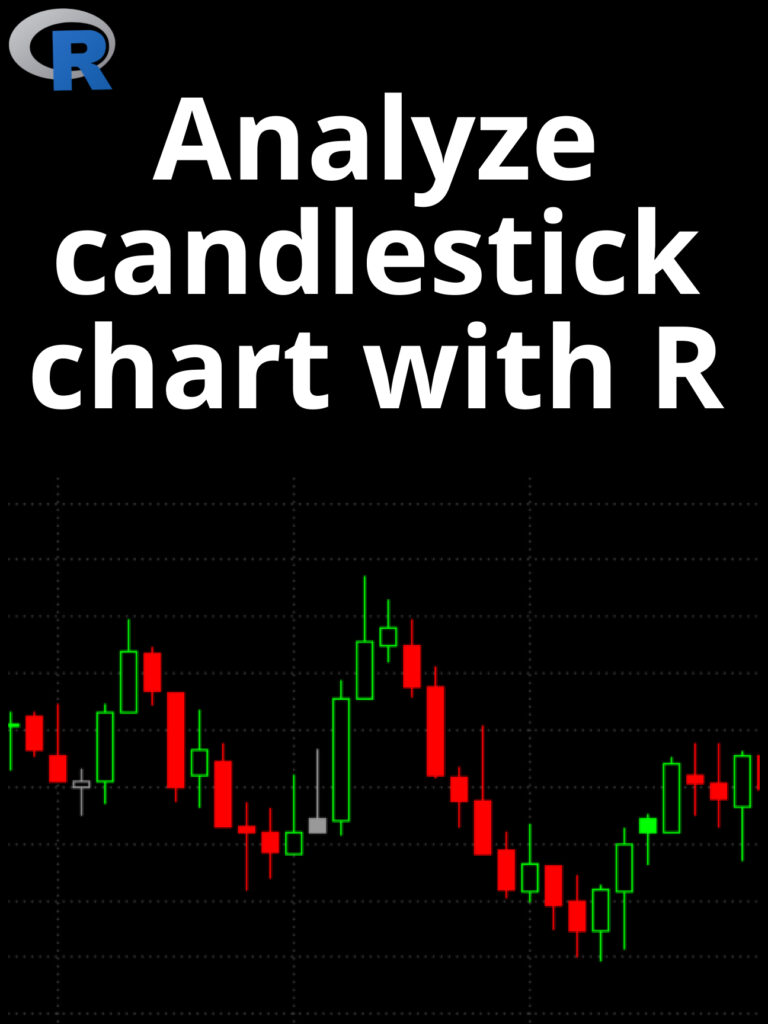
Analyze candlestick chart with R: A candlestick chart is a type of financial chart used to represent the price movement of an asset, such as a stock, currency, or commodity, over a specific period of time. It is called a “candlestick” chart because each data point is represented by a rectangular box with a vertical line protruding from the top and bottom, resembling a candle with a wick. To analyze a candlestick chart in R, you can use the quantmod package which provides functions for downloading financial data and plotting candlestick charts. Here’s an example of how to analyze a candlestick chart in R:

Analyze candlestick chart with R
 
  1. Install and load the quantmod package:
install.packages("quantmod")
library(quantmod)
  1. Download financial data for a stock using the getSymbols() function. In this example, we’ll download data for Apple (AAPL) from Yahoo Finance:
getSymbols("AAPL", from = "2020-01-01", to = "2022-02-27")

This downloads daily data for AAPL from January 1, 2020 to February 27, 2022.

  1. Plot a candlestick chart using the chartSeries() function from quantmod:
chartSeries(AAPL, theme = "white", TA = NULL)

This will plot a candlestick chart for AAPL with a white background and no technical indicators.

  1. Analyze the chart. Candlestick charts can provide a wealth of information about price movements and trends. Here are some things to look for:
  • Long green candles (or “bullish” candles) indicate that buyers were in control and pushed the price up.
  • Long red candles (or “bearish” candles) indicate that sellers were in control and pushed the price down.
  • Small candles with long upper and lower wicks indicate indecision or uncertainty in the market.
  • Patterns such as “doji” candles (where the opening and closing prices are very close together) can indicate a potential trend reversal.

You can also use technical indicators and overlays to further analyze the chart, such as moving averages, Bollinger Bands, or MACD. The quantmod package provides functions for adding these indicators to your chart.

Here’s an example of how to add a simple moving average to your chart:

addSMA(20)

This will add a 20-day simple moving average to your chart. You can adjust the period of the moving average by changing the number in the function call.

Overall, analyzing candlestick charts requires some knowledge and interpretation of the technical analysis. It’s important to remember that past performance is not necessarily indicative of future results, and that chart patterns and indicators should be used in conjunction with other information to make trading decisions.

Download:

Best Ways To Scraping Data With R

Best Ways To Scraping Data With R: Scraping data refers to the process of extracting information from websites and other online sources. The data collected can be used for various purposes, such as market research, competitor analysis, and content creation. There are several ways to scrape data with R, depending on the type of data and the source of the data. Here are some common methods:

Best Ways To Scraping Data With R
  1. Using the rvest package: The rvest package provides easy-to-use tools for web scraping. Here is an example code to scrape the titles and authors of the articles on the New York Times homepage:
library(rvest)

url <- "https://www.nytimes.com/"
page <- read_html(url)

titles <- page %>%
  html_nodes(".css-1qiat4j") %>%
  html_text()

authors <- page %>%
  html_nodes(".css-1n7hynb") %>%
  html_text()

data <- data.frame(title = titles, author = authors)
  1. Using the RSelenium package: The RSelenium package provides a way to automate web browsers using R. Here is an example code to scrape the titles and URLs of the articles on the New York Times homepage using RSelenium:
library(RSelenium)
library(rvest)

remDr <- remoteDriver(browserName = "chrome")
remDr$open()

url <- "https://www.nytimes.com/"
remDr$navigate(url)

page <- read_html(remDr$getPageSource()[[1]])

titles <- page %>%
  html_nodes(".css-1qiat4j") %>%
  html_text()

urls <- page %>%
  html_nodes(".css-1qiat4j a") %>%
  html_attr("href")

data <- data.frame(title = titles, url = urls)

remDr$close()
  1. Using the httr package: The httr package provides functions to make HTTP requests and handle responses. Here is an example code to scrape the current Bitcoin price from the Coinbase API using the httr package:
library(httr)

url <- "https://api.coinbase.com/v2/prices/BTC-USD/spot"
response <- GET(url)
data <- content(response)$data

price <- data$amount
currency <- data$currency

print(paste("Bitcoin price:", price, currency))

Try challenging yourself with interesting use cases and uncovering challenges. Scraping the web with R can be really fun!

Download(PDF)

Automate The Boring Stuff With Python

Automate The Boring Stuff With Python: Python is a powerful language that can be used to automate a wide range of tasks. Here are some steps to get started with automating boring stuff with Python:

Automate The Boring Stuff With Python
  1. Identify the task you want to automate: The first step is to identify the task or tasks that you want to automate. These can be anything from sending repetitive emails to scraping data from a website.
  2. Break down the task into smaller steps: Once you have identified the task, break it down into smaller steps. This will help you understand the process and identify areas where you can automate.
  3. Write Python code to automate the task: With the task broken down into smaller steps, start writing Python code to automate each step. There are many Python libraries and modules that can help with automation, such as Selenium for web automation and PyAutoGUI for GUI automation.
  4. Test the code: Once you have written the code, test it thoroughly to ensure that it works as expected. If there are any errors or bugs, debug the code and try again.
  5. Schedule the automation: Once you are confident that the code works, you can schedule it to run automatically at a specific time or on a specific trigger. This can be done using tools like Task Scheduler on Windows or cron on Linux.
  6. Monitor the automation: Finally, monitor the automation to ensure that it is running correctly and making the desired changes. If there are any issues, debug the code and make the necessary adjustments.

By following these steps, you can automate boring tasks and free up your time for more important things.

Download:

Logistic regression with R

Logistic regression with R: Logistic regression is a type of statistical model used to analyze the relationship between a binary outcome variable (such as yes/no or true/false) and one or more predictor variables. It estimates the probability of the binary outcome based on the values of the predictor variables. The model outputs a logistic function, transforming the input values into a probability range between 0 and 1. Logistic regression is commonly used in fields such as medicine, social sciences, and business to predict the likelihood of a certain outcome based on given input variables. To perform logistic regression in the R programming language, you can follow the following steps:

Logistic regression with R: Logistic regression is a type of statistical model used to analyze the relationship between a binary outcome variable (such as yes/no or true/false) and one or more predictor variables.

Step 1: Load the required packages

library(tidyverse)
library(caret)

Step 2: Load the data

data <- read.csv("path/to/your/data.csv")

Step 3: Split the data into training and testing sets

set.seed(123)
training_index <- createDataPartition(data$target_variable, p = 0.8, list = FALSE)
training_data <- data[training_index, ]
testing_data <- data[-training_index, ]

Step 4: Build the logistic regression model

log_model <- train(target_variable ~ ., 
                   data = training_data, 
                   method = "glm", 
                   family = "binomial")

Step 5: Predict using the model

predictions <- predict(log_model, newdata = testing_data)

Step 6: Evaluate the model’s performance

confusionMatrix(predictions, testing_data$target_variable)

This is a basic logistic regression model building and evaluation process. You can modify the code according to your specific use case.

Download(PDF)

The Essentials of Data Science: Knowledge Discovery Using R

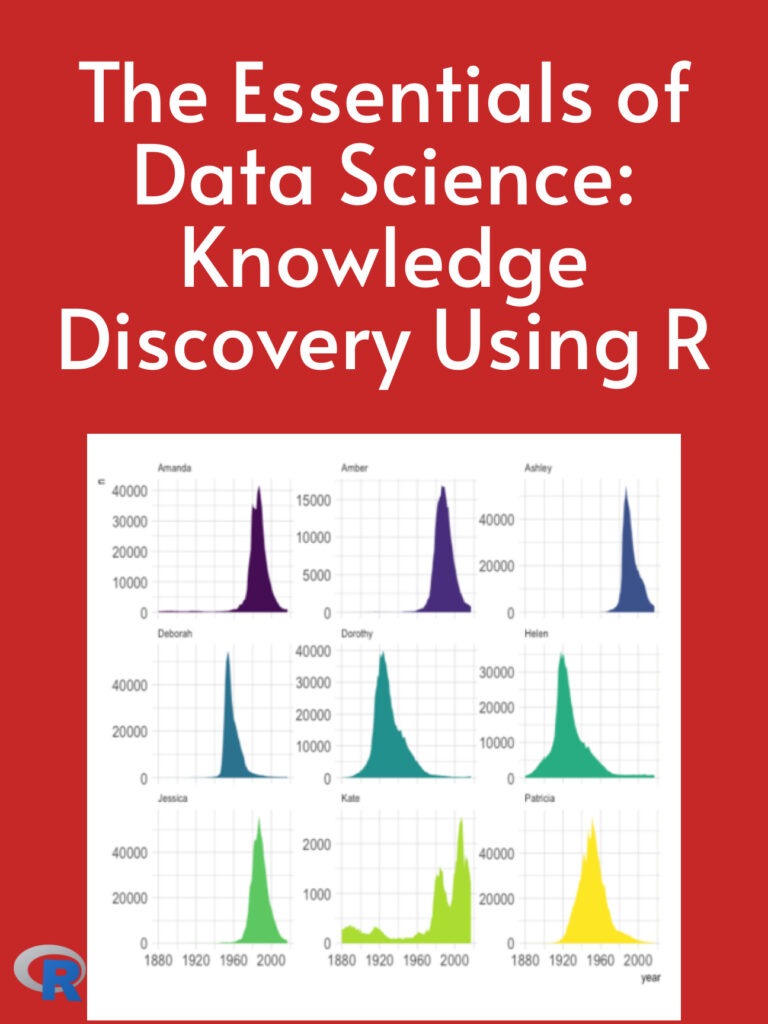
The Essentials of Data Science: Knowledge Discovery Using R: R is a powerful tool for data science that allows you to perform data preparation, data exploration and visualization, statistical analysis, machine learning, and communication all within the same environment. With its extensive libraries and active community, R is an essential tool for any data scientist. In this article, we will discuss the essentials of data science using R.

The Essentials of Data Science: Knowledge Discovery Using R
  1. Data Preparation The first step in any data science project is data preparation. This involves cleaning and transforming raw data into a form that can be analyzed. Common data preparation tasks include data cleaning, data transformation, and data integration. R has many built-in functions and packages for data preparation, including dplyr, tidyr, and lubridate.
  2. Data Exploration and Visualization Once the data has been prepared, the next step is data exploration and visualization. This involves analyzing the data to gain insights and identify patterns. R has many powerful visualization packages, including ggplot2 and lattice, that allow you to create a wide range of visualizations, such as scatter plots, bar charts, and heat maps.
  3. Statistical Analysis After data exploration, the next step is statistical analysis. This involves using statistical methods to test hypotheses and make predictions. R has many built-in functions and packages for statistical analysis, including lm() for linear regression and glm() for generalized linear models.
  4. Machine Learning Machine learning is a subfield of data science that involves using algorithms to learn from data and make predictions. R has many powerful machine learning packages, including caret, mlr, and tensorflow, that allow you to build a wide range of machine learning models, such as linear regression, decision trees, and neural networks.
  5. Communication The final step in any data science project is communication. This involves communicating your findings and insights to stakeholders in a clear and concise manner. R has many powerful tools for communication, including R Markdown and Shiny, that allow you to create interactive reports and dashboards.

Download(PDF)

Create a ggalluvial plot in R

Create a ggalluvial plot in R: A ggalluvial plot, also known as an alluvial diagram, is a type of visualization used to show how categorical data is distributed among different groups. It is particularly useful for visualizing how categorical variables are related to each other across different levels of a grouping variable.

Create a ggalluvial plot in R

To create a ggalluvial plot in R, you can follow these steps:

Step 1: Install and load the required packages

install.packages("ggplot2")
install.packages("ggalluvial")
library(ggplot2)
library(ggalluvial)

Step 2: Prepare the data

The ggalluvial package requires data to be in a specific format. The data must be in a data frame where each row represents a single observation, and each column represents a category. Each category column should have a unique name, and each row should have a unique identifier.

Here is an example data frame:

# create example data frame
data <- data.frame(
  id = c(1, 2, 3, 4, 5, 6),
  gender = c("Male", "Male", "Female", "Male", "Female", "Female"),
  age = c("18-24", "25-34", "35-44", "18-24", "25-34", "35-44"),
  country = c("USA", "Canada", "USA", "Canada", "Canada", "USA")
)

Step 3: Create the ggalluvial plot

ggplot(data = data,
       aes(x = gender, stratum = age, alluvium = id, fill = country)) +
  geom_alluvium() +
  geom_stratum() +
  ggtitle("Gender, Age, and Country") +
  theme(legend.position = "bottom")

The geom_alluvium() function creates the flowing paths that connect the different categories, and the geom_stratum() function adds the vertical bars that represent the categories. The ggtitle() function adds a title to the plot, and the theme() function adjusts the legend position to the bottom.

For next example, let’s use the diamonds dataset from the ggplot2 package:

data("diamonds")

Now let’s create a ggalluvial plot to visualize the relationship between cut, color, and price of diamonds:

ggplot(diamonds, aes(y = price, axis1 = cut, axis2 = color)) +
  geom_alluvium(aes(fill = cut), width = 0.1) +
  geom_stratum(width = 1/8, fill = "black", color = "grey") +
  geom_text(stat = "stratum", aes(label = after_stat(stratum)), 
            size = 3, fontface = "bold", color = "white") +
  scale_fill_brewer(type = "qual", palette = "Set1") +
  theme_minimal() +
  labs(title = "Diamonds by Cut, Color, and Price",
       subtitle = "Data from ggplot2::diamonds")

This code will create a ggalluvial plot with cut and color on the axes, and price represented by the y-axis. The alluvia are colored by cut, and the strata are filled in black with white text labels.

You can customize the plot further by adjusting the parameters in the geom_alluvium, geom_stratum, and scale_fill_brewer functions.

Download:

Building Chatbots with Python: Using Natural Language Processing and Machine Learning

Building chatbots with Python is a popular application of natural language processing (NLP) and machine learning (ML) techniques. Chatbots can be used for a variety of purposes, such as customer service, online shopping, and personal assistants.

Building Chatbots with Python: Using Natural Language Processing and Machine Learning

Here are the steps to build a chatbot with Python using NLP and ML techniques:

  1. Define the purpose and scope of the chatbot: Decide on the use case for your chatbot, the type of conversations it will handle, and the data sources it will use.
  2. Choose a chatbot framework: There are several chatbot frameworks available in Python, such as ChatterBot, NLTK, and SpaCy. Choose the one that best fits your requirements.
  3. Collect and preprocess training data: Collect relevant training data, such as customer service conversations, and preprocess the data to remove noise, extract keywords, and tokenize the text.
  4. Train the chatbot: Use machine learning algorithms such as classification or clustering to train the chatbot on the preprocessed training data.
  5. Test and evaluate the chatbot: Test the chatbot with sample conversations to evaluate its performance and identify areas of improvement.
  6. Deploy the chatbot: Once the chatbot is trained and tested, deploy it to your chosen platform, such as a website or messaging app.
  7. Continuously improve the chatbot: Monitor the chatbot’s performance and feedback from users, and make improvements to the training data and machine learning models as necessary.

Overall, building a chatbot with Python using NLP and ML techniques can be a complex process, but it has the potential to provide a valuable service to users and improve customer satisfaction.

Download(PDF)