In today’s data-driven world, the ability to convey complex information effectively is paramount. That’s where “Mastering Shiny” comes into play. This innovative tool is a game-changer for data professionals and storytellers alike, enabling them to craft compelling and interactive data visualizations. In this comprehensive guide, we will explore the ins and outs of Mastering Shiny, helping you unlock its full potential and elevate your data storytelling skills.
Getting Started with Mastering Shiny
Mastering Shiny is not just a tool; it’s a gateway to creating dynamic, user-friendly applications for data visualization. Here’s a breakdown of how to embark on your journey:
The Basics of Mastering Shiny
To master Shiny, you need a solid grasp of its foundational elements. This includes understanding reactive programming, Shiny UI components, and server functions. Dive deep into each of these aspects to build a strong foundation.
Creating Your First Shiny App
The best way to learn is by doing. Let’s create your first Shiny app together. We’ll guide you through the process step by step, from setting up your environment to deploying your app for the world to see.
Shiny isn’t just about creating flashy visualizations; it’s a powerful tool for data analysis, too. Here’s how you can leverage its capabilities:
Interactive Data Exploration
With Shiny, you can dynamically explore your datasets. We’ll show you how to build interactive widgets that allow users to filter and manipulate data on the fly, gaining insights like never before.
Real-time Dashboards
Mastering Shiny enables you to create real-time dashboards that display crucial metrics and updates as they happen. We’ll teach you the tricks to make your dashboards informative and visually appealing.
Advanced Techniques and Tips
To truly become a Shiny master, you need to go beyond the basics. Here are some advanced techniques and tips:
Customizing Your Shiny Apps
Learn how to add your personal touch to Shiny apps by customizing the appearance and behavior to suit your specific needs and branding.
Deployment and Scalability
Discover the best practices for deploying Shiny apps to ensure they run smoothly and efficiently, even under heavy user loads.
Extending Shiny with R Packages
Explore how you can extend Shiny’s functionality by incorporating R packages. We’ll introduce you to some must-have packages for supercharging your Shiny apps.
FAQs
What is Mastering Shiny?
Mastering Shiny is the process of becoming proficient in using the Shiny framework to create interactive and dynamic data visualizations and applications.
How can I get started with Shiny?
To get started with Shiny, you can install the Shiny package in R and explore online resources and tutorials. Additionally, you can refer to our guide for a comprehensive introduction.
Can I use Shiny for data analysis?
Absolutely! Shiny is not just for creating visualizations; it’s a powerful tool for data analysis, allowing you to build interactive data exploration tools and real-time dashboards.
Are there any limitations to Shiny?
While Shiny is incredibly versatile, it may have performance limitations for extremely complex applications. However, with proper optimization, you can overcome most challenges.
Is Shiny suitable for beginners?
Yes, Shiny is beginner-friendly, especially when you follow structured tutorials and guides. Start with the basics and gradually progress to more advanced features.
Where can I find support and resources for Shiny?
You can find a vibrant community of Shiny users and developers online. Additionally, there are numerous books, courses, and forums dedicated to Shiny.
Conclusion
Mastering Shiny is your ticket to becoming a data storytelling virtuoso. With its ability to create stunning, interactive visualizations and robust data analysis tools, Shiny is an indispensable tool for anyone working with data. Dive into the world of Shiny, practice your skills, and unlock the true potential of data storytelling.
Introduction to Deep Learning: In today’s fast-paced world, technology is evolving at an unprecedented rate. One of the most exciting and transformative fields within technology is deep learning. Deep learning has not only revolutionized artificial intelligence but has also permeated various aspects of our daily lives. In this article, we will take a journey through the fascinating world of deep learning, starting from its logical calculus roots and progressing to its current applications in artificial intelligence.
Understanding the Basics of Deep Learning
The Foundation: Artificial Neural Networks
At the heart of deep learning lies the concept of artificial neural networks (ANNs). These networks are inspired by the structure and function of the human brain. ANNs consist of layers of interconnected nodes, or neurons, which process and transmit information. This hierarchical structure allows for complex computations and pattern recognition.
Introduction to Deep Learning: From Logical Calculus to Artificial Intelligence
Deep learning traces its origins to logical calculus, a branch of mathematics concerned with formal logic and deduction. Logical calculus provided the groundwork for developing algorithms that mimic human decision-making processes.
Evolution of Deep Learning (H1)
From Perceptrons to Convolutional Neural Networks
The journey of deep learning began with the invention of perceptrons, the simplest form of artificial neural networks. Over the years, researchers developed more sophisticated architectures, such as convolutional neural networks (CNNs), which excel in image recognition tasks.
The Rise of Recurrent Neural Networks
Another significant milestone was the introduction of recurrent neural networks (RNNs). RNNs are designed to work with sequential data, making them indispensable in applications like natural language processing and speech recognition.
Deep Learning in Action
Image Recognition
Deep learning has made remarkable strides in image recognition. From identifying objects in photographs to medical image analysis, deep learning models have achieved human-level accuracy in various domains.
Natural Language Processing
In the realm of natural language processing (NLP), deep learning has empowered machines to understand and generate human language. Chatbots, language translation, and sentiment analysis are some of the applications benefiting from NLP.
Challenges and Limitations
Overfitting and Data Requirements
One of the challenges in deep learning is overfitting, where models perform well on training data but fail to generalize to new data. Addressing this issue often requires vast amounts of labeled data.
Computational Resources
Training deep learning models can be computationally intensive, requiring powerful hardware and significant energy consumption. This limitation is a concern in terms of sustainability.
The Future of Deep Learning
Explainable AI
As deep learning becomes more prevalent, the need for understanding model decisions grows. The future of deep learning includes developing more explainable AI systems to build trust and transparency.
Integration with Other Technologies
Deep learning is poised to integrate with other emerging technologies like blockchain and augmented reality, leading to innovative applications we can only begin to imagine.
Conclusion
In conclusion, deep learning has come a long way, from its roots in logical calculus to becoming a driving force behind artificial intelligence. Its ability to handle complex tasks like image recognition and natural language processing has transformed industries and opened up new possibilities. However, challenges like overfitting and resource requirements must be addressed as we continue to harness the power of deep learning.
FAQs (Introduction to Deep Learning)
What is the difference between deep learning and traditional machine learning? Deep learning is a subset of machine learning that focuses on neural networks with multiple layers, allowing it to learn complex patterns and representations.
How does deep learning benefit healthcare? Deep learning aids in medical image analysis, disease diagnosis, and drug discovery, improving patient care and outcomes.
Are there any ethical concerns related to deep learning? Yes, deep learning raises ethical concerns, particularly in areas like privacy, bias, and job displacement.
Can I get started with deep learning as a beginner? Yes, numerous online resources and courses cater to beginners interested in exploring deep learning.
What are some practical applications of deep learning in everyday life? Deep learning is used in applications such as virtual assistants, recommendation systems, and autonomous vehicles, enhancing user experiences and convenience.
Unleashing the Potential of R For Data Science Import, Tidy, Transform, Visualize, And Model Data
Welcome to the world of data science, where information is gold, and analytics is the key to unlocking its hidden treasures. In this article, we will explore the versatile capabilities of R for data science to import, tidy, transform, visualize, and model data. From its inception, R has been a powerful tool for data professionals, and it continues to evolve, making it indispensable in the data science toolkit.
R For Data Science: An Overview
R is an open-source programming language and environment designed specifically for statistical computing and graphics. Its extensive libraries and packages make it a preferred choice for data scientists, statisticians, and analysts worldwide. Let’s dive into the depths of R’s capabilities.
R For Data Science: Import, Tidy, Transform, Visualize, And Model Data
In data science, the first step is importing data, and R offers multiple ways to do this. One of the most efficient methods is using the ‘readr’ package, renowned for its speed and flexibility. With just a few lines of code, you can effortlessly read data from various file formats such as CSV, Excel, or even from a URL.
Data Import Using ‘readxl’
If you’re dealing with Excel files, ‘readxl’ is your go-to package. It simplifies the process of importing spreadsheets, enabling you to focus on your analysis rather than data wrangling.
Scraping Web Data with ‘rvest’
For web scraping enthusiasts, ‘rvest’ comes to the rescue. Extracting data from websites becomes a breeze with this package, allowing you to gather real-time information for analysis.
Tidying Up Your Data
The ‘tidyr’ Package for Data Cleaning
Messy data is a common challenge in data science. ‘Tidyr,’ an integral part of the ‘tidyverse,’ offers a wide array of functions to tidy up your data. From reshaping to handling missing values, ‘tidyr’ streamlines the process.
Dealing with Missing Values
Missing data can be a headache, but R provides elegant solutions. Learn how to identify, handle, and impute missing values effectively.
Transforming Data for Analysis
Data Transformation Techniques
Data transformation is crucial for deriving meaningful insights. Explore techniques such as filtering, grouping, and summarizing to prepare your data for analysis.
Applying Functions with ‘dplyr’
The ‘dplyr’ package simplifies data manipulation with a user-friendly syntax. Learn to perform operations like filtering rows, selecting columns, and creating new variables effortlessly.
Visualizing Data with R
Creating Stunning Visuals with ‘ggplot2’
Visualizing data is the key to conveying insights effectively. ‘ggplot2’ is a versatile package that lets you create beautiful, customized visualizations to enhance your data stories.
Interactive Visualizations with ‘plotly’
For interactive charts and graphs, ‘plotly’ is your ally. Engage your audience with dynamic visualizations that allow them to explore the data on their terms.
Modeling Data with R
Building Predictive Models
R’s prowess extends to predictive modeling. Discover how to build regression, classification, and clustering models to make data-driven decisions.
Evaluating Model Performance
Modeling is just the beginning; assessing how well your models perform is crucial. Dive into techniques for model evaluation and fine-tuning.
FAQs
How do I install R on my computer?
To install R, visit the official R website (https://www.r-project.org/) and follow the installation instructions for your operating system. It’s a straightforward process that usually takes just a few minutes.
Can R handle large datasets?
Yes, R can handle large datasets efficiently. By optimizing your code and using packages like ‘data.table,’ you can work with sizable data without performance issues.
What is the best IDE for R programming?
RStudio is the most popular integrated development environment (IDE) for R programming. It offers a user-friendly interface, excellent debugging tools, and seamless package integration.
How can I create interactive dashboards in R?
To create interactive dashboards in R, consider using the ‘shiny’ package. It allows you to build web applications with interactive elements, making data exploration and presentation a breeze.
Are there resources for learning R online?
Absolutely! You can find many online courses, tutorials, and communities dedicated to R. Websites like Coursera, edX, and Stack Overflow are excellent starting points.
What industries benefit from R in data science?
R is versatile and finds applications in various industries, including finance, healthcare, marketing, and academia. Its adaptability and extensive package ecosystem make it a valuable asset in any data-driven field.
Conclusion
R for data science import, tidy, transform, visualize, and model data is a potent combination for professionals in the field. With its user-friendly packages and robust capabilities, R empowers data scientists to turn raw data into actionable insights. Whether you’re a beginner or an experienced analyst, mastering R will undoubtedly elevate your data science journey.
In today’s data-driven world, extracting meaningful insights from vast amounts of text data is crucial. One powerful tool at your disposal is Supervised Machine Learning for Text Analysis in R. This article will guide you through the essential steps to master this technology and leverage it effectively for your projects. Let’s dive in!
Supervised Machine Learning for Text Analysis in R
Supervised Machine Learning for Text Analysis in R is a technique that allows computers to learn from labeled data, making predictions or classifications based on that learning. In the realm of text analysis, it involves training a model to understand and categorize text data accurately.
Getting Started with Supervised Machine Learning
Before we delve deeper, let’s cover the basics. To get started with Supervised Machine Learning for Text Analysis in R, you’ll need to have R installed on your system. You can download it from the official R Project website.
Understanding the Supervised Learning Process
Supervised learning involves providing the algorithm with labeled training data, which means each data point is associated with a known outcome. The algorithm learns from this data and can then make predictions or classify new, unlabeled data.
Supervised Machine Learning for Text Analysis in R
The quality of your training data is paramount. Ensure your text data is clean, relevant, and representative of the problem you want to solve. Data preprocessing is often required to remove noise and irrelevant information.
Data Preprocessing and Cleaning
Text data can be messy, containing punctuation, stopwords, and other noise. Use text preprocessing techniques to clean the data, such as removing special characters, converting text to lowercase, and eliminating stopwords.
Feature Extraction
Feature extraction is a critical step in text analysis. It involves converting text data into numerical features that machine learning algorithms can understand. Common methods include TF-IDF (Term Frequency-Inverse Document Frequency) and word embeddings like Word2Vec.
Choosing the Right Algorithm
Selecting the appropriate machine learning algorithm depends on your specific text analysis task. Common choices include Naive Bayes, Support Vector Machines, and Deep Learning models like Recurrent Neural Networks (RNNs) or Transformer-based models.
Model Training and Evaluation
Train your selected model on the labeled data and evaluate its performance using appropriate metrics, such as accuracy, precision, recall, and F1-score. Fine-tune your model to achieve the best results.
Handling Imbalanced Data
In text analysis, imbalanced datasets are common, where one class of data significantly outweighs the others. Employ techniques like oversampling or undersampling to address this issue and prevent bias in your model.
Interpretability and Explainability
Understanding why a model makes specific predictions is crucial, especially in applications with legal or ethical implications. Employ techniques like LIME (Local Interpretable Model-agnostic Explanations) to interpret your model’s decisions.
Deployment and Scaling
Once your model is ready, deploy it to make real-time predictions or classifications. Scaling may be necessary to handle large volumes of text data efficiently.
FAQs
Q: How does Supervised Machine Learning differ from Unsupervised Machine Learning? Supervised Machine Learning relies on labeled data for training, whereas Unsupervised Machine Learning deals with unlabeled data and aims to discover hidden patterns or structures within the data.
Q: Can I use Supervised Machine Learning in R for sentiment analysis? Absolutely! Supervised Machine Learning in R is well-suited for sentiment analysis, where you can classify text as positive, negative, or neutral based on labeled training data.
Q: Are there any recommended packages for text analysis in R? Yes, R offers several packages for text analysis, including tm, quanteda, and text2vec, which provide various tools for data preprocessing and analysis.
Q: How can I handle multi-class classification in text analysis using R? To tackle multi-class classification, you can use algorithms like Support Vector Machines or deep learning models with appropriate modifications to the output layer.
Q: What are some common challenges in text analysis, and how can I overcome them? Common challenges include data preprocessing, handling imbalanced data, and ensuring model interpretability. Refer to the respective sections in the article for solutions to these challenges.
Q: Is Supervised Machine Learning in R suitable for natural language processing (NLP) tasks? Yes, Supervised Machine Learning in R is widely used in NLP tasks such as text classification, sentiment analysis, and named entity recognition.
Conclusion
Mastering Supervised Machine Learning for Text Analysis in R opens up a world of possibilities for extracting valuable insights from text data. By following the steps outlined in this article, you can harness the power of this technology and elevate your data analysis projects to new heights. Stay curious, keep learning, and watch your data-driven insights flourish.
In today’s data-driven world, the ability to analyze financial data and implement financial models is a crucial skill for professionals in various fields, from finance and investments to business planning and decision-making. One of the most powerful tools at your disposal for this purpose is R, a versatile programming language and environment for statistical computing and graphics. In this comprehensive guide, we will delve into the world of analyzing financial data and implementing financial models using R. Let’s embark on a journey that will empower you to make informed, data-backed decisions in your financial endeavors.
1. Getting Started with R
Analyzing Financial Data and Implementing Financial Models Using R
Before we dive into the specifics of financial analysis and modeling, let’s begin with the basics. Familiarize yourself with R, its installation, and setup to ensure a smooth journey ahead.
R is a free, open-source software environment that provides an array of tools for data analysis and visualization. To get started, you’ll need to download and install R on your computer. Once installed, you can access the R console, where you’ll write and execute R code.
Leveraging, Analyzing Financial Data, and Implementing Financial Models Using R
To perform meaningful analysis and build financial models, you first need data. Learn how to import financial data from various sources into R, including CSV files, databases, and web APIs.
Financial data can come from a multitude of sources, such as stock exchanges, financial databases, or your organization’s internal records. R offers a wide range of packages and functions for importing data, making it a versatile choice for financial analysis.
3. Data Cleaning and Preprocessing
Preparing, Analyzing Financial Data and Implementing Financial Models Using R
Raw data often requires cleaning and preprocessing to remove errors and inconsistencies. Discover how to clean and prepare your financial data for analysis in R.
Cleaning and preprocessing involve tasks like handling missing values, removing outliers, and standardizing data formats. R provides a comprehensive set of tools for these tasks, ensuring your data is ready for in-depth analysis.
4. Exploratory Data Analysis (EDA)
Analyzing Financial Data and Implementing Financial Models Using R: EDA
EDA is a crucial step in understanding your financial data. Learn how to visualize and explore data patterns, relationships, and outliers using R’s powerful visualization tools.
Visualizing data through plots and charts can reveal valuable insights about financial trends and correlations. R’s flexibility in creating custom visualizations allows you to tailor your EDA to the specific needs of your analysis.
5. Financial Modeling with R
Building, Analyzing Financial Data and Implementing Financial Models Using R
Now comes the heart of our journey—financial modeling. Discover how to create and implement various financial models, from time series forecasting to risk assessment, using R’s statistical modeling capabilities.
R’s extensive library of packages includes specialized tools for financial modeling, making it a go-to choice for professionals in finance. Learn to build predictive models that can guide investment decisions and risk management strategies.
6. Model Evaluation and Validation
Analyzing Financial Data and Implementing Financial Models Using R: Validation
No financial model is complete without thorough evaluation and validation. Explore techniques for assessing the accuracy and reliability of your models in R.
Validation ensures that your financial models provide trustworthy results. We’ll delve into methods like cross-validation and back-testing to ensure your models perform well in real-world scenarios.
7. Implementing Financial Strategies
Applying Analyzing Financial Data and Implementing Financial Models Using R
With your financial models in place, it’s time to put them to work. Learn how to apply these models to make informed financial decisions and develop effective strategies.
Financial modeling is not just about numbers; it’s about making sound decisions based on data-driven insights. We’ll discuss how to use your models to optimize portfolios, assess investment risks, and make informed financial choices.
Frequently Asked Questions (FAQs)
Q: What are the advantages of using R for financial analysis?
R’s flexibility, extensive libraries, and statistical capabilities make it a powerful tool for financial analysis. It allows for customized analysis and modeling, making it suitable for various financial applications.
Q: Can I use R for real-time financial data analysis?
Yes, R can handle real-time financial data analysis when combined with appropriate packages and data sources. It’s a versatile tool for both historical and real-time analysis.
Q: Are there any prerequisites for learning R for financial analysis?
While a background in finance is beneficial, it’s not a strict requirement. Basic knowledge of statistics and programming concepts will help you get started with R for financial analysis.
Q: What industries benefit from financial modeling in R?
Financial modeling in R is valuable across a range of industries, including finance, healthcare, marketing, and more. Any field that relies on data-driven decision-making can benefit from these techniques.
Q: How can I stay updated with the latest developments in R for financial analysis?
To stay current, consider joining R-related forums, following R experts on social media, and regularly checking R packages for updates. Continuous learning is key in this dynamic field.
Q: What role does visualization play in financial analysis with R?
Visualization is crucial in financial analysis, as it helps in conveying complex data insights effectively. R’s visualization capabilities enable you to create informative charts and graphs for presentations and reports.
Conclusion
Analyzing financial data and implementing financial models using R is a skill set that opens doors to data-driven decision-making, empowering professionals in various industries. In this comprehensive guide, we’ve explored the fundamentals of R, data import, cleaning, exploratory analysis, financial modeling, and strategy implementation. Armed with this knowledge, you’re prepared to make informed financial decisions and navigate the complexities of the modern financial landscape.
Introduction to Machine Learning with Python: In today’s data-driven world, the field of machine learning has emerged as a game-changer for businesses and industries across the globe. One of the most popular and versatile programming languages for implementing machine learning algorithms is Python. In this comprehensive guide, we will delve into the world of machine learning with Python, catering specifically to data scientists. Whether you are a beginner looking to explore the basics or an experienced practitioner seeking advanced insights, this guide has something for everyone.
What is Machine Learning?
Machine learning, often abbreviated as ML, is a subfield of artificial intelligence (AI) that focuses on the development of algorithms and statistical models that enable computer systems to learn and improve from experience. These algorithms allow computers to identify patterns, make predictions, and automate decision-making processes without being explicitly programmed.
Python has become the de facto programming language for machine learning, and for several good reasons:
1. Versatility and Ease of Use
Python’s simple and readable syntax makes it accessible to both beginners and experienced programmers. This versatility ensures that data scientists can quickly prototype and experiment with machine learning models.
2. Rich Ecosystem of Libraries
Python boasts a vast ecosystem of libraries and frameworks tailored for machine learning, such as TensorFlow, scikit-learn, and PyTorch. These libraries provide pre-built functions and tools that simplify the implementation of complex algorithms.
3. Community Support
Python has a large and active community of developers and data scientists who contribute to open-source projects. This support network means that you can find solutions to common problems and stay updated with the latest developments in the field.
4. Integration Capabilities
Python seamlessly integrates with other data science tools and technologies, such as Jupyter Notebooks for interactive coding and data visualization libraries like Matplotlib and Seaborn.
5. Machine Learning Frameworks
Python offers access to powerful machine learning frameworks like scikit-learn, which simplifies tasks such as data preprocessing, model selection, and evaluation.
Getting Started with Python for Machine Learning
Setting Up Your Environment
Before diving into machine learning, you need to set up your Python environment. Here are the steps to get you started:
Install Python: If you don’t have Python installed, download and install the latest version from the official Python website (https://www.python.org/downloads/).
Install a Code Editor: Choose a code editor or integrated development environment (IDE) like Visual Studio Code or Jupyter Notebook to write and execute your Python code.
Install Libraries: Use pip, Python’s package manager, to install essential libraries like NumPy, pandas, scikit-learn, and TensorFlow.
Exploring Python’s Data Structures
Python offers several data structures that are crucial for data manipulation and analysis. These include lists, tuples, dictionaries, and sets. Understanding these data structures is essential for working with datasets in machine learning.
Basic Python Programming Concepts
To become proficient in Python, you should grasp fundamental programming concepts, such as variables, data types, loops, and conditional statements. Python’s simplicity makes it easy to pick up these concepts quickly.
Introduction to Machine Learning Algorithms
Now that you have a solid foundation in Python, let’s explore some fundamental machine learning algorithms:
Linear Regression: A basic algorithm used for predicting a continuous target variable based on one or more predictor variables.
Classification Algorithms: These algorithms, including logistic regression, decision trees, and support vector machines, are used for categorizing data points into predefined classes or categories.
Clustering Algorithms: Algorithms like K-means clustering and hierarchical clustering group data points with similar characteristics.
Neural Networks: Deep learning, a subset of machine learning, utilizes neural networks to model complex patterns in data, such as image and speech recognition.
Introduction to Machine Learning with Python (FAQs)
How can I start learning machine learning with Python?
Begin by learning Python programming basics. Then, explore machine learning libraries like scikit-learn and TensorFlow. Online courses, tutorials, and books can provide structured learning paths.
What are some real-world applications of machine learning with Python?
Machine learning with Python is used in various fields, including healthcare (for disease prediction), finance (for fraud detection), and e-commerce (for recommendation systems).
Do I need a strong mathematical background to excel in machine learning?
While a basic understanding of mathematics, including linear algebra and calculus, is beneficial, many libraries and tools in Python abstract away the mathematical complexities, allowing data scientists to focus on application.
Are there any online communities or forums for Python machine learning enthusiasts?
Yes, there are numerous communities, such as Stack Overflow, Reddit’s r/MachineLearning, and GitHub, where you can seek help, share your knowledge, and collaborate on projects.
What is the future of machine learning with Python?
Python’s dominance in the field of machine learning is expected to continue. As the community grows, so will the capabilities of Python libraries and frameworks, making it an even more powerful tool for data scientists.
How do I stay updated with the latest developments in Python for machine learning?
To stay informed, follow influential data scientists and organizations on social media platforms like Twitter and LinkedIn, and regularly check dedicated websites and blogs in the field.
Conclusion
In this guide, we’ve introduced you to the world of machine learning with Python, tailored for data scientists. Python’s simplicity, rich library ecosystem, and supportive community make it an ideal choice for those looking to harness the power of machine learning. Remember that the journey of mastering machine learning is both exciting and rewarding. Start with the basics, explore algorithms, and stay curious. As you continue your learning journey, you’ll discover new possibilities and applications for machine learning with Python.
Introduction to Probability for Data Science: Greetings to the fascinating world of data science, where the potential of data meets the enchantment of probability. Probability, a vital branch of mathematics, enables us to measure uncertainty and randomness. In data science, it plays a critical role in diverse applications, such as predicting outcomes and making informed decisions based on data patterns. In this article, we will explore the intriguing world of probability and its significance in data science. So, let us embark on this enlightening journey together and discover how probability can empower us to uncover the concealed secrets within data! data!
Understanding Probability Basics
Probability is the measure of the likelihood of an event occurring. It is expressed as a value between 0 and 1, where 0 indicates an impossible event, and 1 denotes a certain event. Understanding probability basics is essential for any data scientist, as it forms the foundation for various statistical methods and machine learning algorithms.
In probability theory, a sample space represents the set of all possible outcomes of a random experiment. An event is a subset of the sample space, representing a particular outcome or a combination of outcomes. For example, when flipping a fair coin, the sample space consists of {Heads, Tails}, and an event could be “getting Heads.”
2. Probability Distribution
The probability distribution of a random variable defines the likelihood of each possible value occurring. It provides valuable insights into the behavior of the random variable and aids in making predictions and analyzing data.
3. Conditional Probability
Conditional probability measures the likelihood of an event occurring given that another event has already occurred. It is denoted as P(A|B), where A and B are events. Understanding conditional probability is crucial for analyzing data with dependencies.
4. Bayes’ Theorem
Bayes’ Theorem is a fundamental concept in probability that allows us to update the probability of an event based on new evidence. It finds extensive applications in data science, especially in machine learning algorithms like Naive Bayes.
Probability Distributions in Data Science
5. Discrete Probability Distributions
Discrete probability distributions deal with random variables that can only take on distinct values. Common examples include the binomial distribution, Poisson distribution, and Bernoulli distribution. These distributions are widely used in data science to model various phenomena.
6. Continuous Probability Distributions
Continuous probability distributions deal with random variables that can take on any value within a certain range. The normal distribution, also known as the Gaussian distribution, is one of the most commonly used continuous distributions in data science.
Applications of Probability in Data Science
7. Hypothesis Testing
Hypothesis testing is a statistical method that allows data scientists to draw conclusions about a population based on a sample. Probability forms the backbone of hypothesis testing, helping us determine the significance of observed differences and relationships.
8. Machine Learning
Machine learning algorithms heavily rely on probability concepts to make predictions and classifications. Techniques like logistic regression and decision trees leverage probability to estimate probabilities of outcomes.
9. Bayesian Inference
Bayesian inference is a powerful framework that combines prior knowledge with new evidence to update probability estimates. It finds applications in various data science domains, including natural language processing and image recognition.
10. Monte Carlo Simulations
Monte Carlo simulations use random sampling techniques to estimate complex mathematical expressions. These simulations are valuable for solving problems that involve uncertainty and are extensively used in data science for risk analysis and optimization.
Importance of Probability in Data-driven Decision Making
Modern businesses and organizations rely on data-driven decision-making. Probability helps data scientists measure uncertainties and evaluate risks, which leads to informed and optimal decision-making.
Challenges in Probability for Data Science
11. Handling Missing Data
In real-world datasets, missing data is a common challenge that can impact the accuracy of probability estimates. Data scientists employ various techniques like imputation and probabilistic modeling to handle missing data effectively.
12. Dealing with High-Dimensional Data
As datasets grow in complexity and size, data scientists face the challenge of dealing with high-dimensional data. Probability-based dimensionality reduction techniques like Principal Component Analysis (PCA) help in managing such data.
Frequently Asked Questions (FAQs)
What is the significance of probability in data science? Probability is fundamental to data science as it quantifies uncertainties and enables data-driven decision-making.
How is probability used in machine learning? Probability is used in machine learning for estimating probabilities of outcomes and making predictions.
What are discrete probability distributions? Discrete probability distributions deal with random variables that can only take on distinct values.
How does Bayes’ Theorem impact data science? Bayes’ Theorem allows us to update probability estimates based on new evidence, making it essential in data science.
Why is handling missing data a challenge in probability for data science? Missing data can impact the accuracy of probability estimates, and effective handling techniques are crucial.
How does probability help in data-driven decision-making? Probability allows data scientists to assess risks and uncertainties, leading to more informed decision-making.
Conclusion Introduction to Probability for Data Science
To sum up, probability plays a vital role in data science. It enables us to analyze and interpret data effectively. As a data scientist, it is crucial to comprehend probability concepts and distributions to maximize the potential of data-driven insights. Probability has diverse applications in data science, from hypothesis testing to machine learning, providing valuable insights for decision-making. Therefore, let’s appreciate the power of probability and embark on a thrilling journey of discovery in the world of data science!
The Art of Data Science: Data science has emerged as a critical field in the digital age, revolutionizing the way businesses make decisions and uncover insights. From analyzing customer behavior to predicting market trends, data science plays a vital role in various industries. The Art of Data Science aims to provide a comprehensive overview of data science, its importance, and the skills required to excel in this field.
1. IntroductiontoThe Art of Data Science:
In today’s data-driven world, the ability to extract meaningful information from vast amounts of data is invaluable. Data science combines statistical analysis, machine learning, and programming to extract actionable insights. It encompasses a wide range of techniques and methodologies aimed at understanding complex data sets and driving data-informed decision-making.
The Art of Data Science A Guide for Anyone Who Works with Data
Data science is an interdisciplinary field that involves extracting knowledge and insights from structured and unstructured data. It combines elements of statistics, mathematics, computer science, and domain knowledge to discover patterns, make predictions, and solve complex problems. Data scientists utilize various tools, algorithms, and programming languages to analyze data and derive valuable insights.
3. The Role of a Data Scientist
A data scientist is a professional responsible for analyzing, interpreting, and deriving insights from data. Their role involves formulating questions, collecting and cleaning data, applying statistical and machine-learning techniques, and communicating findings to stakeholders. Data scientists play a crucial role in shaping data-driven strategies and making informed business decisions.
4. Essential Skills for Data Science
To succeed in the field of data science, several essential skills are required. These include:
4.1 Programming and Software Engineering
Proficiency in programming languages like Python, R, or SQL is essential for data scientists. They should be able to write efficient code, manipulate data, and build machine learning models.
4.2 Statistics and Mathematics
A strong foundation in statistics and mathematics is vital for data scientists. They should be familiar with probability theory, hypothesis testing, regression analysis, and other statistical concepts.
4.3 Data Visualization
Data scientists need to be proficient in visualizing data effectively. They should be able to create informative and visually appealing charts, graphs, and dashboards to communicate insights to non-technical stakeholders.
4.4 Machine Learning and AI
Data scientists must have a solid understanding of machine learning algorithms and artificial intelligence techniques. They should be able to select appropriate models, train them on data, and evaluate their performance.
5. Steps in the Data Science Process
Data science projects typically follow a well-defined process that involves the following steps:
5.1 Problem Formulation
Defining the problem and formulating relevant questions to guide the data analysis process.
5.2 Data Collection and Preparation
Gathering relevant data from various sources and preparing it for analysis, including data cleaning, integration, and transformation.
5.3 Exploratory Data Analysis (EDA)
Exploring the data to gain insights, identify patterns, and understand the underlying structure. EDA involves visualizations, summary statistics, and hypothesis testing.
5.4 Data Modeling and Machine Learning
Building predictive or descriptive models using machine learning algorithms. This step involves feature selection, model training, and evaluation.
5.5 Model Evaluation and Deployment
Assessing the performance of the models and deploying them for real-world applications.
5.6 Communication and Visualization
Presenting the findings and insights derived from the data analysis in a clear and understandable manner to stakeholders.
6. Collecting and Preparing Data
Data collection is a crucial step in the data science process. It involves identifying relevant data sources, acquiring the data, and ensuring its quality and integrity. Proper data preparation, including cleaning, transforming, and integrating data, is essential to ensure accurate and meaningful analysis.
7. Exploratory Data Analysis
Exploratory Data Analysis (EDA) involves examining the data to discover patterns, relationships, and outliers. Through visualizations, summary statistics, and hypothesis testing, data scientists gain a deeper understanding of the data, uncover hidden insights, and identify potential challenges.
8. Data Modeling and Machine Learning
Data modeling involves the construction of mathematical models to represent real-world phenomena. In data science, it refers to the development and implementation of machine learning algorithms to make predictions or derive insights from data. Model selection, training, and evaluation are crucial steps in this process.
9. Data Visualization
Data visualization plays a significant role in data science as it helps communicate complex findings in a visually appealing and accessible manner. Through the use of charts, graphs, and interactive dashboards, data scientists can effectively convey insights to a broader audience.
10. Data Science Tools and Technologies
Data science relies on a variety of tools and technologies to analyze and manipulate data effectively. Some popular tools include Python libraries like NumPy, Pandas, and scikit-learn, as well as visualization tools like Tableau and Power BI. Additionally, programming languages such as R and SQL are commonly used in data science projects.
11. Challenges in Data Science
Data science projects come with their fair share of challenges. Some common challenges include data quality issues, lack of domain expertise, ethical considerations, and interpretability of machine learning models. Overcoming these challenges requires a combination of technical skills, critical thinking, and domain knowledge.
12. Ethical Considerations in Data Science
Data scientists must be mindful of ethical considerations when working with data. Privacy, security, and bias are critical concerns that need to be addressed to ensure responsible and ethical data practices. Data scientists should strive to use data in a way that respects individual privacy rights and minimizes bias and discrimination.
13. The Future of Data Science
As technology advances and data availability continues to grow, the field of data science is expected to evolve rapidly. Emerging technologies like artificial intelligence, big data analytics, and the Internet of Things (IoT) will shape the future of data science, offering new opportunities and challenges.
FAQs
Q1. What qualifications do I need to become a data scientist?
To become a data scientist, a strong educational background in fields like computer science, mathematics, statistics, or engineering is beneficial. Additionally, acquiring relevant certifications and gaining hands-on experience with data analysis tools and techniques can greatly enhance your prospects in this field.
Q2. What industries can benefit from data science?
Data science has applications in various industries, including finance, healthcare, retail, marketing, and manufacturing. Any industry that generates and collects data can leverage data science to gain insights, improve decision-making, and optimize operations.
Q3. Is programming knowledge necessary for data science?
Yes, programming knowledge is essential for data science. Proficiency in programming languages like Python or R allows data scientists to manipulate and analyze data efficiently and build machine learning models.
Q4. What are the key challenges in data science?
Some key challenges in data science include data quality issues, lack of interpretability in machine learning models, data privacy concerns, and the need for continuous learning and keeping up with evolving technologies.
Q5. How can I stay updated with the latest developments in data science?
To stay updated with the latest developments in data science, you can join online communities, attend webinars and conferences, read industry publications and blogs, and participate in online courses or training programs.
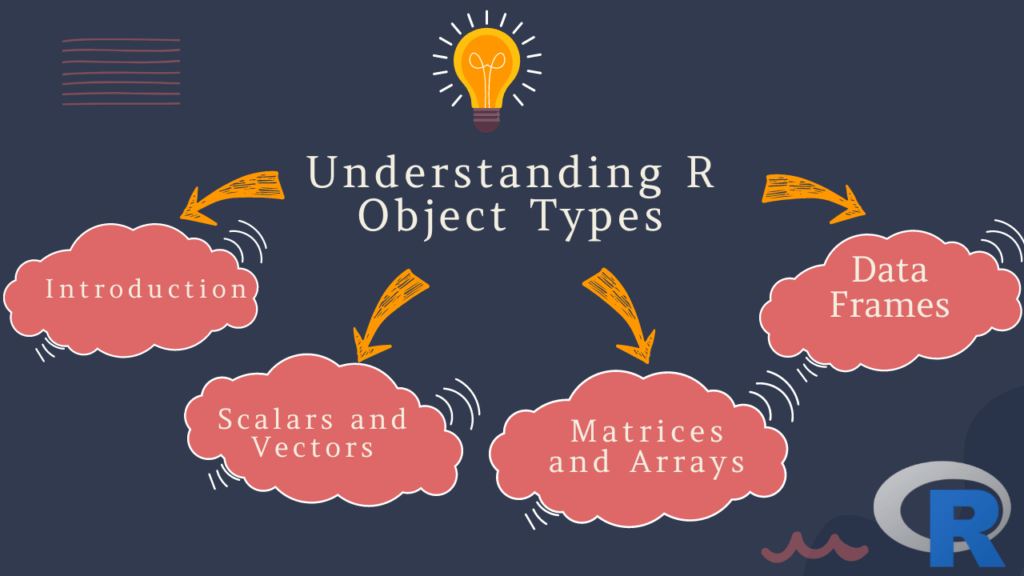
Understanding R Object Types: If you’re new to R, one of the first things you’ll need to understand is the concept of object types. R is a dynamically-typed language, meaning that objects are not assigned a specific type at the time of declaration, but rather their type is determined at runtime. In this article, we’ll cover the different types of objects in R, how to create and manipulate them, and how to work with their associated functions.
Table of Contents
Introduction
Scalars and Vectors
Numeric Vectors
Integer Vectors
Complex Vectors
Logical Vectors
Character Vectors
Factor Vectors
Matrices and Arrays
Lists
Data Frames
FAQs
Understanding R Object Types
1. Introduction
R is a powerful programming language used extensively for data analysis and statistical computing. One of its key features is its ability to work with a variety of object types. In R, objects can be anything from a single number to a complex data structure containing many elements.
2. Scalars and Vectors
Scalars are single values in R, such as a number or character string. Vectors are collections of scalars of the same type, arranged in a specific order.
Numeric Vectors
Numeric vectors are the most common type of vector in R, and can contain any real number. They are created using the c() function:
> x <- c(1.5, 2.7, 3.9)
> x
[1] 1.5 2.7 3.9
Integer Vectors
Integer vectors can contain only whole numbers. They are created using the as.integer() function:
> y <- as.integer(c(1, 2, 3))
> y
[1] 1 2 3
Complex Vectors
Complex vectors are used to represent complex numbers, which have both real and imaginary component. They are created using the c() function with the complex() function:
> z <- c(1+2i, 2+3i, 3+4i)
> z
[1] 1+2i 2+3i 3+4i
Logical Vectors
Logical vectors contain either TRUE or FALSE values, and are used extensively in conditional statements. They are created using the c() function:
> a <- c(TRUE, FALSE, TRUE)
> a
[1]  TRUE FALSE  TRUE
Character Vectors
Character vectors contain text strings. They are created using the c() function with quotes:
> b <- c("apple", "banana", "cherry")
> b
[1] "apple"  "banana" "cherry"
Factor Vectors
Factor vectors are used to represent categorical data. They are created using the factor() function:
> c <- factor(c("red", "green", "blue"))
> c
[1] red   green blue
Levels: blue green red
3. Matrices and Arrays
Matrices are two-dimensional collections of data, while arrays can have any number of dimensions. They are created using the matrix() and array() functions:
Lists are one of the most versatile object types in R. They can contain objects of different types and sizes, and can even contain other lists. They are created using the list() function:
Data frames are used to represent tabular data, such as spreadsheets or database tables. They are similar to matrices but can contain columns of different types. They are created using the data.frame() function:
> df <- data.frame(name=c("Alice", "Bob", "Charlie"), age=c(25, 30, 35), married=c(TRUE, FALSE, TRUE))
> df
     name age married
1   Alice  25    TRUE
2     Bob  30   FALSE
3 Charlie  35    TRUE
6. FAQs
What is the difference between a scalar and a vector in R?
A scalar is a single value, while a vector is a collection of values of the same type.
How do I create a matrix in R?
You can create a matrix using the matrix() function.
What is a data frame in R?
A data frame is a type of object used to represent tabular data, such as spreadsheets or database tables.
What is a factor in R?
A factor is a type of vector used to represent categorical data.
Why is it important to choose the right type of object in R?
The type of an object can affect how it is treated by R functions, so choosing the right type is important to ensure correct results.
Creating Violin Plots Using R: Violin plots are a popular method for visualizing the distribution of a dataset. These plots are similar to box plots but provide a more detailed view of the distribution by showing the density of the data at different values. In this article, we will discuss how to create violin plots using R and how to interpret them.
To begin, we will need a dataset to work with. For this example, we will use the “mtcars” dataset which is built into R. This dataset contains information on various attributes of 32 cars, including their miles per gallon (mpg), number of cylinders (cyl), and horsepower (hp). We will focus on the mpg variable for our example.
Creating Violin Plots Using R
First, let’s load the dataset into R:
data(mtcars)
Now, let’s create a simple violin plot of the mpg variable:
library(ggplot2)
ggplot(mtcars, aes(x = "", y = mpg)) +
  geom_violin()
This will produce a basic violin plot of the mpg variable. The x-axis is left blank because we are not grouping the data by any variable. The y-axis shows the values of the mpg variable, and the width of the violin at each point indicates the density of the data at that value. The thicker portions of the violin indicate where the data is more densely distributed.
We can customize the plot in several ways. For example, we can color the violins based on the number of cylinders in each car:
ggplot(mtcars, aes(x = factor(cyl), y = mpg, fill = factor(cyl))) +
  geom_violin()
This will produce a violin plot with each violin colored based on the number of cylinders in each car. We can see that cars with 4 cylinders tend to have higher mpg values than cars with 6 or 8 cylinders.
We can also overlay a box plot on the violin plot to show additional information about the distribution:
ggplot(mtcars, aes(x = factor(cyl), y = mpg, fill = factor(cyl))) +
  geom_violin() +
  geom_boxplot(width = 0.1, fill = "white")
This will produce a violin plot with a box plot overlaid on top of it. The box plot shows the median, quartiles, and any outliers in the data.