data

Modern Artificial Intelligence and Data Science

Modern Artificial Intelligence and Data Science: As digital transformation advances across every industry, Artificial Intelligence (AI) and Data Science are at the forefront of technological innovation. These disciplines are not only reshaping businesses and improving processes but are also setting new standards in customer engagement, decision-making, and operational efficiency. In this article, we’ll explore the essential tools, techniques, and systems that form the backbone of modern AI and data science, providing insights into their significance and future potential.

The Role of Artificial Intelligence and Data Science Today

AI and Data Science go hand in hand, enabling organizations to extract meaningful insights from large sets of data. Together, they empower data-driven decision-making, enhance automation, and even bring forward predictive capabilities that help anticipate trends. Whether it’s machine learning, natural language processing, or predictive analytics, AI and Data Science work as a duo to improve business performance, streamline processes, and open doors to new opportunities.

Modern Artificial Intelligence and Data Science Tools, Techniques and Systems
Modern Artificial Intelligence and Data Science: Tools, Techniques and Systems

Key Tools in Modern AI and Data Science

A range of tools has emerged to support AI and data science workflows, from data analysis and visualization to complex machine learning model deployment. Here are some leading tools widely used by data scientists and AI developers:

1. Python and R

  • Python remains a top choice due to its flexibility, readability, and extensive libraries (e.g., TensorFlow, scikit-learn, Keras, Pandas, NumPy). Python’s versatility makes it ideal for tasks ranging from data preprocessing to building machine learning models.
  • R, on the other hand, is favored for statistical analysis and visualization. Its comprehensive statistical packages and libraries such as ggplot2 make it popular among data scientists specializing in data analysis and visualization.

2. Jupyter Notebooks

  • Jupyter Notebooks offers a collaborative environment where data scientists can write code, visualize data, and document processes in one place. This open-source tool has become essential for data exploration and prototyping.

3. Apache Spark

  • Spark is a powerful analytics engine for big data processing, and it supports multiple languages (Python, Java, Scala, and R). With libraries like MLlib for machine learning and Spark SQL for querying structured data, Apache Spark provides scalability and flexibility for processing large datasets in distributed computing environments.

4. TensorFlow and PyTorch

  • TensorFlow, developed by Google, and PyTorch, backed by Facebook, are two of the most popular frameworks for deep learning. TensorFlow’s flexibility with data flow graphs and PyTorch’s dynamic computational graphs make them ideal for building and deploying complex neural networks.

5. Tableau and Power BI

  • For data visualization, Tableau and Power BI are powerful tools that enable users to create interactive and visually appealing dashboards. These tools are user-friendly and allow non-technical stakeholders to understand and interact with data insights effectively.

Essential Techniques in AI and Data Science

The success of AI and data science depends on a variety of sophisticated techniques. Here are some key methods driving innovation in these fields:

1. Machine Learning (ML)

  • ML is a core subset of AI that enables systems to learn and improve from experience without explicit programming. Techniques include supervised learning (classification, regression), unsupervised learning (clustering, association), and reinforcement learning.

2. Deep Learning

  • Deep Learning, a subset of ML, uses neural networks with multiple layers (deep neural networks) to analyze patterns and structures within complex data. It’s behind advances in image and speech recognition, autonomous vehicles, and even language translation.

3. Natural Language Processing (NLP)

  • NLP techniques allow AI systems to understand, interpret, and generate human language. NLP powers chatbots, sentiment analysis, and language translation making it a valuable tool for customer service, content analysis, and more.

4. Predictive Analytics

  • Predictive analytics uses historical data to make informed predictions about future events. It’s widely applied in industries like finance, healthcare, and retail to forecast trends, customer behavior, and potential risks.

5. Data Wrangling and Data Cleaning

  • Before data can be analyzed, it needs to be prepared. Data wrangling (the process of cleaning, structuring, and enriching raw data) and data cleaning are essential techniques that ensure the quality and accuracy of data used in analysis and modeling.

Systems Supporting AI and Data Science Workflows

Behind every AI model and data science project, there’s a supporting system infrastructure. Here are some essential systems that enable the execution, storage, and scalability of AI and data science projects:

1. Cloud Computing Platforms (AWS, Azure, Google Cloud)

  • Cloud platforms offer scalable infrastructure and services for data storage, computation, and analytics. AWS, Microsoft Azure, and Google Cloud provide comprehensive suites for data science and AI, including machine learning as a service (MLaaS) and managed databases.

2. Big Data Ecosystems (Hadoop, Apache Hive, Apache Kafka)

  • For processing and analyzing massive amounts of data, big data ecosystems like Hadoop, Hive, and Kafka are vital. These systems enable distributed data storage and parallel processing, supporting large-scale AI and data science workflows.

3. Data Lakes and Data Warehouses

  • Data lakes and data warehouses are designed for large-scale data storage and management. Data lakes store unstructured and structured data, while data warehouses are optimized for structured data analysis, both facilitating data access and integration.

4. Edge Computing

  • Edge computing brings computation closer to data sources, which is crucial for real-time applications. It reduces latency by processing data near its source, making it ideal for IoT devices, autonomous systems, and applications that demand rapid response times.

Future Trends in AI and Data Science

As AI and Data Science continue to evolve, several trends are emerging that promise to shape the future of these fields:

1. Automated Machine Learning (AutoML)

  • AutoML automates the process of building machine learning models, making it more accessible for non-experts and accelerating model development. This trend will likely democratize AI even further, allowing more businesses to leverage its benefits without requiring highly specialized expertise.

2. Explainable AI (XAI)

  • Explainable AI is gaining importance as organizations prioritize transparency and accountability. XAI techniques aim to make AI models understandable and interpretable, especially in high-stakes fields like healthcare, finance, and law.

3. AI for Ethical and Sustainable Development

  • With AI’s impact on society becoming more apparent, ethical AI is a growing area of focus. AI researchers and practitioners are exploring ways to minimize bias, protect privacy, and reduce AI’s environmental footprint, making AI a force for positive change.

4. Integration of Quantum Computing in AI

  • Quantum computing holds the promise of solving complex problems at unprecedented speeds. As quantum technology advances, it may revolutionize AI by enabling faster processing and deeper analysis, opening new doors for scientific and industrial applications.

Conclusion: Modern Artificial Intelligence and Data Science

The synergy between AI and Data Science continues to propel innovation across all sectors. With powerful tools, advanced techniques, and robust systems, businesses can harness the full potential of data-driven insights and AI-powered solutions. As these fields evolve, staying updated on emerging tools and trends will be key for professionals and organizations looking to stay competitive in the digital era. AI and Data Science are no longer just buzzwords—they are the essential pillars of modern technology, shaping the future of industries worldwide.

Download: Machine Learning And Its Applications: Advanced Lectures

How To Start With Data Science Career 2023?

How To Start With Data Science? There’s no doubt about it data science is in high demand. As of 2023, the average data scientist in the US makes over $113,000 a year, and data scientists in San Francisco make over $140,000. Learn data science and you could find yourself working in this promising, well-compensated field. Just thinking about the first step can leave you dazed and confused, especially if you lack previous experience in the field. With so many different data science careers to explore, you might find yourself wondering which is the right one for you and if you’ve got what it takes to fit the profile. Wondering how to start with Data Science. Start with this!

How To Start With Data Science Career 2023?

Is Data Science for Me? Well, we’ve all asked ourselves that question when we were at square one of our data science learning path. And we haven’t forgotten that every expert was once a beginner.

  • So, this data science career guide has a three-fold purpose:
  • Show you why data science opportunities are worth exploring;
  • Inform you about the different careers in data science and boost your efficiency in discovering suitable data science roles
  • Give you the know-how you need to pursue your professional data science path

Figure out what you need to learn Data science can be an overwhelming field. Many people will tell you that you can’t become a data scientist until you master the following: statistics, linear algebra, calculus, programming, databases, distributed computing, machine learning, visualization, experimental design, clustering, deep learning, natural language processing, and more. That’s simply not true.

So, what exactly is data science? It’s the process of asking interesting questions and then answering those questions using data. Generally speaking, the data science workflow looks like this:

  • Ask a question
  • Gather data that might help you to answer that question
  • Clean the data
  • Explore, analyze, and visualize the data
  • Build and evaluate a machine-learning model
  • Communicate results

This workflow doesn’t necessarily require advanced mathematics, deep learning mastery, or many other skills listed above. But it does require knowledge of a programming language and the ability to work with data in that language. And although you need mathematical fluency to become really good at data science, you only need a basic understanding of mathematics to get started.

Get comfortable with Python and R: Python and R are both great choices as programming languages for data science. R tends to be more popular in academia, and Python tends to be more popular in the industry, but both languages have a wealth of packages that support the data science workflow.

You don’t need to learn both Python and R to get started. Instead, you should focus on learning one language and its ecosystem of data science packages. If you’ve chosen Python you may want to consider installing the Anaconda distribution because it simplifies the process of package installation and management on Windows, OSX, and Linux.

You also don’t need to become a Python expert to move on. Instead, you should focus on mastering the following: data types, data structures, imports, functions, conditional statements, comparisons, loops, and comprehensions. Everything else can wait until later!

Learn data analysis, manipulation, and visualization with pandas: For working with data in Python, you should learn how to use panda’s library. pandas provide a high-performance data structure (called a “DataFrame”) suitable for tabular data with columns of different types, similar to an Excel spreadsheet or SQL table. It includes tools for reading and writing data, handling missing data, filtering data, cleaning messy data, merging datasets, visualizing data, and so much more. In short, learning about pandas will significantly increase your efficiency when working with data.

However, pandas include an overwhelming amount of functionality, and (arguably) provide too many ways to accomplish the same task. Those characteristics can make it challenging to learn about pandas and discover best practices.

Focus on practical applications and not just theory: While undergoing courses and training, you should focus on the practical applications of things you are learning. This would help you not only understand the concept but also give you a deeper sense of how it would be applied in reality.

A few tips you should do when following a course:

  • Make sure you do all the exercises and assignments to understand the applications.
  • Work on a few open data sets and apply your learning. Even if you don’t understand the math behind a technique initially, understand the assumptions, what it does and how to interpret the results. You can constantly develop a deeper understanding at a later stage.
  • Take a look at the solutions by people who have worked in the field. They would be able to pinpoint you with the right approach faster.

Keep learning and practising: Here is my best advice for improving your data science skills: Find “the thing” that motivates you to practice what you learned and to learn more, and then do that thing. That could be personal data science projects, Kaggle competitions, online courses, reading books, reading blogs, attending meetups or conferences, or something else! Your data science journey has only begun! There is so much to learn in the field of data science that it would take more than a lifetime to master. Just remember: You don’t have to master it all to launch your data science career, you just have to get started!

Solving a System of Equations in R With Examples

Solving a System of Equations in R With Examples: Solving a system of equations in R is a common task in mathematical and statistical applications. R has several built-in functions and packages to solve systems of equations, including the lm() function and the ‘rootSolve’ package. In this article, we will demonstrate how to solve a system of equations in R using these tools, with examples.

Solving a System of Equations in R With Examples

Example 1: Solving a System of Linear Equations with lm() Function

The lm() function can be used to solve a system of linear equations, where the equation can be represented in the form of y = mx + b, where m is the slope and b is the y-intercept. Let’s consider the following system of two linear equations:

y = 2x + 1

y = -x + 3

To solve this system of equations using lm() function, we first have to create a data frame to represent the equations, and then use the lm() function to fit a linear model to the data.

Creating a data frame to represent the equations

df <- data.frame(x = c(1, 2, 3), y = c(3, 5, 7))

Fitting a linear model to the data

lm_fit <- lm(y ~ x, data = df)

Extracting the coefficients of the model

coeffs <- coefficients(lm_fit)

Solving for x and y

x <- -(coeffs[1]/coeffs[2]) y <- coeffs[1] + coeffs[2] * x

Printing the solution

cat(“The solution is x =”, x, “and y =”, y)

The output will be:

The solution is x = 1.5 and y = 4

Example 2: Solving a Non-Linear System of Equations with rootSolve Package

The rootSolve package can be used to solve a non-linear system of equations, where the equations are not represented in the form of y = mx + b. Let’s consider the following system of two non-linear equations:

x^2 + y^2 = 1

x + y = 1

To solve this system of equations using rootSolve package, we first have to install and load the package, and then use the uniroot() function to find the solution.

Installing and loading the rootSolve package

install.packages(“rootSolve”) library(rootSolve)

Defining the system of equations

equations <- function(z) { x <- z[1] y <- z[2] f1 <- x^2 + y^2 – 1 f2 <- x + y – 1 c(f1, f2) }

Solving for x and y

solution <- uniroot(equations, c(-1, -1))

Printing the solution

cat(“The solution is x =”, solution$root[1], “and y =”, solution$root[2])

The output will be:

The solution is x = 0.5 and y = 0.5

Solving a system of equations in R is a straightforward task with the help of built-in functions and packages such as lm() and rootSolve. These functions can be used to solve both linear and non-linear systems of equations and provide accurate solutions for real-world problems.

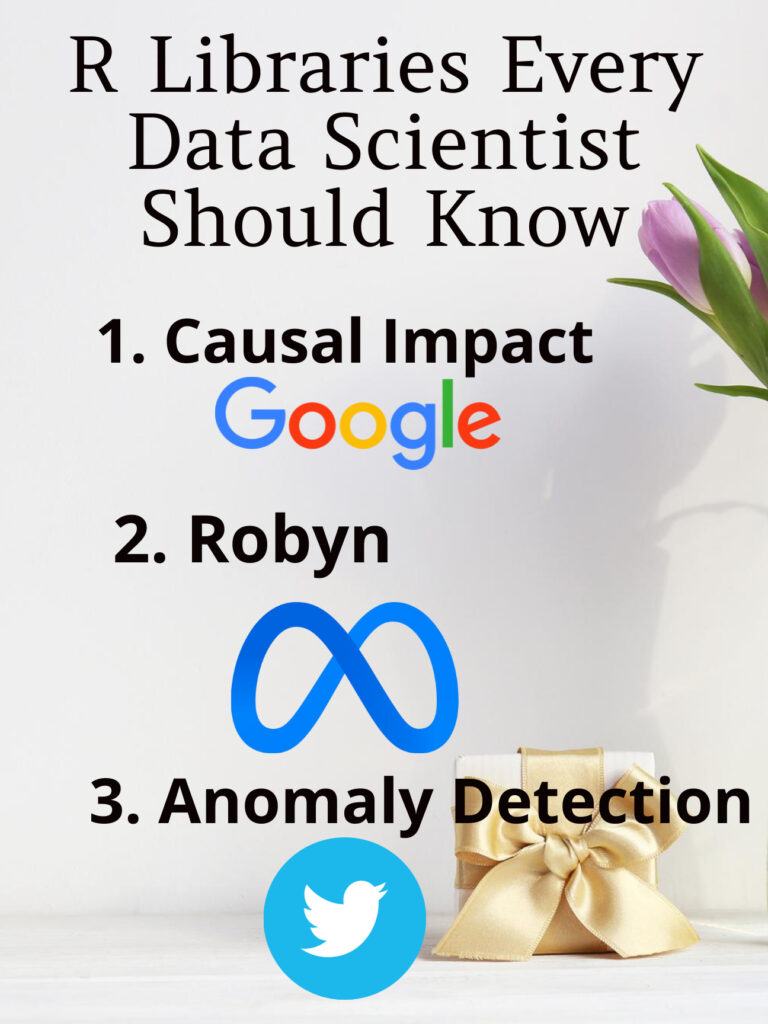
R Libraries Every Data Scientist Should Know

I have been using R for the longest time in my professional life, I realized that R outclasses Python in several use cases, particularly for statistical analyses. As well, R has some powerful packages that were built by the world’s biggest tech companies, and they aren’t in Python! And so, in this article, I wanted to go over three R packages that I highly recommend that you take the time to learn and add to your arsenal of tools because they are seriously powerful tools. Without further ado, here are three R packages that every data scientist should know:

R Libraries Every Data Scientist Should Know

1. Causal Impact (Google)

The package is designed to make a counterfactual inference as easy as fitting a regression model, but much more powerful, provided the assumptions above are met. The package has a single entry point, the function CausalImpact(). Given a response time series and a set of control time series, the function constructs a time-series model, performs posterior inference on the counterfactual, and returns an CausalImpact object. The results can be summarized in terms of a table, a verbal description, or a plot.

2. Robyn (Meta / Facebook)

Robyn is an automated Marketing Mix Modeling (MMM) code. It aims to reduce human bias by means of ridge regression and evolutionary algorithms, enables actionable decision making provides a budget allocator and diminishing returns curves and allows ground-truth calibration to account for causation

3. Anomaly Detection (Twitter)

AnomalyDetection is an open-source R package to detect anomalies that is robust, from a statistical standpoint, in the presence of seasonality and an underlying trend. The anomaly detection package can be used in a wide variety of contexts. For example, detecting anomalies in system metrics after a new software release, user engagement post an A/B test, or problems in econometrics, financial engineering, political and social sciences.

Download: Data Science with R: A Step-by-Step Guide

7 Free Datasets for Data Science Project

If you’ve ever worked on a personal data science project, you’ve probably spent a lot of time browsing the internet looking for interesting datasets to analyze. It can be fun to sift through dozens of datasets to find the perfect one, but it can also be frustrating to download and import several CSV files, only to realize that the data isn’t that interesting after all. In this post, we’ll walk through several types of data science projects, including data visualization projects, data cleaning projects, and machine learning projects, and identify good places to find datasets for each.

1. Kaggle

Kaggle is a great resource for machine learning datasets. The advantage of using Kaggle is it contains datasets from almost every domain and you can find the number of kernels relating to each dataset.

7 Free Datasets for Data Science Projects

2. NASA

NASA is a publicly-funded government organization, and thus all of its data is public. It maintains websites where anyone can download its datasets related to earth science and datasets related to space. You can even sort by format on the earth science site to find all of the available CSV datasets.

7 Free Datasets for Data Science Projects

3. UCI

The UCI has publically available datasets specifically for machine learning and data analysis. The datasets present are tagged up with categories e.g. Classification, Regression, Recommender-Systems, etc. so you can easily search for a dataset to practice a particular machine learning technique.

7 Free Datasets for Data Science Projects

4. Quandl

Quandl is a repository of economic and financial data. Some of this information is free, but many data sets require purchase. Quandl is useful for building models to predict economic indicators or stock prices. Due to a large number of available data sets, it’s possible to build a complex model that uses many data sets to predict values in another. View Quandl Data sets.

5. US Government Open Dataset — DATA.GOV

US Government Open Dataset — DATA.GOV is the website by the US government that provide free datasets. Here you can find datasets based on different categories like Agriculture, Climate, Health and many more.

6. World Bank Dataset

For your data science project, The World Bank Dataset is the best open dataset provided by the World Bank. Here you can find many resources related to the datasets like Open Data Catalog, DataBank, Microdata Library and many more.

7. Google Cloud BigQuery public datasets

Google Cloud BigQuery public datasets provide various public datasets by Google Cloud Marketplace. Datasets provided here are not completely free. The first 1TB of data per month is free, after that, they have some price associated. In order to access the datasets present, you have to create a project in the Google Cloud Platform.

5 Steps to Improve Your Data Visualization In Excel

You can display your data analysis reports in several ways in Excel. However, if you know the right data visualization technique your data analysis results can be more notable, and your audience can quickly grasp what you want to project in the data. It also leaves a good impact on your presentation style. You can improve your data visualization productivity by using the built-in table functionality available in Excel.

1. Create The Table

Place your cursor in the area you want to make a table. On the menu bar, select Insert, Table.  Excel will guess the range to create the table.

5 Steps to Improve Your Data Visualization In Excel

You will then validate the area that Excel has determined is the table you wish to create. Your table should have headers and the checkbox will default to accept the first row of the range to be the table headers.

5 Steps to Improve Your Data Visualization In Excel

Once you hit OK the range will format as a table with the default formatting. Select Table Tools that will now be visible on the menu bar which will display more formatting options.

The Design menu bar has many visual and operational options to choose from, some of which we will cover below.

2. Name the Table to Allow for Easier References

As shown in the screen capture above, the default name for the first table is “Table1”. Naming the table something meaningful allows you to reference the table in calculations and other functionality. The reference, rather being Table1 would be YearlySalary which allows for built-in documentation making your calculations more meaningful.

To change the table name, enter a new value in the Table Name box under the Table Tools option on the toolbar, as pictured below.

5 Steps to Improve Your Data Visualization In Excel

3. Format the Columns

As you use the tables in other Excel features, such as pivot tables and graphs, the column format will be picked up in the other tools. For example, formatting the columns as Currency and then no decimals will cause the formats to be used in Graphs as shown in the last section below.

4. Insert Slicers

Under the table tools, there is a Slicer option. Clicking on this option allows you to use various columns in the table as filters which allows you to slice the data for different views. With a cell selected in the table, select the Insert Slicer toolbar item in the Table Tools menu bar. You can then select the slicers you want to add.  The final view is below with the Insert Slicer dialogue.

5. Insert a Chart

Now that you have filters you can easily add a chart. Selecting the table, you can insert a graph by selecting the Insert menu option then, select a chart you want to view by selecting that option on the toolbar.  The graph is then filtered based on your slicer selection.

Note: The graph pictured has the axis formatted with the Year value removed.  There are several formats available in the graph format menu option.

5 Steps to Improve Your Data Visualization In Excel

10 Effective Way To Clean Data On Excel

In this day and age, our data dependence is overwhelming. Thanks to our cellphones and laptop, a halo of data surrounds our life. Data is nothing but a piece of classified information. Microsoft Excel is one of the most used data handling/analysis software. At the same time, one tiny mistake in analyzing data can cause headaches. Data is the backbone of any analysis that you do. It is an eternal problem and not only in Excel! Here’s a list of the top 10 Super Neat Ways to Clean Data in Excel as follows.

1. Get Rid of Extra Spaces

When it comes to clean data on excel extra spaces are painfully difficult to spot. While you may somehow spot the extra spaces between words or numbers, trailing spaces are not even visible. Here is a neat way to get rid of these extra spaces.

– Use TRIM Function.

Here a practical examples of using the TRIM function.

Example 1 – Remove Leading, Trailing, and Double Spaces

TRIM function is made to do this.

Below is an example where there are leading, trailing, and double spaces in the cells.

Excel TRIM Function - Data set Example 1

You can easily remove all these extra spaces by using the below TRIM function:

=TRIM(A1)

Copy-paste this into all the cells and you are all set.

2. Select & Treat all blank cells

Blank cells are troublesome because they often create errors while creating reports. And, people usually want to replace such cells with 0, Not Available or something like that. But replacing each cell manually on a large data table would take hours. Luckily, there’s an easy way to tackle this problem.


Steps:

  • Select the entire Data (you want to treat)
  • Press F5 (on the keyboard)
  • A dialogue box will appear > Select “Special
  • Select “Blanks” & click “OK
  • Now, all blank cells will be highlighted in pale grey color, out of which one cell would be white with a different border. That’s the active cell, type the statement you want to replace in blank cells.
  • Hit “Ctrl+Enter

3. Convert Numbers Stored as Text into Numbers

When you want to Clean Data On Excel Sometimes you import data from text files or external databases, numbers get stored as text. Also, some people are in the habit of using an apostrophe (‘) before a number to make it text. This could create serious issues if you are using these cells in calculations. Here is a foolproof way to convert these numbers stored as text back into numbers.

Steps:

  • In any blank cell, type 1
  • Select the cell where you typed 1, and press Control + C
  • Select the cell/range which you want to convert to numbers
  • Select Paste –> Paste Special (KeyBoard Shortcut – Alt + E + S)
  • In the Paste Special Dialogue box, select Multiply (in the operations category)
  • Click OK. This converts all the numbers in text format back to numbers.
Clean Data in Excel - Paste Special Multiply

4. Remove Duplicates

Elimination of duplicate data is necessary for the creation of unique data & less usage of storage. In duplication, you can either highlight it or delete it.

A) Highlight Duplicates:

  • Select the data & go to Home > Conditional Formatting > Highlight Cell Rules > Duplicate Values
  • A dialogue box will appear (Duplicate Values), Select Duplicate & format colour
  • Press OK
  • All duplicate values will be highlighted!
Clean Data in Excel - Highlight Duplicates

B) Delete Duplicates:

  • Select the data & go to DATA > Remove Duplicates
  • A dialogue box will appear (Remove Duplicates), and tick columns whose duplicates need to be found.
  • Remember to click on “My data has headers” (if your Data has headers) or else column heads will be considered as data & a duplication search will be applied to it too.
  • Click OK!
Clean Data in Excel - Remove Duplicates select column

Duplicate values will be removed! Suppose you select 4 of 4 columns. Then that four column rows should also match or else; they won’t be considered a duplicate.

5. Highlight Errors

There are 2 ways you can highlight Errors while cleaning Data on Excel:

Using Conditional Formatting

  • Select the entire data set
  • Go to Home –> Conditional Formatting –> New Rule
  • In New Formatting Rule Dialogue Box select ‘Format Only Cells that Contain’
  • In the Rule Description, select Errors from the drop-down
  • Set the format and click OK. This highlights any error value in the selected dataset
Clean Data in Excel - Highlight Errors

Using Go To Special

  • Select the entire data set
  • Press F5 (this opens the Go To Dialogue box)
  • Click on Special Button at the bottom left
  • Select Formulas and uncheck all options except Errors

This selects all the cells that have an error in it. Now you can manually highlight these, delete them, or type anything into them.

Clean Data in Excel - Select Errors

6. Change Text to Lower/Upper/Proper Case

While importing data, we often find names in irregular forms like lower, upper case, or sometimes mixed. Such errors are not easy to eliminate manually. Here’s a fingertip trick to bring back the consistency.

  • LOWER(text)
  • UPPER(text)
  • PROPER(text)

Steps:

  • Just type the formula you want to use, suppose “LOWER(“ and select the cell whose case needs to be changed.
  • Hit “CTRL+ENTER.”
  • The case has been changed & Consistent
  • Drag down to do the same for other cells.
  • Similarly for UPPER() & PROPER()

7. Parse Data Using Text to Column

Sometimes the received Data has texts filled in one cell, only separated by punctuations. Usually, the addresses are cramped in one cell separated by a comma. To distinguish values in separate cells, we can use “Text to Column.”

Steps:

  • Select the Data
  • Go to Data> Text to Column
  • A dialogue box will appear (Convert Text to Columns Wizard – Step 1 of 3), select Delimited or Fixed Width as per your convenience.
  • Delimited is to be selected if the width isn’t fixed, click “NEXT
  • In Delimiters tick the option which separates your text in the cell. Suppose “Norwich Cathedral, Norwich, UK,” here three values are separated by commas. So we will select “Comma” for this example. And, deselect the rest options.
  • View the preview & click on “NEXT
  • Select Column Data Format & destination cell address
  • Click “FINIS

8. Spell Check

Spelling mistakes are common in text files & PowerPoint. However, MS points out such errors by underlining them with colourful dashes. And, MS Excel doesn’t have such a feature. But you can use it below steps to clean data on excel.

  • Select the Data
  • Press “F7
  • A dialogue box appears, which shows you the possible wrong word & it’s the possible correct spelling. Click on “Change,” if you agree with the suggestion.
  • Check & change till it says “Spell check complete. You’re good to go!

9. Delete all Formatting

In my job, I used multiple databases to get the data in excel. Every database had it’s own data formatting. When you have all the data in place, here is how you can delete all the formatting in one go:

  1. Select the data set
  2. Go to Home –> Clear –> Clear Formats

Similarly, you can clear Content, Comments, Hyperlink, or entire data (using Clear All).

Clean Data in Excel - Clear Formats

10. Use Find & Replace to Clean Data in Excel

A) Changing Cell References:

  • Press “CTRL+H” to open “Find and Replace
  • Now in Replace > “Find What” (change the reference range too) “Replace With
  • Suppose Find What: $B to Replace With $C
  • Click on “Replace All
  • Similarly finding & replacing using reference range we can clean the Data

B) Find & Change Specific Format:

  • Press “CTRL+H
  • Select “Options
  • Now go to “Format” of “Find What.” Here you can specify the format or choose a format from the cell. Suppose you select a format.
  • Now it will show you the preview for “Find What.”
  • Click on “Format” of “Replace With.” Suppose we go for “Format…”
  • Now select format, for example, Number, Alignment, Font, Border, Fill, Protection.
  • Suppose we select Color and then select any colour to fill the column header cell.
  • Click on Replace All
  • Instantly the format has been changed!

C) Removal of Line Breaks:

Suppose we have data where it is separated by line breaks (same cell but different rows). To remove these line breaks, follow the below steps:

  • Press “CTRL+H
  • Find and Replace dialogue box will appear, press “CTRL+J
  • Go to the replace with box & type a single space
  • Click Replace All
  • All rows will be managed in one row within the same cell!

D) Removal of Parenthesis:

  • Select the Data
  • Press “CTRL+H
  • Type (*) in “Find What” (This will consider all characters within parenthesis)
  • Leave the Replace With column empty & click Replace
  • Parenthesis characters are removed!

Data Scientist vs Data Analyst vs Data Engineer

Data engineer, data analyst and data scientist are job titles you’ll often hear mentioned together when people are talking about the fast-growing field of data science. Of course, there are plenty of other job titles in data science, but here, we’ll talk about these three primary roles,  how they differ from one another, and which position might be best for you. Although each company may have its own definitions for each position, there are big differences between what you might be doing each day as a data analyst, data scientist, or data engineer. We’re going to dig into each of these specific roles in more depth.

Data Scientist vs Data Analyst vs Data Engineer: Job Role, Skills, and Salary

Data Scientist vs Data Analyst vs Data Engineer

Data Scientist 

They use advanced data techniques such as clustering, neural networks, decision trees, and the like for deriving business insights. In this role, you will be the senior-most in a team and should have deep expertise in machine learning, statistics, and data handling. You will be responsible for developing actionable business insights after they get inputs from Data Analysts and Data Engineers. You should have the skill set of both a data analyst and a data engineer. However, in the case of a data scientist, the skill sets need to be more in-depth and exhaustive.

The Required Skillsets

Coding skills are central to each of these job roles – data scientists need to have mastery over programming languages like Java, Python, SQL, R, and SAS, to name a few. Additionally, you need a working knowledge of Big Data frameworks like Hadoop, Spark, and Pig. Understanding the basics of technologies such as Deep learning, Machine learning, and the like also can propel your career in this role.

Responsibilities

The responsibilities you have to shoulder as a data scientist include:

1. Manage, mine, and clean unstructured data to prepare it for practical use. 

2. Develop models that can operate on Big Data

3. Understand and interpret Big Data analysis

4. Take charge of the data team and help them towards their respective goals

5. Deliver results that have an  impact on business outcomes

Salary of data scientist

As a data scientist, you can earn as much as $137,000 a year.

Data Analyst 

A Data Analyst occupies an entry-level role in a data analytics team. In this role, you need to be adept at translating numeric data into a form that can be understood by everyone in an organization. Moreover, you need to have required proficiency in several areas, including programming languages such as python, tools such as excel, and fundamentals of data handling, reporting, and modelling.  With enough experience under your belt, you can gradually progress from a data analyst to assume the role of a data engineer and a data scientist.

The Required Skillsets

When we talk about the role of a data analyst, you should know that it is less technical. It is an entry-level role, and you need to have an understanding of tools such as SAS Miner, Microsoft Excel, SPSS, and SSAS. If you have a basic knowledge of Python, SQL, R, SAS, and JavaScript, it would be a plus point. 

Responsibilities

As a data analyst, you will have to assume specific responsibilities, including:

1. Collecting information from a database with the help of a query

2. Enable data processing and summarize results

3. Use basic algorithms in their work like logistic regression, linear regression and so on

4. Possess and display deep expertise in data munging, data visualization, exploratory data analysis and statistics

Salary of data analyst

Data analysts can expect an average salary of $67,000 per year, which is remarkable, considering that it is an entry-level role.

Data Engineers 

Data Engineers are the intermediary between data analysts and data scientists. As a data engineer, you will be responsible for the pairing and preparation of data for operational or analytical purposes. A lot of experience in the construction, development, and maintenance of data architecture will be demanded from you for this role. Usually, in this role, you will get to work on Big Data, compile reports on it, and send them to data scientists for analysis.

Related post: Data Science: Free Online Courses For 2023

The Required Skillsets

The role of a Data Engineer requires you to have a deep understanding of programming languages such as Java, SQL, SAS, Python, and the like. You should also be adept at handling frameworks such as Hadoop, MapReduce, Pig, Hive, Apache Spark, NoSQL, and Data Streaming, at naming a few.

Responsibilities

Your responsibilities in this role are:

1. Data Mining for getting insights from data

2. Conversion of erroneous data into a useable form for data analysis

3. Writing queries on data

4. Maintenance of the data design and architecture

5. Develop large data warehouses with the help of extra transform load (ETL)

Salary of a data engineer

Data engineers can have a salary upwards of $116,000 a year which is remarkable.