Economy

Mathematical Methods for Economic Analysis

In the realm of economics, where decisions hold immense financial implications, harnessing the power of Mathematical Methods for Economic Analysis is nothing short of crucial. By leveraging sophisticated quantitative tools, economists can unravel complex scenarios, forecast trends, and devise effective strategies. This article takes you on a journey through the landscape of Mathematical Methods for Economic Analysis, highlighting key concepts, applications, and the synergy between mathematics and economics.

Mathematical Methods for Economic Analysis: Bridging Theory and Application

Mathematical Methods for Economic Analysis serves as the bedrock upon which economic theories are formulated, tested, and refined. It’s the art of translating real-world economic problems into mathematical equations that can be analyzed, manipulated, and solved. This synergy between mathematics and economics empowers professionals to make well-informed decisions backed by data-driven insights.

Mathematical Methods for Economic Analysis

Download:

Exploring Key Mathematical Concepts in Economics

Calculus: The Language of Change

Calculus lies at the heart of Economic Analysis. It provides tools to examine how variables change in relation to one another. Whether it’s determining marginal cost, optimizing production, or understanding elasticity, calculus enables economists to quantify rates of change and make precise predictions.

Linear Algebra: Mapping Relationships

Linear algebra comes into play when analyzing relationships between variables. From input-output models to understanding supply and demand interdependencies, economists employ matrices and vectors to represent and manipulate these relationships, unraveling the intricate web of economic dynamics.

Differential Equations: Modeling Change

Differential equations are essential for modeling dynamic economic processes. They capture how variables change over time, enabling economists to simulate and predict economic behavior. Whether it’s population growth, investment trajectories, or interest rate fluctuations, differential equations offer invaluable insights.

Statistics and Probability: Deciphering Uncertainty

Economic decisions often hinge on uncertain outcomes. Here, statistics and probability step in, providing tools to measure and manage uncertainty. Economists use probability distributions, hypothesis testing, and regression analysis to assess risk, forecast trends, and make informed choices.

Real-World Applications of Mathematical Methods

Financial Markets Analysis

Mathematical Methods enable economists to dissect financial market trends, evaluate risk-return profiles, and develop investment strategies. Whether it’s pricing options using the Black-Scholes model or understanding the efficient market hypothesis, mathematics provides the analytical backbone for financial decision-making.

Macroeconomic Policy Formulation

From monetary policy to fiscal stimulus, governments rely on Mathematical Methods to design effective macroeconomic policies. Equations modeling national income, inflation, and unemployment rates guide policymakers in maintaining economic stability and growth.

Game Theory and Strategic Behavior

In a world of strategic interactions, game theory emerges as a guiding light. By employing mathematical models, economists decipher optimal strategies in competitive scenarios. This finds applications in industries ranging from telecommunications to international trade negotiations.

Environmental and Resource Economics

Mathematical Methods extend their reach to environmental economics, aiding in resource management and sustainability. Equations modeling resource depletion, pollution control, and renewable energy adoption aid policymakers in balancing economic growth with environmental well-being.

FAQs

Q: How do Mathematical Methods enhance economic forecasting? A: Mathematical Methods provide tools like time series analysis and econometric models that help economists analyze historical data and make accurate forecasts based on trends and patterns.

Q: Can Mathematical Methods be applied to behavioral economics? A: Absolutely! Mathematical models can capture behavioral aspects, enabling economists to incorporate human psychology into economic analyses, offering a comprehensive understanding of decision-making.

Q: What role do Mathematical Methods play in international trade? A: Mathematical Methods help economists model trade patterns, exchange rates, and tariffs, aiding in the formulation of trade policies and predicting the outcomes of international economic interactions.

Q: Are Mathematical Methods only for advanced economists? A: Not at all. While some applications may be complex, foundational concepts like supply and demand curves or compound interest calculations are examples of Mathematical Methods accessible to all.

Q: How are Mathematical Methods utilized in risk management? A: In risk management, concepts like value-at-risk (VaR) and portfolio optimization rely on Mathematical Methods to assess and mitigate financial risks effectively.

Q: Can you recommend resources for learning more about Mathematical Methods? A: Certainly. Websites like Khan Academy, Coursera, and MIT OpenCourseWare offer a wealth of resources for learning Mathematical Methods for Economic Analysis.

Conclusion

Mathematical Methods for Economic Analysis is a testament to the symbiotic relationship between mathematics and economics. From deciphering market trends to formulating policies with environmental consciousness, these methods empower economists with a robust toolkit for decision-making. By embracing the quantitative elegance of mathematics, we illuminate the path toward a more informed and prosperous economic landscape.
Download(PDF)

Download: Basic Statistics for Business & Economics

Top 5 Nobel Prize-Winning Economic Theories Everyone Should Know

The Sveriges Riksbank Prize in Economic Sciences in Memory of Alfred Nobel was established in 1968 by the Bank of Sweden, and it was first awarded in 1969, more than 60 years after the distribution of the first Nobel Prizes.

It has been awarded 51 times to 84 Laureates who have researched and tested dozens of ground-breaking ideas. Here are five prize-winning economic theories that you’ll want to be familiar with. These are ideas you’re likely to hear about in news stories because they apply to major aspects of our everyday lives.

1. Management of Common Pool Resources

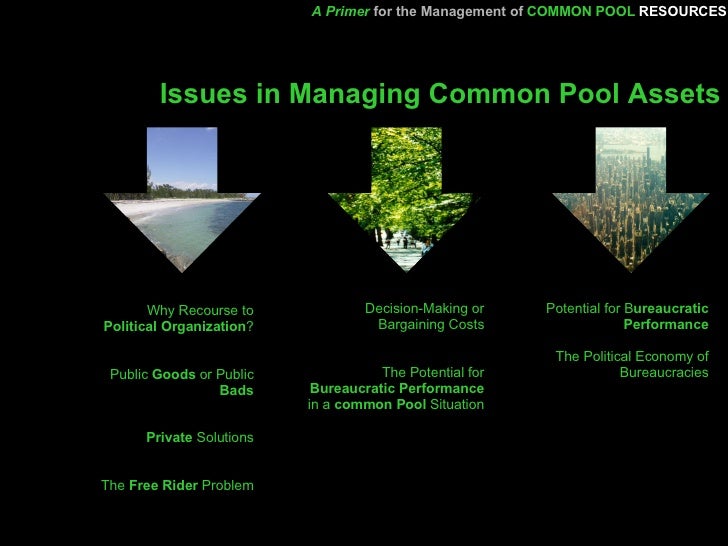
Common Pool Theory

In 2009, Indiana University political science professor, Elinor Ostrom, became the first woman to win the Nobel Prize in economics. She received it “for her analysis of economic governance, especially the commons.

Management of common-pool resources is a resource that benefits a group of people, but which provides diminished benefits to everyone if each individual pursues his or her self-interest. The value of a common pool resource can be reduced through overuse because the supply of the resource is not unlimited, and using more than can be replenished can result in scarcity. Overuse of a common pool resource can lead to the tragedy of the commons problem.

2. Behavioral Economics

Intro to Behavioral Economics

The US academic Richard Thaler won the Nobel prize in economics for his pioneering work in behavioural economics. The Royal Swedish Academy of Sciences, which awarded the £845,000 prize, praised Thaler for incorporating psychological assumptions into analyses of economic decision-making.

Unlike the field of classical economics, in which decision-making is entirely based on cold-headed logic, behavioural economics allows for irrational behaviour and attempts to understand why this may be the case. The concept can be applied in miniature to individual situations, or more broadly to encompass the wider actions of a society or trends in financial markets. The theory is particularly useful for companies and marketers looking to increase sales by encouraging changes in behaviour by consumers.

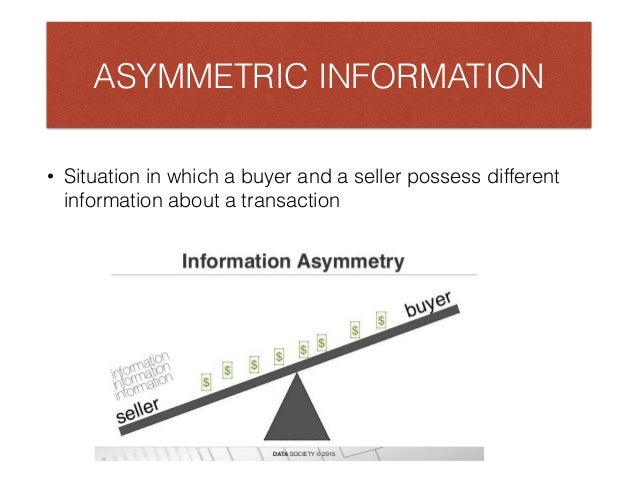
3. Asymmetric Information

Information Asymmetry
Nobel Prize-Winning Economic Theories Everyone Should Know

In 2001, George A. Akerlof, A. Michael Spence, and Joseph E. Stiglitz won the prize for their analyses of markets with asymmetric information. The theory showed that economic models predicated on perfect information are often misguided because, in reality, one party to a transaction often has superior information, a phenomenon known as information asymmetry.

An understanding of information asymmetry has improved our understanding of how various types of markets work and the importance of corporate transparency. Asymmetric information can also be viewed as the specialization and division of knowledge, as applied to any economic trade. For example, doctors typically know more about medical practices than their patients. After all, physicians have extensive medical school educational backgrounds that their patients generally don’t have. This principle equally applies to architects, teachers, police officers, attorneys, engineers, fitness instructors, and other trained professionals. Asymmetric information, therefore, is most often beneficial to an economy and a society in increasing efficiency.

4. Game Theory

Top 5 Nobel Prize-Winning Economic Theories Everyone Should Know

The academy awarded the 1994 prize to John C. Harsanyi, John F. Nash Jr., and Reinhard Selten for their pioneering analysis of equilibria in the theory of non-cooperative games. The theory of non-cooperative games is a branch of the analysis of strategic interaction commonly known as “game theory.”

One of Nash’s major contributions was the Nash Equilibrium, a method for predicting the outcome of non-cooperative games based on equilibrium. Nash’s 1950 doctoral dissertation, “Non-Cooperative Games,” details his theory. The Nash Equilibrium expanded upon earlier research on two-player, zero-sum games. Selten applied Nash’s findings to dynamic strategic interactions, and Harsanyi applied them to scenarios with incomplete information to help develop the field of information economics. Their contributions are widely used in economics, such as in the analysis of oligopoly and the theory of industrial organization, and have inspired new fields of research.

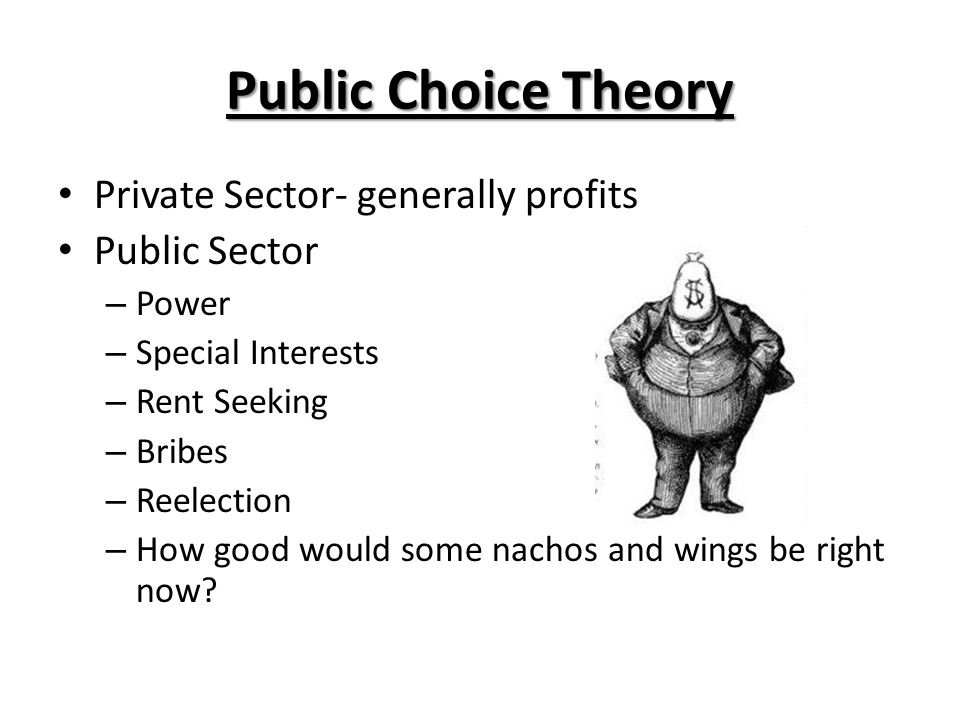
5. Public Choice Theory

Nobel Prize-Winning Economic Theories Everyone Should Know

James M. Buchanan Jr. received the prize in 1986 for his development of the contractual and constitutional bases for the theory of economic and political decision-making. Using Buchanan’s insights regarding the political process, human nature, and free markets.

He showed that contrary to the conventional wisdom that public-sector actors act in the public’s best interest as “public servants”, politicians and bureaucrats tend to act in their self-interest, just like the private sector. He described his theory as “politics without romance.” We can better understand the incentives that motivate political actors and better predict the results of political decision-making. We can then design fixed rules that are more likely to lead to desirable outcomes.

Hy we are on Patreon: https://www.patreon.com/pyoflife

Economists Whose Idea Are Changing The World

Economics is one of the most important and influential fields of study one can enter: the ramifications of its theory have changed our world, and will of course continue to do so. When we think of powerful men of the past, our minds turn to politicians and leaders the Churchills, Ghandis and even the Stalins and Hitlers who led men to glory, freedom, or destructions. However, the economists on whose ideas and counsel these giants of the modern age based their policies have had no less of an influence, indeed arguably even more of an impact, on our world.

We’re living in the age of the rock star academic. Everyone is trying to make sense of financial crises and the old economics textbooks don’t work so well anymore. So it’s natural to turn to the people who study this stuff for a living. Thomas Piketty, a French academic, sold 1.5 million copies of his book “Capital in the Twenty-First Century,” while Nobel prize-winning economists like Paul Krugman and Joseph Stiglitz can be found burning up social media, the newspapers, and the conference circuit. But not everyone with influential ideas on economics and finance is as well-known. Here are the Economists that are changing the world behind-the-scenes.

Related post: Skill And knowledge Required For An Economics Major:

1: Ha-Joon Chang, University of Cambridge

Idea: Developed countries talk a lot about the free market but really use their power and financial strength to profit at the expense of emerging economies. Chang’s ideas are controversial, centering on the role that international bodies like the IMF and World Bank play in the world economy. In books such as Kicking Away the Ladder and The Myth of Free Trade he argues that the governments of bigger economies help out their own companies, while preaching the benefits of the free market to developing nations.

2: Katherina Pistor, Columbia Law School

Idea: The rule of law must be suspended for financial markets in a crisis, or the whole system will collapse. Pistor, who won the Max Planck academic research award in 2012, is developing a legal theory of finance to work out how laws affect its shape and composition. She discovered that, in a crisis, the regulations that build markets aren’t worth the paper they’re printed on. Political power is the driving force behind who gets hit in the heat of the moment.

3: Charles Calomiris, Columbia Business School

Idea: Financial collapses don’t happen at random and aren’t inevitable. They come from complex bargains between politicians and bankers that spiral out of the government’s control. That’s one of the reasons why the US has had 12 major banking crises since 1840, while Canada has had none.

Related post: Economics Books For Economist.

4: Jon Danielsson, London School of Economics

Idea: Trusting your risk models will lose you money in a crisis. Risk models will generally tend to have the same outcomes when everything is going well, even if they have different mathematical foundations. This tricks people in to thinking that they work all the time. But when all hell breaks loose, the models will give you wildly different risk assesments, leaving you flying blind. This is bad for banks and hedge funds but even worse for central banks, who have to make policy decisions for everyone else.

5: Marianne Bertrand, University of Chicago Booth

Idea: CEOs are rewarded for luck rather than performance. Also, employers judge applicants on their name as much as their qualifications. Bertrand is one the reasons why there’s been such a shareholder backlash against CEO pay, after proving their huge bonuses are based on luck rather than genius. In a 2003 paper, she and Sendhil Mullainathan also famously replied to help-wanted ads in Chicago and Boston with fake names. Some applicants used names like Emily and Greg, while others used names like Lakisha and Jamal. “The results show significant discrimination against African-American names,” the authors wrote. “White names receive 50% more callbacks for interviews.”

Related post: Highest Paying Jobs with an Economics Degree

6: Alvin Roth, Harvard University and Stanford University

Idea: You don’t need money to make a stable market for something. Roth, along with Lloyd Shapely, won the Nobel Prize in 2012 for showing that people can make a market based on mutually-beneficial swaps rather than cash to satisfy a specific need. This was particularly useful for easing the shortage of kidney donors in the US. Roth used game theory to pair up donors with patients they didn’t know, making it easier for people to swap their organs and find a match.

7: Richard Portes, London Business School

Idea: Bondholders can often work together to get concessions from a borrower. Portes, now professor of economics at London Business School, laid down the groundwork for collective action clauses, where sovereign bondholders use their bargaining power to impose conditions on a debtor country. The work has been especially important in cases like Greece or Argentina.

Related post: 11 Best Modern Economics Books

8: Charles Goodhart, London School of Economics

Idea: Goodhart’s Law. Goodhart said that as soon as governments or central banks turn a statistic, such as the stock market, into an implicit policy target, it ceases to become a reliable statistic. This is because players in financial markets change their investment strategies to pre-empt the policy. Goodhart was one of the orignal members of the Bank of England’s monetary policy committee in 1997, and a veteran of financial crises in 1970s.

9: Alberto Alesina, Harvard University

Idea: Far from hurting growth, austerity measures can actually help economies recover. In 2009, Alesina and Silvia Ardegna published a paper called Large Changes in Fiscal Policy: Taxes Versus Spending. It was an important part of the debate in the years that followed over whether austerity and reducing debt or boosting government spending were the best strategies for economies recovering, cited by fiscal hawks.

Every reader contribution, however big or small, is so valuable for our future. Support pyoflife.com from as little as $1 – and it only takes a minute. Thank you.

6 REASONS WHY YOU SHOULD BE ECONOMIST

A question or a challenge? There is a variety of reasons a student would choose to major in any discipline. These choices are inspired by different reasons, from family background to the environment or peer group association or it could even be for a choice of career or passion, whichever it is, it is important for you to understand some basic insight about economics.

From a personal perspective, the study of economics has provided me with a systematic framework for analyzing, researching, writing, and teaching about a wide array financial and regional economic issues. Economics has provided me with a methodology for understanding and making sense of our complex environment. So here are 6 absolutely foolproof reasons for studying economics.

1. Economic Forecaster:

As an economist, you can make a living from predicting future economic events. The key to being a good economic forecaster is to use a mixture of dice and lottery numbers. (some economists make the mistake of using just lottery numbers, but this can lead to really bad forecasting) If this method fails just use the statistics from the previous year; they are always more accurate than the actual predictions of economists. An economist practically evaluates risks, which may be conditions or circumstances that may lead to a result of fluctuating from their initial estimates, hence demonstrates the thorough and deep thinking process used to final forecast estimates. Forecast results are sometimes generated annually but at other times updated frequently. Though there are so many tools put in place to help economists achieve results but need the statistical knowledge and models to follow in order to arrive at the result for particular variables. For your information economists have successfully predicted 10 out of the last 2 recessions.

2. You will understand the Market dynamics:

learning, as they say, is all-round progress, which touches every part of one’s life. Choosing to study economics will help you to understand the dynamics of the market. Market dynamics are simply those factors that impact the market. An economist perspective would mean demand and supply, opportunity cost, scarcity, equilibrium just to mention a few. The course will expand your vocabulary and knowledge to understand how the market works even if you would not be working primarily as an economist, but always at the back of your mind to help understand your organization market and can also help to influence the strategic decision in improving your organization’s performance.

3. Economists know reasons for unemployment:

Economist would define unemployment as a part of the labour force actively seeking employment. Dividing the unemployed over the employed gives an economist a statistically calculated percentage. An indicator used in understanding the operations of the total country’s labour force. Unemployment consequentially has an adverse effect on a country’s economy, especially when the rates are so high. This can then draw the attention of the media and other nations of the world too. There are numerous reasons for unemployment of a particular person in a country but if a country experiences recession or economic fall, most of the available private sector may be forced to lay off staff to reduce cost, and this, in turn, is causative for sometimes the mental minds both for the unemployed and employed. Reasons are numbers to an economist, which they could also predict or decipher in an economy.

Related post: Economics Books For Economist.

4. Able to make a good decision on personal spending:

There is a funny idea that economists are stingy people, but it is not so, they are only after making a very good economic decision. Learning to major in this course would enlighten your scope of reasoning to another level and eventually with enough passion to carry on would turn into a habit that is economically sound and financially healthy, since economics will teach you about market behaviours and organization trends. For example, learning about willingness to pay theory could help you develop your own spending habits, which will prove your sound economic mind and able to influence analytical thinking in immediate family members if possible.

5. Economists earn a high paying Job:

This is another reason be it as it may, why some students study economics as a major. It gives you the power to examine the labour markets, prospective private companies, industry tendencies or forces which direct the economy as it is. Definitely a major in economics could land you different jobs, one of such is a market research analyst, where they are required to apply skills like graphical representation, statistical skills and a critical mind for thinking, another is an economic consultant is needed across various sectors like government, finance, education, healthcare and business, they are required also to analyze and research economic strategies in order to help enhance performance. Any student that enjoys analytical thinking could major in economics which in turn will help to understand deeper how to coordinate and interpret data using mathematical formulas and statistics to make calculations. There are models also in place to learn, which helps to predict the effect of policy decisions, industry tendencies, climate change, investment, just to mention a few. The ability for problem-solving and great communication skills should be a strong suit for such an interested student, they are required to evaluate problems and recommend solutions.

Related post: Highest Paying Jobs with an Economics Degree

6. You can always give advice.

When the economy enters a recession, you will be able to tell everybody why the economy is in a recession. Also, you will be able to suggest several conflicting reasons as to how we can get out of a recession. This will simultaneously, both confuse and impress everybody; but it doesn’t matter because nobody ever listen to economists.

Related post: Skill And knowledge Required For An Economics Major:

Every reader contribution, however big or small, is so valuable for our future. Support pyoflife.com from as little as $1 – and it only takes a minute. Thank you.

Different Ways To Calculate GDP Of A Country

The gross domestic product (GDP) of a nation is an estimate of the total value of all the goods and services it produced during a specific period, usually a quarter or a year. Its greatest use is as a point of comparison: Did the nation’s economy grow or contract compared to the previous period measured?

There are three different methods (Expenditure, Income and Production) which can be used to measure the GDP of a country. All of these methods in theory should sum to the same amount.

1. Expenditure method

The expenditure approach is where you add up all the various types of spending which occurs within an economy. There are 4 different types.

Consumption (C)

Consumption is all the spending that households do on goods and services. For example, the number of apples a household purchases; the amount of money spent on healthcare; the amount of money spent purchasing new cars and the money spent on pizza are all examples of consumption spending.

Investment (I)

Investment is the spending that firms do machinery and equipment to operate their businesses. Examples of investment spending would be a mining company purchases a truck to transport coal; It companies purchasing new computers and the purchase of a new plane for an airline company.

Government Spending (G)

Government spending is the spending that the government conducts within an economy. Examples of government spending include spending on defence; spending on health care; the building of roads and education spending.

Net Exports (NX)

Net exports is defined at the purchases of domestically produced goods by foreigners subtracted from the purchases of internationally produced goods by local residents. In essence, it is the value of what is sent overseas minus the value of stuff that comes here.

If an airline company operating in the USA purchases a new plane from France, this would be considered an import for the USA and an export for France. This would cause the net exports to decrease for the USA whilst causing the net exports to increase for France.

An interesting case is where a foreign student from China comes and studies at a school in the USA. This is considered an export from the USA to China since the USA is producing a service (education) which is essentially being “sent” to a Chinese student who is from the Chinese economy. Thus, China is importing education from the USA.

Therefore, if we add up these 4 components we get:

GDP = C + I + G +NX

This is also called the demand approach to calculating GDP since all these components are demands for goods and services. It is looking at the demand side of the economy.

For example, using the input-output tables for Australia you can calculate the GDP for Australia in the year 2018 with:

C=$969,173C=$969,173
I=$418,703I=$418,703
G=$309,325G=$309,325
X=$308,306X=$308,306
M=$357,121M=$357,121

Giving GDP=$969,173+$418,703+$309,325+$308,306−$357,121GDP=$969,173+$418,703+$309,325+$308,306−$357,121

GDP=$1,659,604GDP=$1,659,604

where GDP is measured in millions of dollars.

2. Income Method :

The income approach starts with the income earned from the production of goods and services. Under the income approach, we calculate the income earned by all the factors of production in an economy.

Factors of production are the inputs which go into producing final product or service. Thus, the factors of production for business are – Land, Labour, Capital and Management within the domestic boundaries of a country. 

In this approach, we calculate income from each of these Factor of production which includes the wages got by labour, the rent earned by land, the return on capital in the form of interest, as well as business profits earned by management. Sum of All these incomes constitutes national income and is a way to calculate GDP.

Formula : Net National Income = Wages + Rent + Interest + Profits

To make it gross, we need to do two adjustments – Add depreciation of capital & Add Net Foreign Factor Income. NFFI is (income earned by the rest of the world in the country – income earned by the country from the rest of the world)

GDP (Factor Cost) = Wages + Rent + Interest + Profits+ Depreciation + Net Foreign Factor Income

This basically is the sum of final income of all factors of production contributing to a business in a country before tax.

Now if we add taxes and deduct subsidies, then it becomes GDP at Market cost.

GDP (Market Cost) = GDP (Factor Cost)+ (Indirect Taxes – Subsidies)

3. Production Method:

The production method (or value-added) is where we calculate the total value of all goods produced in the economy minus the value of intermediate goods.

Consider an economy which produces steel and cars. Suppose the economy produces 100 units of steel which it sells for $1 and it produces 10 cars, using 5 units of steel, which it sells for $100.

As the production of steel requires no intermediate inputs, the value added from the production of steel is $100.

The production of cars produces $1000 worth of cars using $50 of steel. Therefore, the value added is $950.

The total value-added/GDP of the economy is thus $1050. Alternatively, we could have added the total amount spent on the cars $1000 and total spend on steel $100 giving $1100 and then subtracted the $50 of intermediate inputs to also get $1050.

Every reader contribution, however big or small, is so valuable for our future. Support pyoflife.com from as little as $1 – and it only takes a minute. Thank you.

Highest Paying Jobs with an Economics Degree

What can you do with an economics degree? This is a question many prospective college students ask when considering this popular major. While there may be many potential answers to this question, some of the most lucrative ones are highlighted below. If you want to study economics and earn a handsome salary upon graduation, these are the career paths you should consider.

Job TitleMedian Salary (2018)*Job Growth (2018-2028)*
Economist$104,3408%
Budget Analyst$76,2204%
Top Executive$104,9806%
Personal Financial Advisor$88,8907%
Financial Manager$127,99016%
Source: *U.S. Bureau of Labor

1. Economist

With a bachelor’s degree in economics, you would be qualified for entry-level positions and pursuing a graduate degree in economics would open up several other options. Economist uses analytical and research skills to carry out studies regarding economic scenarios. They analyze industry trends to help organizations improve their performance.

They might work for organizations in a variety of industries, including business, finance, healthcare, education, the government, and more. The economist can also act as an expert witness in legal cases to assess economic damages, analyze intellectual property and antitrust violations, and address regulatory violations.  In 2018, economists made a median annual salary of $104,340.

2. Budget Analyst

A budget analyst is employed by an organization or business and is responsible for helping the company develop and manage an annual budget. They may work closely with other company executives and managers to understand the financial needs of each department, as well as the expenditures.

An economics bachelor’s degree would be adequate preparation for a career as a budget analyst, though certification may also be helpful for those working in the government. These professionals made a median salary of $76,220.

Related post: Economics Books For Economist.

3. Top Executive

Top executives work in several different capacities for companies and organizations, like operations managers, executive directors, and CEOs. While their responsibilities and job duties may vary depending on their specific role, top executives are often in charge of setting organizational goals, working with other company executives, analyzing sales and financial reports, and overseeing the daily operations of a company.

With an economics degree and relevant work experience, you would be qualified for a position as a top executive. In 2018, top executives made a median annual salary of $104,980 and there is the potential to earn even more depending on your role, as the top ten per cent of CEOs made over $208,000 in 2018.

4. Personal Financial Advisor

As a personal financial advisor, you will work closely with clients who are seeking financial advice concerning their investments and savings. You may help them set up savings funds for retirement or their children’s future education, manage their investment portfolios, and navigate tax season.

A degree in economics would provide an individual with a good foundation for a career as a personal financial advisor and certifications or licenses may provide an additional advantage. These advisors made a median annual salary of $88,890 in 2018, which is also much higher than the national median of $38,640 for all occupations.

5. Financial Manager

Financial managers play a key role in businesses and organizations, as they oversee all of the business’s financial activities and make important financial decisions. For example, a financial manager would be responsible for managing the finance department and all of its employees, producing financial reports and statements, making sure budgets are set and abided by, and reporting to top executives.

Financial managers typically have a bachelor’s degree in a relevant field, like economics, and significant work experience in a related role. In 2018, financial managers earned a median annual salary of $127,990.

The Inventions That Changes The Modern Economy

Human inventions and technologies have shaped civilizations and transformed life on Earth.  As expectations and capabilities evolve, each new generation possesses its own set of innovative thinkers. Right from the invention of the wheel to the development of Mars rover, several inventions are revolutionary.

The past decade has seen a significant-tech boom and an increase in products featuring smart technology. Here are some of the most important and influential inventions that change the modern economy.

Related post: Economics Books To Study If You are Going To Be Economist.

1.Search Engine

Google, Www, Online Search, Search

Google isn’t the only search engine available, it certainly is the most popular. Since it’s creation the website has achieved things that were previously impossible, from SEO optimisation to seamless global collaboration. Search engines give us access to limitless information 24 hours a day. It completely changed how we consume news and find out about current events. Search engines have changed marketing forever. Whether its pay per click advertising campaigns or SEO optimisation, most businesses now promote themselves online and rely heavily on sites like Google to pull in results.

2. Smartphones

Smartphone, Technology, Mockup, Apps


Yes, phones existed before 2000. The age of the smartphone, however, is a whole different ball game. There have been many variations and the smartphone now is far more advanced than even 5 years ago. However, the role that modern-day smartphones play in our day to day lives is undeniable. Being able to access almost any type of information or service at the touch of a button must surely make the smartphone one of the very best inventions of all time.

3.Artificial Intelligence

Artificial Intelligence, Brain, Think


Sci-fi movies from older times feature talking robots and computers that can think for themselves. These things still feature in movies, admittedly, but artificial intelligence is becoming a real “thing”. In 2011, for instance, a computer system called IBM Watson competed on and won American quiz-show Jeopardy, beating two all-time champions in the process. Though we’re not at a stage where robots are uprising and taking over the world, the capability to develop full artificial intelligence can’t be too far off.

4. Blockchain

Bitcoin, Blockchain, Crypto

You’ve likely heard about it even if you don’t fully understand it. The simplest explanation of blockchain is that it is an incorruptible way to record transactions between parties – a shared digital ledger that parties can only add to and that is transparent to all members of a peer-to-peer network where the blockchain is logged and stored. The technology was first deployed in 2008 to create Bitcoin, the first decentralized cryptocurrency, but it has since been adopted by the financial sector and other industries for myriad uses, including money transfers, supply chain monitoring, and food safety.

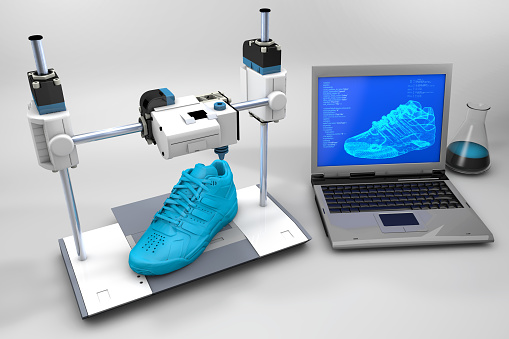
5. 3D printing

The Inventions That Changes The Modern Economy

The earliest application of the layering method used by today’s 3D printers took place in the manufacture of topographical maps in the late 19th century, and 3D printing as we know it began in 1980. The convergence of cheaper manufacturing methods and open-source software, however, has led to a revolution of 3D printing in recent years. Today, the technology is being used in the production of everything from lower-cost car parts to bridges to less painful ballet slippers and it is even considered for artificial organs.

6. The Electric Car

Tesla, Tesla Model X, Charging


If you haven’t heard of Elon Musk and Tesla by now, we’re almost 100% certain you’re living in a media black hole. While his latest antics have been more geared towards space exploration, Tesla was an innovation of its own. Although electric cars had been invented previously, and subsequently, Tesla was the first to make them easily and readily available. Nissan and BMW have recently followed suit and produced their own commercially available electric cars.

7. High-density battery packs

lithium-ion cells

Tesla electric cars have received so much attention largely because of their batteries. The batteries, located underneath the passenger cabin, consist of thousands of high-density lithium-ion cells, each barely larger than a standard AA battery, nestled into a large, heavy battery pack that also offers Tesla electric cars a road-gripping low centre of gravity and structural support. The brainchild of Tesla co-founder J.B. Straubel, these battery modules pack more of a punch than standard (and cheaper) electric car batteries. These packs are also being used in residential, commercial, and grid-scale energy storage devices.

8. Facebook

Facebook logo


Facebook, introduced in 2004, wasn’t the first social media site to grace the internet but it was by far the most influential. Initially developed for Harvard students only, Facebook now has over 2 billions users. The ability to share your life with a multitude of contacts and use the internet to build lasting networks is one that is now ingrained into everyday life for both business and individuals.

9. YouTube

YouTube


YouTube arrived on our screens in 2005 just over a decade ago. To think that YouTube has changed the face of media consumption in such a short space is incredible. For everything from how-to videos, to comedy show catch-ups, viral videos and marketing campaigns, YouTube is to go-to whenever a video element is needed.

10. The Apple iPod


The Inventions That Changes The Modern Economy


Now it becomes I tunes. The iPod was the gadget that transformed how we listen to music. Gone were the days of walkmans and CD’s, and the ability to carry around so many songs in such a small device made it the must-have item of 2001.

If you like my work, support me on: https://www.patreon.com/pyoflife

Happiness: How much money do we need to be happy?

Having money may bring you more happiness than spending it. It isn’t unusual for people to ask themselves how much money it takes to be happy. The next time this thought crosses your mind, don’t take it lightly because the answer is important.

Being Rich Doesn’t Mean Happy

A common assumption is a notion that happiness is synonymous with being rich. One problem with that assumption is that even members of your own family might have different expectations for what rich is. Contemporary sociologists such as Dennis Gilbert, a professor at New York’s Hamilton College, define rich as those who live off of income from their investments rather than occupation-driven income.

Have you read this:

  1. Start A Business With No Money
  2. COVID-19 Pandemic: Top Business Opportunities
  3. Entrepreneurs: Best books for your life

By this standard, a doctor even one earning $1 million a year isn’t as rich as someone who has earned $1 million from stocks, bonds, real estate, copyrights, or other passive income sources. The reason has to do with time. The investor can sit at home and make money, while the doctor stops receiving a paycheck if they stop working. They’re only paid if they continue to sell their labour. However, others might define being rich by entirely different metrics.

It means our life satisfaction depends on. How you feel about what you’ve accomplished, but the degree to which you love your work is the icing on the cake.

So How Much Money Do We Need to Be Happy?

Psychologists from Purdue University and the University of Virginia analyzed World Gallup Poll data from 1.7 million people in 164 countries and cross-referenced their earnings and life satisfaction. Although the cost and standard of living different across these countries, researchers came up with a bold conclusion: The ideal income for individuals is $95,000 a year for life satisfaction and $60,000 to $75,000 a year for emotional well-being. Families with children, of course, will need more.

If you like my work, support me on: https://www.patreon.com/pyoflife

Top 5 Free economics eBooks on the internet

Economics is a beautiful subject not as complicated as people might think. In fact, economics starts with individual human action. If you understand that humans act with a purpose, you’re well on your way to understanding economics. To help you learn from the ground up, I’ve compiled a list of 5 free economics eBooks, ranked from easiest-to-understand to more advanced.

This list will give you a new perspective on what economics actually is, tools and terminology to talk econ with the best of them, examples of common economic misconceptions, and a base-level understanding to jump-start your dive into more advanced material. Here are the top 5 Free economics eBooks you can download now.

1. “I, Pencil” – Leonard E. Read

Top 5 Free economics eBooks

This timeless and perspective-shifting essay was originally written by FEE founder Leonard E. Read in 1958 and is a must-read for anybody curious about economics. Read tells a story through the eyes of a pencil that details the innumerous forces behind market production, and how no single person could possess the know-how or resources to produce such a thing.

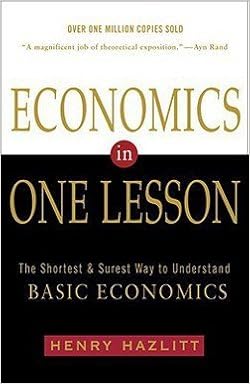
2. Economics in One Lesson – Henry Hazlitt

Top 5 Free economics eBooks

Economics in One Lesson is an introduction to economics written by Henry Hazlitt and first published in 1946. The art of economics consists in looking not merely at the immediate but at the more prolonged effects of any act or policy; it consists in tracing the consequences of that policy not merely for one group but for all groups.

3. A Renewable World: Energy, Ecology, Equality

Top 5 Free economics eBooks

This path-breaking book provides sound and practical introduction, arguments, directions, and specific solutions not only for the fast diffusion of renewable energies but for a whole revolution widening their exponential dynamics (and advantages) to all sectors, to demonstrate that yes, “we can renew our world, despite many of the grim developments of the last few centuries”

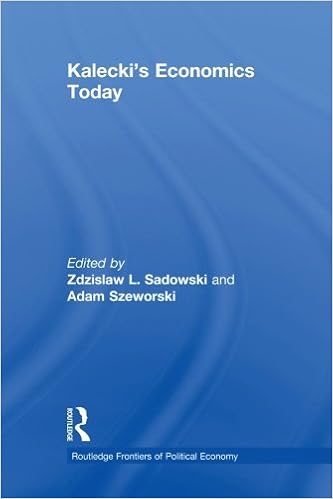
4. Kalecki’s Economics Today

.Top 5 Free economics eBooks

This 250-pages-long book presents not only the legacy of Kalecki (a brilliant economist, whose only fault was to publish in the Polish language; he independently discovered many of the key concepts of what is now identified as Keynesian theory) but also a possible reading of Michal Kalecki as a behavioral economist and the implications for modern evolutionary economic analysis.

5. Econometrics textbook

Top 5 Free economics eBooks

This free textbook about econometrics analysis, methods, and algebra cover themes like regression, ordinary least squares estimation, multicollinearity, omitted variables, generalized least squares, heteroskedasticity, generalized method of moments, bootstrap techniques, time series analysis, vector auto-regressive analysis (VAR), cointegration, non-parametric methods.

The skills required for the digital economy

We are living in a digital economy. Business executives around the world worry about the future of jobs and the welfare of their employees as technology automated processes and make sections of staff redundant. According to a recent PwC study, almost half 46 per cent of CEOs globally said significant retraining is the most important initiative to close a potential skills gap, against just 18 per cent who said they would be hiring from outside their industry.

Tech companies, and indeed all organizations in the digital economy, are coming to realise that digital skills are vital for employees in the digital era. It is more important than ever that new employees are cross-disciplined and have both hard and soft skills.  Whatever the specific job you are interviewing for, recruiters will be looking out for a wider skill set and broader experience in their new hires.

This list covers the top skills employers are looking for today and in the coming years. 

1. Human skills

Human skills include communication, creativity, critical thinking, collaboration, and analytical skills. Since an analysis of job descriptions highlighted human skills as a must-have, they didn’t seem to warrant a premium in salary. However, the reality is that although hard to judge in an interview, lacking any of these skills might cause candidates to be deemed unsuitable for certain jobs.

An interesting thing in an analysis of human skills was the fact that collaboration, as a skill, is becoming increasingly important in the work environment.

2. Programming, Web and App Development

At the heart of any tech product or digital service is coding. The core languages that most programming and web and app development positions need include Bootstrap, jQuery, Angular, Code Igniter, PHP/JavaScript, Python and MySQL. These skills are listed regularly in the top 10 most in-demand by employers on LinkedIn. Having a portfolio of projects demonstrating your coding skills can also help to validate your knowledge and expertise and help you land your dream role. Examples of mobile and responsive web development experience will give you an edge over other candidates.

Coding is also vital for emerging technologies such as augmented reality (AR) and virtual reality (VR). Coding will provide AR and VR Developers with the foundation skills needed to develop the next generation of AR and VR technologies. 

3. Digital Business Analysis

Digital Business Analysis helps organizations to make the right choices by providing an independent and objective mindset and applying a range of proven analysis techniques to make a convincing business case for investment in a digital solution.  As digital transformation is central to all organizations in the digital economy, digital business analysis skills have become the hottest skills to have on your CV in the 21st Century. Digital Business Analysts are at the epicentre of digital transformation projects. They help organisations develop a digital ecosystem of technologies that will help drive digital transformation and business growth. Much needed skill for the digital economy.

4. Data Design and Data Visualization

Websites, Apps and Digital Services have one thing in common; a user interface. Any designer with experience creating effective, dynamic user experiences will be in high demand with most tech companies.

Designers can also visualize complex data to help management make vital business decisions. This skill is called data visualization. Data visualization is useful for senior leaders to gain valuable insights from data. Tools such as Tableau and Power BI are used by designers to analyse and visualize data.

5. Digital Product Management

Another skill that is not unique to software development but one that is particularly valuable nonetheless is Digital Product Management. Software services in particular need to have a lifecycle management plan put in place. The continued growth of Software as a Service will make Product Management ever more integral to the tech sector.

6. Digital Marketing

To promote their products and services tech companies will look to digital marketing. Understanding of how to get the most value for money out of the broadest range of networks will be key here. In-demand skills for Digital Marketers include: 

  • Digital marketing tools 
  • Analytics tools
  • Social media marketing 
  • Content marketing 
  • SEO 
  • UX (User Experience Design)

7. Social Media

Some of the best PR today is carried out almost exclusively through social media. Twitter, Facebook, Reddit, Instagram and countless other platforms give tech companies direct access to customers, thought leaders and evangelists. The best Tech PR managers are Social Media managers.

8. Data Science and Data Analytics

Companies gather huge amounts of data that can be immensely valuable to them if they have a Big Data Analyst who can make sense of it all. Data Scientists are in-demand by employers across the world. Glassdoor constantly features Data Scientists in their Best Jobs Listing. Not only is Data Science an excellent career path for professionals in the digital age, but demand far outweighs supply, making Data Scientists highly employable. A recent McKinsey report showed that “The United States alone faces a shortage of 140,000 to 190,000 people with analytical expertise and 1.5 million managers with skills to make decisions based on the analysis of big data.” As data science becomes a minimum requirement for more and more manager-level jobs, learning data science will help you position yourself ahead of the curve.