Having money may bring you more happiness than spending it. It isn’t unusual for people to ask themselves how much money it takes to be happy. The next time this thought crosses your mind, don’t take it lightly because the answer is important.
Being Rich Doesn’t Mean Happy
Happiness: How much money do we need to be happy?
A common assumption is a notion that happiness is synonymous with being rich. One problem with that assumption is that even members of your own family might have different expectations for what rich is. Contemporary sociologists such as Dennis Gilbert, a professor at New York’s Hamilton College, define rich as those who live off of income from their investments rather than occupation-driven income.
By this standard, a doctor even one earning $1 million a year isn’t as rich as someone who has earned $1 million from stocks, bonds, real estate, copyrights, or other passive income sources. The reason has to do with time. The investor can sit at home and make money, while the doctor stops receiving a paycheck if they stop working. They’re only paid if they continue to sell their labour. However, others might define being rich by entirely different metrics.
It means our life satisfaction depends on. How you feel about what you’ve accomplished, but the degree to which you love your work is the icing on the cake.
So How Much Money Do We Need to Be Happy?
Happiness: How much money do we need to be happy?
Psychologists from Purdue University and the University of Virginia analyzed World Gallup Poll data from 1.7 million people in 164 countries and cross-referenced their earnings and life satisfaction. Although the cost and standard of living different across these countries, researchers came up with a bold conclusion: The ideal income for individuals is $95,000 a year for life satisfaction and $60,000 to $75,000 a year for emotional well-being. Families with children, of course, will need more.
Coronavirus pandemic has affected almost every continent and country. It had an unprecedented impact not only on health and humanity but also on the global economy. The drastic shift in consumer behaviour has created an everlasting ripple effect on businesses from all industries.
Here are some business opportunities worth spending time and money:
AI-Empowered Online Education platform
The most important thing we learn from this pandemic is our education system does not work. Educational institutions around the world are forced to shut down and shift to online learning programmes. Institutions are adopting innovative tools for learning to thrive in this post-pandemic world.
This shift in the learning system with online classes replacing the traditional methods; and the demand for new learning management software have created opportunities to collaborate education with technology on a better scale. AI-empowered tools to assist in attendance and validate candidates are predicted to be the new normal for the future educational system.
24 Hour Online Medicine and health care Service
At this moment, pharmaceutical businesses have an essential role to play. Patients are being advised to seek care from their homes. A large majority of the audience who never tried telehealth services are comfortable with using it now. Due to COVID-19, the industry is demanding support for medical assistance, customer service, health report maintenance and many more.
It is also the responsibility of every business person to provide true value to healthcare through quality service and cost-efficiency. You can offer the best possible solutions to their health issues with the help of your own branded online healthcare app or website.
E commerce Marketplace
It is very difficult for small business and shop owner to find their sustainability in the market. Thankfully, the digital world has a solution to this problem. Businesses have a golden opportunity to expand their customer reach by going online and boost their sales.
Online sales have surged 52% from the year-ago period, and the number of online shoppers has increased by 8.8% since the outbreak began. Taking your e-commerce business online, you can enable contactless commerce deliveries now.
Grocery Delivery Service
The fear of getting exposed to the pandemic keeps people from going to offline grocery stores. While the stock in their homes doesn’t seem to be lasting for longer now, they are ordering it online. It is the major reason for the exponential rise in a number of downloads for grocery delivery apps in recent days.
Did you know, downloads of grocery app and Shipt have increased every day? Take your grocery store online to ensure timely delivery of grocery orders at customers’ doorstep.
Pickup and Delivery Service
With all types of businesses finding ways to reach their customer’s doorstep, delivery solutions are becoming a life-saviour. And for this reason, delivery services have observed a surge in their business amid the coronavirus crisis.
A changing economy means new opportunities, especially for delivery services. Regardless of the business size & type, there is a need for a delivery management solution. To increase your business you can provide service for small business.
Online Payment Service
The World Health Organization (WHO) recommends customers to pay contactless rather than with cash.It is very important to improve the existing online payment system. When the pandemic made every store adopt a curb-side pickup and eCommerce module, online payment gateways turned to be the ultimate support for every retailer big or small.
Online payment platforms are now creating more digital options and solutions for customers. Devising an inclusive setup for the audience irrespective of their educational and financial background. Building omnichannel payment solutions to accommodate varying ways of shopping accelerating business opportunities to collaborate with tech support in the future.
Food Delivery Service
Several restaurants had to shut their shutters after the government ordered an enforced lockdown. Waiting for the situation to get back to normal seems no longer a good option for them. But switching to online delivery sounds certainly perfect.
The food delivery services thrive, as consumers stay home to avoid the spread of contagious diseases. Launch your branded food delivery app to enable your customers to order food online and delight them with contactless deliveries.
Fitness App
The impact of the pandemic on the fitness industry has been nothing short of catastrophic. Though the ambience of the instructor-led classrooms cannot be replicated on online sessions, the industry has no choice but to adopt digital instruction modules to combat the impact.
The solution to combine the sale of fitness equipment with live classes and pre-recorded content as a subscription model is finding revenue. However, the challenge according to Peloton, an American exercise equipment and media company, is meeting the soaring customer demand. With the situation changing after the lockdown scenario, the fitness industry definitely needs business support to meet the demand of the bifurcating audience, choosing between traditional classroom workout and the luxury of at-home workout routines.
When I was a kid I used to wonder what stops the government from printing money? Can’t a country just print money and distribute that money to its citizens?
Actually, it does not work like that. Money can be considered as a record that is accepted as compensation or payment for any services or goods. Money provides a socio-economic base to a country.
Printing more money doesn’t increase economic output it only increases the amount of cash circulating in the economy. If more money is printed, consumers are able to demand more goods, but if firms have still the same amount of goods, they will respond by putting up prices. In a simplified model, printing money will just cause inflation.
Problems with inflation
Fall in value of savings. If people have cash savings, then inflation will erode the value of their savings. Due to inflation years later, your savings would have become worthless. High inflation can also reduce the incentive to save.
Menu costs. If inflation is very high, then it becomes harder to make transactions. Prices frequently change. Firms have to spend more on changing price lists. In the hyperinflation of Germany, prices rose so rapidly; people used to get paid twice a day. If you didn’t buy bread straight away, it would become too expensive, and this is destabilising for the economy.
Uncertainty and confusion. High inflation creates uncertainty. Periods of high inflation discourage firms from investing and can lead to lower economic growth.
What determines the amount of money a country can print?
There is no fixed yard stick which determines the amount of printed money by central bank. It should be sufficient to make transfer of goods and services smooth and at the same time restore the value of currency.
Value of currency depends on many factors e.g. net exports, Current and fiscal deficit, Interest rate in the economy among many moving parameters.
Generally speaking central bank prints almost 2-3% money of total GDP. But this amount of money varies a lot from economy to economy. Mature or developed market prints 2-3% of their GDP. Emerging economy like India has much more than 2-3% money in circulation.
A country may print as much currency as it needs but it has to give each note a different value which further called as denomination. If a country decides to print more currency than it is needed, then all the manufacturers and sellers will ask for more money. If the production of currency is increased with 100 times, then the pricing will also rise accordingly.
The printed money should be produced in perfect balance with the value of goods and services. That is the reason why a country can produce more currency or money when its economy is succeeding
Economics is a beautiful subject not as complicated as people might think. In fact, economics starts with individual human action. If you understand that humans act with a purpose, you’re well on your way to understanding economics. To help you learn from the ground up, I’ve compiled a list of 5 free economics eBooks, ranked from easiest-to-understand to more advanced.
This list will give you a new perspective on what economics actually is, tools and terminology to talk econ with the best of them, examples of common economic misconceptions, and a base-level understanding to jump-start your dive into more advanced material. Here are the top 5 Free economics eBooks you can download now.
1. “I, Pencil” – Leonard E. Read
This timeless and perspective-shifting essay was originally written by FEE founder Leonard E. Read in 1958 and is a must-read for anybody curious about economics. Read tells a story through the eyes of a pencil that details the innumerous forces behind market production, and how no single person could possess the know-how or resources to produce such a thing.
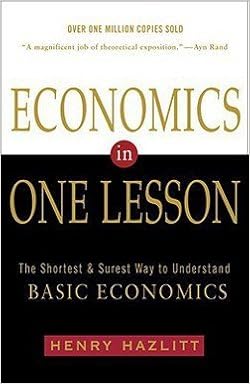
Economics in One Lesson is an introduction to economics written by Henry Hazlitt and first published in 1946. The art of economics consists in looking not merely at the immediate but at the more prolonged effects of any act or policy; it consists in tracing the consequences of that policy not merely for one group but for all groups.
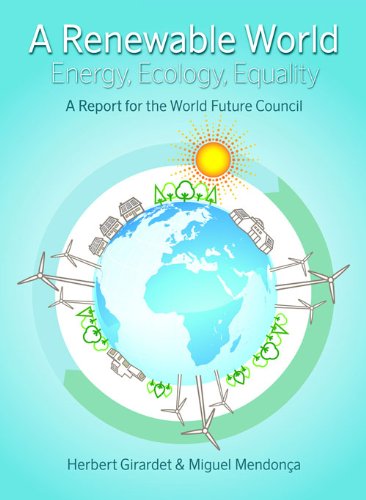
This path-breaking book provides sound and practical introduction, arguments, directions, and specific solutions not only for the fast diffusion of renewable energies but for a whole revolution widening their exponential dynamics (and advantages) to all sectors, to demonstrate that yes, “we can renew our world, despite many of the grim developments of the last few centuries”
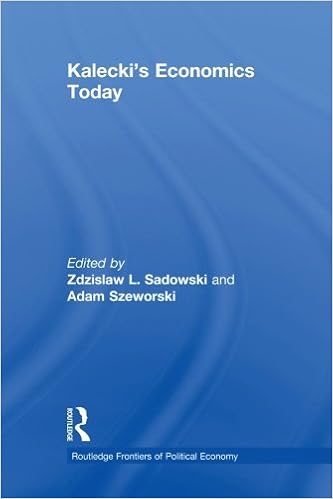
This 250-pages-long book presents not only the legacy of Kalecki (a brilliant economist, whose only fault was to publish in the Polish language; he independently discovered many of the key concepts of what is now identified as Keynesian theory) but also a possible reading of Michal Kalecki as a behavioral economist and the implications for modern evolutionary economic analysis.
This free textbook about econometrics analysis, methods, and algebra cover themes like regression, ordinary least squares estimation, multicollinearity, omitted variables, generalized least squares, heteroskedasticity, generalized method of moments, bootstrap techniques, time series analysis, vector auto-regressive analysis (VAR), cointegration, non-parametric methods.
We are living in a digital economy. Business executives around the world worry about the future of jobs and the welfare of their employees as technology automated processes and make sections of staff redundant. According to a recent PwC study, almost half 46 per cent of CEOs globally said significant retraining is the most important initiative to close a potential skills gap, against just 18 per cent who said they would be hiring from outside their industry.
Tech companies, and indeed all organizations in the digital economy, are coming to realise that digital skills are vital for employees in the digital era. It is more important than ever that new employees are cross-disciplined and have both hard and soft skills. Whatever the specific job you are interviewing for, recruiters will be looking out for a wider skill set and broader experience in their new hires.
This list covers the top skills employers are looking for today and in the coming years.
An interesting thing in an analysis of human skills was the fact that collaboration, as a skill, is becoming increasingly important in the work environment.
2. Programming, Web and App Development
At the heart of any tech product or digital service is coding. The core languages that most programming and web and app development positions need include Bootstrap, jQuery, Angular, Code Igniter, PHP/JavaScript, Python and MySQL. These skills are listed regularly in the top 10 most in-demand by employers on LinkedIn. Having a portfolio of projects demonstrating your coding skills can also help to validate your knowledge and expertise and help you land your dream role. Examples of mobile and responsive web development experience will give you an edge over other candidates.
Coding is also vital for emerging technologies such as augmented reality (AR) and virtual reality (VR). Coding will provide AR and VR Developers with the foundation skills needed to develop the next generation of AR and VR technologies.
3. Digital Business Analysis
Digital Business Analysis helps organizations to make the right choices by providing an independent and objective mindset and applying a range of proven analysis techniques to make a convincing business case for investment in a digital solution. As digital transformation is central to all organizations in the digital economy, digital business analysis skills have become the hottest skills to have on your CV in the 21st Century. Digital Business Analysts are at the epicentre of digital transformation projects. They help organisations develop a digital ecosystem of technologies that will help drive digital transformation and business growth. Much needed skill for the digital economy.
4. Data Design and Data Visualization
Websites, Apps and Digital Services have one thing in common; a user interface. Any designer with experience creating effective, dynamic user experiences will be in high demand with most tech companies.
Designers can also visualize complex data to help management make vital business decisions. This skill is called data visualization. Data visualization is useful for senior leaders to gain valuable insights from data. Tools such as Tableau and Power BI are used by designers to analyse and visualize data.
5. Digital Product Management
Another skill that is not unique to software development but one that is particularly valuable nonetheless is Digital Product Management. Software services in particular need to have a lifecycle management plan put in place. The continued growth of Software as a Service will make Product Management ever more integral to the tech sector.
6. Digital Marketing
To promote their products and services tech companies will look to digital marketing. Understanding of how to get the most value for money out of the broadest range of networks will be key here. In-demand skills for Digital Marketers include:
Digital marketing tools
Analytics tools
Social media marketing
Content marketing
SEO
UX (User Experience Design)
7. Social Media
Some of the best PR today is carried out almost exclusively through social media. Twitter, Facebook, Reddit, Instagram and countless other platforms give tech companies direct access to customers, thought leaders and evangelists. The best Tech PR managers are Social Media managers.
Companies gather huge amounts of data that can be immensely valuable to them if they have a Big Data Analyst who can make sense of it all. Data Scientists are in-demand by employers across the world. Glassdoor constantly features Data Scientists in their Best Jobs Listing. Not only is Data Science an excellent career path for professionals in the digital age, but demand far outweighs supply, making Data Scientists highly employable. A recent McKinsey report showed that “The United States alone faces a shortage of 140,000 to 190,000 people with analytical expertise and 1.5 million managers with skills to make decisions based on the analysis of big data.” As data science becomes a minimum requirement for more and more manager-level jobs, learning data science will help you position yourself ahead of the curve.
If you are a student of economics you may have visited these top youtube channels for economics. Some of them are very popular with economic students all around the world. According to our research team, these are the top youtube channel for economics:
The Berkley channel generously shares full courses (with PowerPoint slides) in many sub-divisions of economics, as well as in a large number of other disciplines. This means you can keep up-to-date with the teachings of one of the world’s leading universities. As a free resource, you can’t get much better. It’s like studying without the fees!
Produced by the author of Economist’s View, this channel is a real treasure trove, giving its viewers access to full courses of lectures all recorded live. The channel covers Econometrics, Monetary Theory and Policy, History of Economic Thought and much more. It really has something for everyone.
The YouTube channel of the Department of Economics of Duke University hosts a small but interesting collection of introductory lectures, as well as lectures on trending economics topics by some renowned speakers. This second feature makes the channel really worth checking in on now and again, as you can never be sure which hotshot economist could be popping up next!
Lambert’s videos provide detailed commentaries on the main undergraduate and graduate courses most universities offer in economics. They are taught through a series of lectures given on an animated chalkboard. A perusal of this site is a great way to get an impression of exactly what an economics degree will be like – without having to pay the admission fee!
Jodi Beggs, author of the popular blog Economists Do It With Models, teaches economics to college and MBA students. In her videos, she shares her expertise in a collection of short explanatory lectures normally between 10-40 minutes. The channel consists not only of introductory videos but also includes practice problem videos, making your research relevant and applicable – essential for those who get bogged down in too much abstraction.
The Economics Detective has a series of short animated videos – real short, normally between 3-4 minutes – covering some of the key economics concepts – a creative, fun, and non-time-consuming way to get yourself familiar with the basics. For those short of time, this is a great way to get a flavour of what the study of economics could bring. Also for those just wanting to brush up on some of the basics, the ‘detective’ could prove an invaluable resource.
Although not a huge catalogue, the University of California, Irvine, has published an extremely useful introductory lecture ‘Math for Economists’. Broken in parts, this small but comprehensive lecture series does exactly what it says on the tin. The viewing figures alone show how useful it has already been, reaching clicks of over 50,000. Quite incredible for an economics lecture series!
Hosted by Hal Snarr, a professor at Westminster College, ‘The Snarr Institute’ provides instructional videos on economics and business quantitative methods. Those of the quantitive inclination will find these introductory videos a great initiation to the field. And for those already familiar with this area, the videos can serve as a useful refresher. It is always advisable to be confident with the fundamentals.
Even though not concentrated exclusively on economics, the voluntary library has shared an interesting collection of videos recorded at various events, offering diverse content not limited to economics. Given that economics is increasingly reliant on the methodology of many of the social sciences, keeping up to date in the development of other fields is of great value!
This must-watch channel will be of particular interest for those specializing in Environmental Economics, as most of its content pertains to this area. In our time of accelerating climate deterioration, this sub-discipline of economics is growing in importance. If we are to lengthen our planet’s life, environmental economists will have to play a significant role. Get started and get watching!