Books

Download Python Cheat Sheet

Python cheat sheet can be an essential tool for anyone looking to learn or improve their skills in this powerful and versatile programming language. Whether you’re just starting out or you’re an experienced developer, a Python cheat sheet is a handy reference that can help you quickly and easily find the information you need to write your code. In this article, we’ll explore some of the key features of Python and provide you with a comprehensive Python cheat sheet that you can use to get up and running quickly.

Python Cheat Sheet
Python Cheat Sheet

Basic Syntax: Python uses indentation to define blocks of code, and its syntax is straightforward and easy to read. The print statement is used to output data to the console, and variables can be defined using the assignment operator (=).

Data Types: Python supports several data types, including integers, floating-point numbers, strings, and lists. There are also several built-in functions and methods that allow you to manipulate and analyze data, such as len(), min(), max(), and sorted().

Operators: Python supports several basic arithmetic operators, such as +, -, *, and /, as well as comparison operators like <, >, and ==. There are also several logical operators, such as and, or, and not, which can be used to control the flow of your code.

Control Flow: Python uses if-elif-else statements to control the flow of your code, and there are also several built-in functions, such as range(), that can be used to loop through data. Additionally, there are several built-in functions for working with arrays and lists, such as sorted(), reversed(), and enumerate().

Functions: Functions are an important part of any programming language, and Python is no exception. Functions can be defined using the def keyword, and they can accept parameters and return values. There are also several built-in functions, such as len(), that can be used to manipulate data.

Libraries: Python is widely used for data analysis, and there are several libraries, such as NumPy and Pandas, that provide tools for working with data. Additionally, there are several libraries for machine learning and artificial intelligence, such as TensorFlow and scikit-learn, that can be used to build sophisticated models.

Here is a comprehensive Python cheat sheet that summarizes the key features of Python:

  1. Basic syntax:
  • Use indentation to define blocks of code
  • The print statement is used to output data to the console
  • Variables are defined using the assignment operator (=)
  1. Data types:
  • Integers
  • Floating-point numbers
  • Strings
  • Lists
  • Built-in functions and methods for manipulating and analyzing data
  1. Operators:
  • Arithmetic operators: +, -, *, /
  • Comparison operators: <, >, ==
  • Logical operators: and, or, not
  1. Control flow:
  • if-elif-else statements
  • Built-in functions for looping through data: range()
  • Built-in functions for working with arrays and lists: sorted(), reversed(), enumerate()
  1. Functions:
  • Defined using the def keyword
  • Can accept parameters and return values
  • Built-in functions for manipulating data: len()
  1. Libraries:
  • NumPy and Pandas for data analysis
  • TensorFlow and scikit-learn for machine learning and artificial intelligence.

How to Choose the Right Data Visualization

How to Choose the Right Data Visualization is divided into chapters, one for each of the main categories for using data visualization. Each chapter is headed by a short introduction and a list of chart types falling into that category. Each chart type is accompanied by a brief description and one or more icons. Below is a key for decoding these symbols:

BASIC: Chart types with this icon represent typical or standard chart types. When you need to create a data visualization, try to see if one of these chart, types works first, before deciding on an uncommon or advanced type.
UNCOMMON: Chart types with this icon are slightly more unusual than the most common chart types. Use cases for these charts are more specialized than other chart types in that same category or more frequently seen in other roles.
ADVANCED: Chart types with this icon are even more specialized in their roles. Make sure that the chart type is the best one for your use case before implementing it. Sometimes, these chart types will not be built into visualization software or libraries, and additional work will need to be done to put these types of charts together.

How to Choose the Right Data Visualization

Follow us on Facebook: https://www.facebook.com/pyoflife

Hypothesis testing A Visual Introduction To Statistical Significance

This book contains examples of different types of hypothesis testing to determine if you have a statistically significant result. It is intended to be direct and to give easy to follow example problems that you can duplicate. In addition to information about what statistical significance is, or what the normal curve is exactly, the book contains a worked example for these types of statistical significance problems

  • Z Test
  • 1 Sample T-Test
  • Paired T-Test ( 2 examples )
  • 2 Sample T-Test with Equal Variance
  • 2 Sample T-Test with Unequal Variance
  • Every example has been worked by hand showing the appropriate equations
  • and also done in Excel using the Excel functions. So every example has 2
  • different ways to solve the problem. Additionally, this book includes a
  • Z Table
  • T Table
  • Along with the functions that you can use to create your own Z-Table or TTable
  • in Excel.

Table of Contents
Statistical Significance Overview
The Most Important Concept In This Book (If you read
nothing else, read this)
Variations Of Statistical Significance Problems
Example 1 – Z Test
But What Is The Normal Curve?
Doing A T-Test, Which Is Slightly Different Than A Z Test
Example 2 – 1 Sample T-Test
Paired T-Test – When You Use The Same Test Subject
Multiple Times
Example 3 – Paired T-Test
Example 3A – Paired T-Test With Non-Zero Hypothesis
Example 4 – Two-Sample T-Test with Equal Variance
Example 5 – 2 Sample T-Test With Unequal Variance
What If You Mix Up Equal Variance With Unequal Variance?
If You Found Errors Or Omissions
More Books
Thank You & Author Information

Top 5 Free economics eBooks on the internet

Economics is a beautiful subject not as complicated as people might think. In fact, economics starts with individual human action. If you understand that humans act with a purpose, you’re well on your way to understanding economics. To help you learn from the ground up, I’ve compiled a list of 5 free economics eBooks, ranked from easiest-to-understand to more advanced.

This list will give you a new perspective on what economics actually is, tools and terminology to talk econ with the best of them, examples of common economic misconceptions, and a base-level understanding to jump-start your dive into more advanced material. Here are the top 5 Free economics eBooks you can download now.

1. “I, Pencil” – Leonard E. Read

Top 5 Free economics eBooks

This timeless and perspective-shifting essay was originally written by FEE founder Leonard E. Read in 1958 and is a must-read for anybody curious about economics. Read tells a story through the eyes of a pencil that details the innumerous forces behind market production, and how no single person could possess the know-how or resources to produce such a thing.

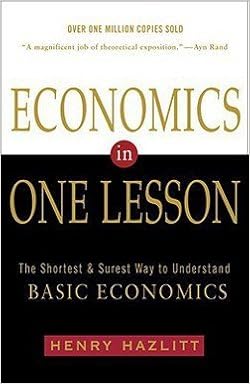
2. Economics in One Lesson – Henry Hazlitt

Top 5 Free economics eBooks

Economics in One Lesson is an introduction to economics written by Henry Hazlitt and first published in 1946. The art of economics consists in looking not merely at the immediate but at the more prolonged effects of any act or policy; it consists in tracing the consequences of that policy not merely for one group but for all groups.

3. A Renewable World: Energy, Ecology, Equality

Top 5 Free economics eBooks

This path-breaking book provides sound and practical introduction, arguments, directions, and specific solutions not only for the fast diffusion of renewable energies but for a whole revolution widening their exponential dynamics (and advantages) to all sectors, to demonstrate that yes, “we can renew our world, despite many of the grim developments of the last few centuries”

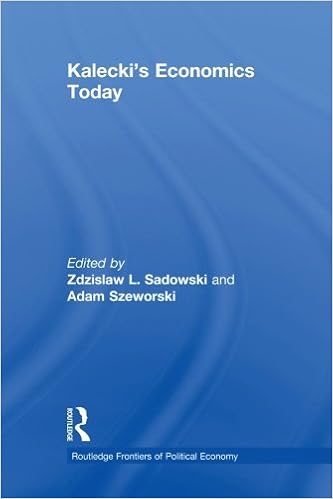
4. Kalecki’s Economics Today

.Top 5 Free economics eBooks

This 250-pages-long book presents not only the legacy of Kalecki (a brilliant economist, whose only fault was to publish in the Polish language; he independently discovered many of the key concepts of what is now identified as Keynesian theory) but also a possible reading of Michal Kalecki as a behavioral economist and the implications for modern evolutionary economic analysis.

5. Econometrics textbook

Top 5 Free economics eBooks

This free textbook about econometrics analysis, methods, and algebra cover themes like regression, ordinary least squares estimation, multicollinearity, omitted variables, generalized least squares, heteroskedasticity, generalized method of moments, bootstrap techniques, time series analysis, vector auto-regressive analysis (VAR), cointegration, non-parametric methods.