business

Mathematical Methods for Economic Analysis

In the realm of economics, where decisions hold immense financial implications, harnessing the power of Mathematical Methods for Economic Analysis is nothing short of crucial. By leveraging sophisticated quantitative tools, economists can unravel complex scenarios, forecast trends, and devise effective strategies. This article takes you on a journey through the landscape of Mathematical Methods for Economic Analysis, highlighting key concepts, applications, and the synergy between mathematics and economics.

Mathematical Methods for Economic Analysis: Bridging Theory and Application

Mathematical Methods for Economic Analysis serves as the bedrock upon which economic theories are formulated, tested, and refined. It’s the art of translating real-world economic problems into mathematical equations that can be analyzed, manipulated, and solved. This synergy between mathematics and economics empowers professionals to make well-informed decisions backed by data-driven insights.

Mathematical Methods for Economic Analysis

Exploring Key Mathematical Concepts in Economics

Calculus: The Language of Change

Calculus lies at the heart of Economic Analysis. It provides tools to examine how variables change in relation to one another. Whether it’s determining marginal cost, optimizing production, or understanding elasticity, calculus enables economists to quantify rates of change and make precise predictions.

Linear Algebra: Mapping Relationships

Linear algebra comes into play when analyzing relationships between variables. From input-output models to understanding supply and demand interdependencies, economists employ matrices and vectors to represent and manipulate these relationships, unraveling the intricate web of economic dynamics.

Differential Equations: Modeling Change

Differential equations are essential for modeling dynamic economic processes. They capture how variables change over time, enabling economists to simulate and predict economic behavior. Whether it’s population growth, investment trajectories, or interest rate fluctuations, differential equations offer invaluable insights.

Statistics and Probability: Deciphering Uncertainty

Economic decisions often hinge on uncertain outcomes. Here, statistics and probability step in, providing tools to measure and manage uncertainty. Economists use probability distributions, hypothesis testing, and regression analysis to assess risk, forecast trends, and make informed choices.

Real-World Applications of Mathematical Methods

Financial Markets Analysis

Mathematical Methods enable economists to dissect financial market trends, evaluate risk-return profiles, and develop investment strategies. Whether it’s pricing options using the Black-Scholes model or understanding the efficient market hypothesis, mathematics provides the analytical backbone for financial decision-making.

Macroeconomic Policy Formulation

From monetary policy to fiscal stimulus, governments rely on Mathematical Methods to design effective macroeconomic policies. Equations modeling national income, inflation, and unemployment rates guide policymakers in maintaining economic stability and growth.

Game Theory and Strategic Behavior

In a world of strategic interactions, game theory emerges as a guiding light. By employing mathematical models, economists decipher optimal strategies in competitive scenarios. This finds applications in industries ranging from telecommunications to international trade negotiations.

Environmental and Resource Economics

Mathematical Methods extend their reach to environmental economics, aiding in resource management and sustainability. Equations modeling resource depletion, pollution control, and renewable energy adoption aid policymakers in balancing economic growth with environmental well-being.

FAQs

Q: How do Mathematical Methods enhance economic forecasting? A: Mathematical Methods provide tools like time series analysis and econometric models that help economists analyze historical data and make accurate forecasts based on trends and patterns.

Q: Can Mathematical Methods be applied to behavioral economics? A: Absolutely! Mathematical models can capture behavioral aspects, enabling economists to incorporate human psychology into economic analyses, offering a comprehensive understanding of decision-making.

Q: What role do Mathematical Methods play in international trade? A: Mathematical Methods help economists model trade patterns, exchange rates, and tariffs, aiding in the formulation of trade policies and predicting the outcomes of international economic interactions.

Q: Are Mathematical Methods only for advanced economists? A: Not at all. While some applications may be complex, foundational concepts like supply and demand curves or compound interest calculations are examples of Mathematical Methods accessible to all.

Q: How are Mathematical Methods utilized in risk management? A: In risk management, concepts like value-at-risk (VaR) and portfolio optimization rely on Mathematical Methods to assess and mitigate financial risks effectively.

Q: Can you recommend resources for learning more about Mathematical Methods? A: Certainly. Websites like Khan Academy, Coursera, and MIT OpenCourseWare offer a wealth of resources for learning Mathematical Methods for Economic Analysis.

Conclusion

Mathematical Methods for Economic Analysis is a testament to the symbiotic relationship between mathematics and economics. From deciphering market trends to formulating policies with environmental consciousness, these methods empower economists with a robust toolkit for decision-making. By embracing the quantitative elegance of mathematics, we illuminate the path toward a more informed and prosperous economic landscape.
Download(PDF)

Download: Basic Statistics for Business & Economics

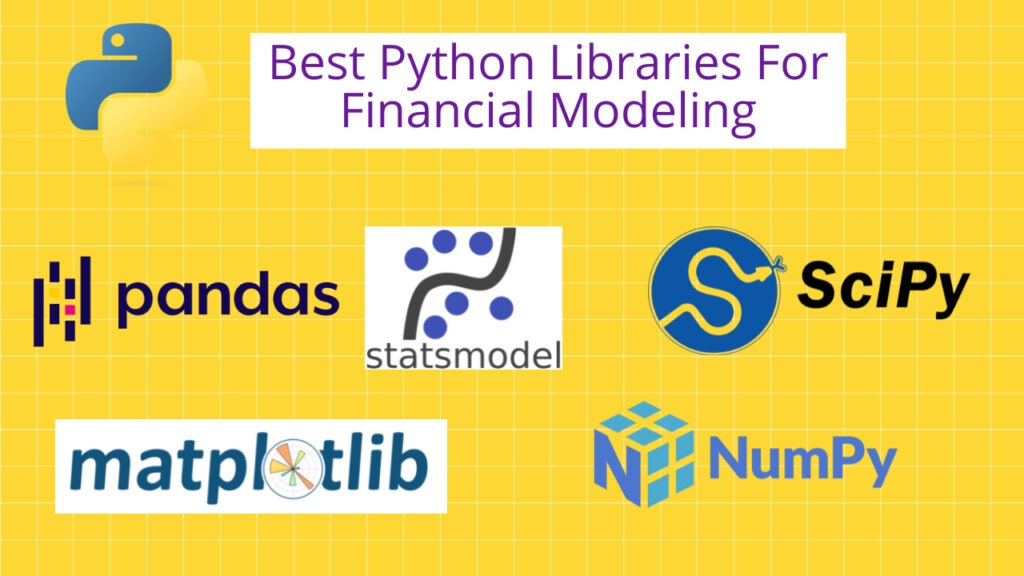
Best Python Libraries For Financial Modeling

Best Python Libraries For Financial Modeling: The rise in the fintech industry amid coronavirus has increased globally. According to reports, over a billion dollar investment will be done in Fintech companies in the next 3–5 years. Python programming language is an excellent tool for developing new financial technologies. A wide range of software packages exists to help users build their own financial models, from crunching raw numbers to creating aesthetically pleasing, intuitive graphical user interfaces. This article provides a list of the best python packages and libraries used by finance professionals.

Best Python Libraries For Financial Modeling

1. NumPy

All financial models rely on crunching numbers.  NumPy is the fundamental package for scientific computing with Python. It is a first-rate library for numerical programming and is widely used in academia, finance, and industry. NumPy specializes in basic array operations.

 2. Pandas

The panda’s library provides high-performance, easy-to-use data structures, and data analysis tools for the Python programming language. Pandas’ focus is on the fundamental data types and their methods, leaving other packages to add more sophisticated statistical functionality.

3. SciPy

SciPy supplements the popular Numeric module, Numpy. It is a Python-based ecosystem of open-source software for mathematics, science, and engineering. It is also used intensively for scientific and financial computation based on Python. This package provides functions and algorithms critical to the advanced scientific computations needed to build any statistical model.

4. Pyfolio

Pyfolio is a Python library for performance and risk analysis of financial portfolios. It works well with the Zipline open-source backtesting library. the pyfolio package provides an easy way to generate a tearsheet containing performance statistics. These statistics include annual/monthly returns, return quantiles, rolling beta/Sharpe ratios, portfolio turnover, and a few more. 

5. Statsmodels

The statsmodels package builds on these packages by implementing more advanced testing of different statistical models. An extensive list of result statistics and diagnostics for each estimator is available for any given model, with the goal of providing the user with a full picture of model performance. The results are tested against existing statistical packages to ensure that they are correct.

6. Zipline

Zipline is a Pythonic algorithmic trading library. It is an event-driven system that supports both backtesting and live trading. It is a formidable algorithmic trading library for Python, evident by the fact that it powers Quantopian, a free platform for building and executing trading strategies. 

7. Pynance

It is an open-source python package that retrieves, analyses, and visualizes the data from stock market derivatives. With this library in hand, you can generate labels and features for machine learning models. To make this library work, it is advised to install numpy, pandas, and matplotlib or have any of these installed beforehand.

8. Matplotlib

Financial data sources, optimal data structures, and statistical models and evaluation mechanisms for financial data are established by the aforementioned Python packages for finance. A crucial Python tool for financial modeling is data visualization, but none of them provides it.

Financial Analyst: Career Guide And Salary

The financial services industry is competitive and it can be tough to break into the field. If you’re interested in a career as a financial analyst, read on to find out what you can do to prepare yourself for the job.

What Is a Financial Analyst?

Financial analysts examine financial data and use their findings to help companies make business decisions. Often, their analysis is meant to inform the investing decisions of companies.

Financial analysts research macroeconomic and microeconomic conditions along with company fundamentals to make predictions about businesses, sectors, and industries. They also often recommend a course of action, such as buying or selling a company’s stock based upon its overall performance and outlook.

An analyst must be aware of current developments in the field in which they specialize, as well as in preparing financial models to predict future economic conditions for any number of variables.

Not all financial analysts analyze the stock or bond markets or help their employers make investments. Companies may also hire an analyst to use numerical data to pinpoint the efficacy of various marketing techniques relative to cost. Businesses that utilize the franchise model often have financial analysts who are responsible for tracking individual franchises or groups of franchises within a geographic region. The analysts determine where the strengths and weaknesses lie and make profit and loss forecasts.

Job Description – Basic Qualifications

1. 0-3+ years of business finance or other relevant experience

2. High proficiency in financial modeling techniques

3. Strong fluency with Excel formulas and functions

4. BA, BS, or B.Com degree required (Bachelor’s Degree in

5. Accounting/Finance/Economics)

6. Strong analytical and data gathering skills

7. Good business acumen

Job Description – Preferred Qualifications

1. 3-5+ years of business finance or other relevant experience

2. MBAs are preferred

3. Finance, Accounting, Economics, or Statistics are preferred major fields

4. Proven work experience in a quantitatively-heavy role

5. FMVA or similar designations preferred

6. Strong quantitative and analytical competency

7. Self-starter with excellent interpersonal communication and problem-solving skills

8. Advanced knowledge of Excel

Job Description – Personality and Interpersonal Skills

1. Ability to streamline functions and passion to learn and grow

2. Strong interpersonal skills, including written and oral communication skills

3. Comfort dealing with ambiguity and the ability to work independently

4. Experience working with, and presenting to, senior executives

5. Excellent communication and presentation skills; be comfortable interacting with executive-level management

6. Strong financial modeling experience

Work Environment for Financial Analysts

The largest employers of financial analysts are as follows:

Securities, commodity contracts, and other financial investments and related activities18%
Credit intermediation and related activities15%
Professional, scientific, and technical services12%
Management of companies and enterprises11%
Insurance carriers and related activities6%

Financial analysts work primarily in offices but travel frequently to visit companies or clients.

Financial Analyst Salaries

The median annual wages for financial analysts in the top industries in which they work are as follows:

Securities, commodity contracts, and other financial investments and related activities$101,410
Professional, scientific, and technical services$84,540
Management of companies and enterprises$83,640
Credit intermediation and related activities$81,420
Insurance carriers and related activities$78,870

Fund managers are typically compensated by fees, usually structured as a percentage of assets under management and a percentage of the fund’s annual return.

Every reader contribution, however big or small, is so valuable for our future. Support pyoflife.com from as little as $1 – and it only takes a minute. Thank you.

Different Ways To Calculate GDP Of A Country

The gross domestic product (GDP) of a nation is an estimate of the total value of all the goods and services it produced during a specific period, usually a quarter or a year. Its greatest use is as a point of comparison: Did the nation’s economy grow or contract compared to the previous period measured?

There are three different methods (Expenditure, Income and Production) which can be used to measure the GDP of a country. All of these methods in theory should sum to the same amount.

1. Expenditure method

The expenditure approach is where you add up all the various types of spending which occurs within an economy. There are 4 different types.

Consumption (C)

Consumption is all the spending that households do on goods and services. For example, the number of apples a household purchases; the amount of money spent on healthcare; the amount of money spent purchasing new cars and the money spent on pizza are all examples of consumption spending.

Investment (I)

Investment is the spending that firms do machinery and equipment to operate their businesses. Examples of investment spending would be a mining company purchases a truck to transport coal; It companies purchasing new computers and the purchase of a new plane for an airline company.

Government Spending (G)

Government spending is the spending that the government conducts within an economy. Examples of government spending include spending on defence; spending on health care; the building of roads and education spending.

Net Exports (NX)

Net exports is defined at the purchases of domestically produced goods by foreigners subtracted from the purchases of internationally produced goods by local residents. In essence, it is the value of what is sent overseas minus the value of stuff that comes here.

If an airline company operating in the USA purchases a new plane from France, this would be considered an import for the USA and an export for France. This would cause the net exports to decrease for the USA whilst causing the net exports to increase for France.

An interesting case is where a foreign student from China comes and studies at a school in the USA. This is considered an export from the USA to China since the USA is producing a service (education) which is essentially being “sent” to a Chinese student who is from the Chinese economy. Thus, China is importing education from the USA.

Therefore, if we add up these 4 components we get:

GDP = C + I + G +NX

This is also called the demand approach to calculating GDP since all these components are demands for goods and services. It is looking at the demand side of the economy.

For example, using the input-output tables for Australia you can calculate the GDP for Australia in the year 2018 with:

C=$969,173C=$969,173
I=$418,703I=$418,703
G=$309,325G=$309,325
X=$308,306X=$308,306
M=$357,121M=$357,121

Giving GDP=$969,173+$418,703+$309,325+$308,306−$357,121GDP=$969,173+$418,703+$309,325+$308,306−$357,121

GDP=$1,659,604GDP=$1,659,604

where GDP is measured in millions of dollars.

2. Income Method :

The income approach starts with the income earned from the production of goods and services. Under the income approach, we calculate the income earned by all the factors of production in an economy.

Factors of production are the inputs which go into producing final product or service. Thus, the factors of production for business are – Land, Labour, Capital and Management within the domestic boundaries of a country. 

In this approach, we calculate income from each of these Factor of production which includes the wages got by labour, the rent earned by land, the return on capital in the form of interest, as well as business profits earned by management. Sum of All these incomes constitutes national income and is a way to calculate GDP.

Formula : Net National Income = Wages + Rent + Interest + Profits

To make it gross, we need to do two adjustments – Add depreciation of capital & Add Net Foreign Factor Income. NFFI is (income earned by the rest of the world in the country – income earned by the country from the rest of the world)

GDP (Factor Cost) = Wages + Rent + Interest + Profits+ Depreciation + Net Foreign Factor Income

This basically is the sum of final income of all factors of production contributing to a business in a country before tax.

Now if we add taxes and deduct subsidies, then it becomes GDP at Market cost.

GDP (Market Cost) = GDP (Factor Cost)+ (Indirect Taxes – Subsidies)

3. Production Method:

The production method (or value-added) is where we calculate the total value of all goods produced in the economy minus the value of intermediate goods.

Consider an economy which produces steel and cars. Suppose the economy produces 100 units of steel which it sells for $1 and it produces 10 cars, using 5 units of steel, which it sells for $100.

As the production of steel requires no intermediate inputs, the value added from the production of steel is $100.

The production of cars produces $1000 worth of cars using $50 of steel. Therefore, the value added is $950.

The total value-added/GDP of the economy is thus $1050. Alternatively, we could have added the total amount spent on the cars $1000 and total spend on steel $100 giving $1100 and then subtracted the $50 of intermediate inputs to also get $1050.

Every reader contribution, however big or small, is so valuable for our future. Support pyoflife.com from as little as $1 – and it only takes a minute. Thank you.

Advantages of using Data Analysis In Small Business

Data analysis isn’t just for corporations. Small businesses can benefit from big data technology, too. You can do it. Even though you operate a small business, you can take advantage of the power of big data analytics.

The value of knowing the customer is one of the biggest benefits of big data, but it is not the only one. Here are some advantages to use data analysis in your small business.

Related post: Business Books: Every Person Should Read

Understanding how your customers think

10 Ways to Make Customers Fall in Love with Your Business

Thanks to data, small businesses can get a big picture of their customers how they think, why they buy, how they prefer to shop, why they switch, what they’ll buy next, and what factors lead them to recommend a company to others.

Companies can also better interact and engage with customers by analysing customer feedback in order to improve a product or service. Useful data sources include traditional in-house data (like sales data and customer service logs), social media, browser logs, text analytics, and large, public data sets.

Social media has become a particularly valuable source of data, making activities such as identifying niche markets and analysing customer feedback much easier and cheaper. Twitter, where almost all conversations are effectively held in public, is easier to mine than most platforms.

Related post: 10 Algorithms And Data Structures Books For All

A Proactive Approach to Your Small Business

Analytics, Chart, Drawing, Colors, Graph

It is easy to be reactive when running a small business, but a proactive approach is better, and potentially more profitable. Analyzing your existing data allows you to move from mere reaction to anticipating the needs of your customers.

Small business owners can use data gleaned from past orders to recommend new products and services to their customers. This proactive approach lowers costs, harnesses existing relationships, builds brands and grows profits over time.

Related post: Start A Business With No Money

Checking out the competition

Advantages of using  Data Analysis In Small Business

In the past, understanding your competition was limited to industry gossip or looking around rivals’ websites or shops. Some might go as far as pretending to be customers in order to find out more about a competitor’s service or product. These days though, you hardly need to leave your desk to find out what the competition is up to; financial data is readily available, Google Trends can offer insights on the popularity of a brand or product, and social media analysis can illustrate the popularity and show what customers are saying.

Again, Twitter is a particularly transparent place to start. All the information you gather can be compared with your own brand; for example, does your competitor get more mentions on Twitter? How do their Twitter conversations with customers compare with yours?

Keep in mind that it’s also easy for your competitors to glean more information on your business than ever before. There’s no way around this, but you can stay one step ahead by keeping up-to-date on the latest big data technologies and uses.

Related post: COVID-19 Pandemic: Top Business Opportunities

A More Effective Online Presence

Advantages of using  Data Analysis In Small Business

Whether your small business operates in the real world or just in cyberspace, a strong online presence is essential. Unfortunately, it is not always easy to allocate those online resources, and many small business owners struggle to build their brands online.

Small businesses also find it difficult to cut through the clutter and reach their intended demographics, but data analysis can make the process easier and more effective. By harnessing the power of data analytics, small business owners gain insight into everything from which keywords bring in the business to which products are the hottest sellers. By making online marketing more effective, data analytics can lower costs, enhance brand loyalty and boost profits.

Related post: Top 10 Data Science Books For Your Career

Improve Future Products

Advantages of using  Data Analysis In Small Business

Even the most successful small business cannot afford to rest on its laurels or rely on its past successes. Even if you have been blessed with a blockbuster product, you need to be gearing up for your next act.

Data analytics can help you make your existing products better while designing additional products your customers will want to buy. By harnessing disparate sources of data from a variety of sources, quality analysis can uncover hidden issues with current products and provide clues for further improvements.

Happiness: How much money do we need to be happy?

Having money may bring you more happiness than spending it. It isn’t unusual for people to ask themselves how much money it takes to be happy. The next time this thought crosses your mind, don’t take it lightly because the answer is important.

Being Rich Doesn’t Mean Happy

A common assumption is a notion that happiness is synonymous with being rich. One problem with that assumption is that even members of your own family might have different expectations for what rich is. Contemporary sociologists such as Dennis Gilbert, a professor at New York’s Hamilton College, define rich as those who live off of income from their investments rather than occupation-driven income.

Have you read this:

  1. Start A Business With No Money
  2. COVID-19 Pandemic: Top Business Opportunities
  3. Entrepreneurs: Best books for your life

By this standard, a doctor even one earning $1 million a year isn’t as rich as someone who has earned $1 million from stocks, bonds, real estate, copyrights, or other passive income sources. The reason has to do with time. The investor can sit at home and make money, while the doctor stops receiving a paycheck if they stop working. They’re only paid if they continue to sell their labour. However, others might define being rich by entirely different metrics.

It means our life satisfaction depends on. How you feel about what you’ve accomplished, but the degree to which you love your work is the icing on the cake.

So How Much Money Do We Need to Be Happy?

Psychologists from Purdue University and the University of Virginia analyzed World Gallup Poll data from 1.7 million people in 164 countries and cross-referenced their earnings and life satisfaction. Although the cost and standard of living different across these countries, researchers came up with a bold conclusion: The ideal income for individuals is $95,000 a year for life satisfaction and $60,000 to $75,000 a year for emotional well-being. Families with children, of course, will need more.

If you like my work, support me on: https://www.patreon.com/pyoflife

COVID-19 Pandemic: Top Business Opportunities

Coronavirus pandemic has affected almost every continent and country. It had an unprecedented impact not only on health and humanity but also on the global economy. The drastic shift in consumer behaviour has created an everlasting ripple effect on businesses from all industries.

The announcements of health regulators to maintain social distancing made customers stay in. On the other hand, it has brought forth an opportunity for the entrepreneurs and business owners to give it back to society in the most critical times.

Here are some business opportunities worth spending time and money:

AI-Empowered Online Education platform

Online, Learning, Education, School
Post-COVID-19 Pandemic: Top Business Opportunities

The most important thing we learn from this pandemic is our education system does not work. Educational institutions around the world are forced to shut down and shift to online learning programmes. Institutions are adopting innovative tools for learning to thrive in this post-pandemic world.

This shift in the learning system with online classes replacing the traditional methods; and the demand for new learning management software have created opportunities to collaborate education with technology on a better scale. AI-empowered tools to assist in attendance and validate candidates are predicted to be the new normal for the future educational system.

24 Hour Online Medicine and health care Service

Post-COVID-19 Pandemic: Top Business Opportunities

At this moment, pharmaceutical businesses have an essential role to play. Patients are being advised to seek care from their homes. A large majority of the audience who never tried telehealth services are comfortable with using it now. Due to COVID-19, the industry is demanding support for medical assistance, customer service, health report maintenance and many more.

It is also the responsibility of every business person to provide true value to healthcare through quality service and cost-efficiency.  You can offer the best possible solutions to their health issues with the help of your own branded online healthcare app or website.

E commerce Marketplace

Post-COVID-19 Pandemic: Top Business Opportunities 
Shopping Cart, Icon, Logo, Shop

It is very difficult for small business and shop owner to find their sustainability in the market. Thankfully, the digital world has a solution to this problem. Businesses have a golden opportunity to expand their customer reach by going online and boost their sales.

Online sales have surged 52% from the year-ago period, and the number of online shoppers has increased by 8.8% since the outbreak began. Taking your e-commerce business online, you can enable contactless commerce deliveries now.

Grocery Delivery Service

Post-COVID-19 Pandemic: Top Business Opportunities

The fear of getting exposed to the pandemic keeps people from going to offline grocery stores. While the stock in their homes doesn’t seem to be lasting for longer now, they are ordering it online. It is the major reason for the exponential rise in a number of downloads for grocery delivery apps in recent days.

Did you know, downloads of grocery app and Shipt have increased every day? Take your grocery store online to ensure timely delivery of grocery orders at customers’ doorstep.

Pickup and Delivery Service

Post-COVID-19 Pandemic: Top Business Opportunities 
Truck, Pickup, Isolated, Human, Move

With all types of businesses finding ways to reach their customer’s doorstep, delivery solutions are becoming a life-saviour. And for this reason, delivery services have observed a surge in their business amid the coronavirus crisis. 

A changing economy means new opportunities, especially for delivery services. Regardless of the business size & type, there is a need for a delivery management solution. To increase your business you can provide service for small business.

Online Payment Service

Post-COVID-19 Pandemic: Top Business Opportunities

The World Health Organization (WHO) recommends customers to pay contactless rather than with cash. It is very important to improve the existing online payment system. When the pandemic made every store adopt a curb-side pickup and eCommerce module, online payment gateways turned to be the ultimate support for every retailer big or small.

Online payment platforms are now creating more digital options and solutions for customers. Devising an inclusive setup for the audience irrespective of their educational and financial background. Building omnichannel payment solutions to accommodate varying ways of shopping accelerating business opportunities to collaborate with tech support in the future.

Food Delivery Service

Post-COVID-19 Pandemic: Top Business Opportunities

Several restaurants had to shut their shutters after the government ordered an enforced lockdown. Waiting for the situation to get back to normal seems no longer a good option for them. But switching to online delivery sounds certainly perfect.

The food delivery services thrive, as consumers stay home to avoid the spread of contagious diseases. Launch your branded food delivery app to enable your customers to order food online and delight them with contactless deliveries.

Fitness App

Post-COVID-19 Pandemic: Top Business Opportunities

The impact of the pandemic on the fitness industry has been nothing short of catastrophic. Though the ambience of the instructor-led classrooms cannot be replicated on online sessions, the industry has no choice but to adopt digital instruction modules to combat the impact.

The solution to combine the sale of fitness equipment with live classes and pre-recorded content as a subscription model is finding revenue. However, the challenge according to Peloton, an American exercise equipment and media company, is meeting the soaring customer demand. With the situation changing after the lockdown scenario, the fitness industry definitely needs business support to meet the demand of the bifurcating audience, choosing between traditional classroom workout and the luxury of at-home workout routines.

https://pyoflife.com/2020/07/10/entrepreneurs-best-books-for-your-life/

The skills required for the digital economy

We are living in a digital economy. Business executives around the world worry about the future of jobs and the welfare of their employees as technology automated processes and make sections of staff redundant. According to a recent PwC study, almost half 46 per cent of CEOs globally said significant retraining is the most important initiative to close a potential skills gap, against just 18 per cent who said they would be hiring from outside their industry.

Tech companies, and indeed all organizations in the digital economy, are coming to realise that digital skills are vital for employees in the digital era. It is more important than ever that new employees are cross-disciplined and have both hard and soft skills.  Whatever the specific job you are interviewing for, recruiters will be looking out for a wider skill set and broader experience in their new hires.

This list covers the top skills employers are looking for today and in the coming years. 

1. Human skills

Human skills include communication, creativity, critical thinking, collaboration, and analytical skills. Since an analysis of job descriptions highlighted human skills as a must-have, they didn’t seem to warrant a premium in salary. However, the reality is that although hard to judge in an interview, lacking any of these skills might cause candidates to be deemed unsuitable for certain jobs.

An interesting thing in an analysis of human skills was the fact that collaboration, as a skill, is becoming increasingly important in the work environment.

2. Programming, Web and App Development

At the heart of any tech product or digital service is coding. The core languages that most programming and web and app development positions need include Bootstrap, jQuery, Angular, Code Igniter, PHP/JavaScript, Python and MySQL. These skills are listed regularly in the top 10 most in-demand by employers on LinkedIn. Having a portfolio of projects demonstrating your coding skills can also help to validate your knowledge and expertise and help you land your dream role. Examples of mobile and responsive web development experience will give you an edge over other candidates.

Coding is also vital for emerging technologies such as augmented reality (AR) and virtual reality (VR). Coding will provide AR and VR Developers with the foundation skills needed to develop the next generation of AR and VR technologies. 

3. Digital Business Analysis

Digital Business Analysis helps organizations to make the right choices by providing an independent and objective mindset and applying a range of proven analysis techniques to make a convincing business case for investment in a digital solution.  As digital transformation is central to all organizations in the digital economy, digital business analysis skills have become the hottest skills to have on your CV in the 21st Century. Digital Business Analysts are at the epicentre of digital transformation projects. They help organisations develop a digital ecosystem of technologies that will help drive digital transformation and business growth. Much needed skill for the digital economy.

4. Data Design and Data Visualization

Websites, Apps and Digital Services have one thing in common; a user interface. Any designer with experience creating effective, dynamic user experiences will be in high demand with most tech companies.

Designers can also visualize complex data to help management make vital business decisions. This skill is called data visualization. Data visualization is useful for senior leaders to gain valuable insights from data. Tools such as Tableau and Power BI are used by designers to analyse and visualize data.

5. Digital Product Management

Another skill that is not unique to software development but one that is particularly valuable nonetheless is Digital Product Management. Software services in particular need to have a lifecycle management plan put in place. The continued growth of Software as a Service will make Product Management ever more integral to the tech sector.

6. Digital Marketing

To promote their products and services tech companies will look to digital marketing. Understanding of how to get the most value for money out of the broadest range of networks will be key here. In-demand skills for Digital Marketers include: 

  • Digital marketing tools 
  • Analytics tools
  • Social media marketing 
  • Content marketing 
  • SEO 
  • UX (User Experience Design)

7. Social Media

Some of the best PR today is carried out almost exclusively through social media. Twitter, Facebook, Reddit, Instagram and countless other platforms give tech companies direct access to customers, thought leaders and evangelists. The best Tech PR managers are Social Media managers.

8. Data Science and Data Analytics

Companies gather huge amounts of data that can be immensely valuable to them if they have a Big Data Analyst who can make sense of it all. Data Scientists are in-demand by employers across the world. Glassdoor constantly features Data Scientists in their Best Jobs Listing. Not only is Data Science an excellent career path for professionals in the digital age, but demand far outweighs supply, making Data Scientists highly employable. A recent McKinsey report showed that “The United States alone faces a shortage of 140,000 to 190,000 people with analytical expertise and 1.5 million managers with skills to make decisions based on the analysis of big data.” As data science becomes a minimum requirement for more and more manager-level jobs, learning data science will help you position yourself ahead of the curve.