Books

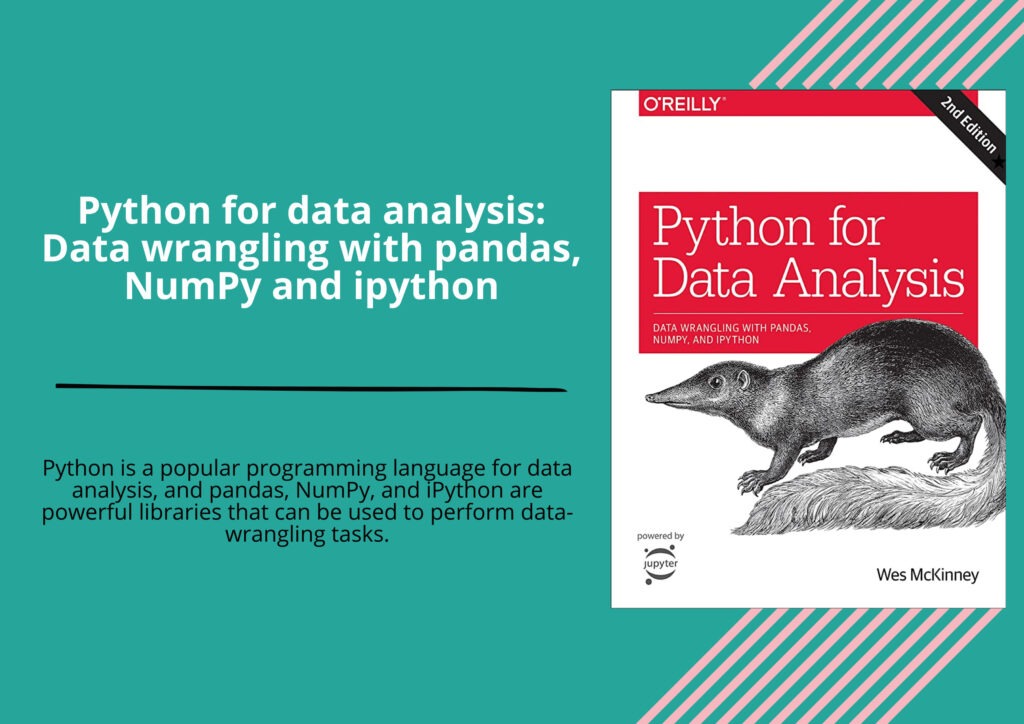
Python for data analysis: Data wrangling with pandas NumPy and ipython

Python for data analysis: Data wrangling with pandas NumPy and ipython: Python is a popular programming language for data analysis, and pandas, NumPy, and iPython are powerful libraries that can be used to perform data-wrangling tasks. Here is a brief overview of each library and how they can be used for data wrangling:

Python for data analysis: Data wrangling with pandas, NumPy and ipython
  1. Pandas: Pandas is a library for data manipulation and analysis. It provides data structures like DataFrames and Series that allow you to work with labeled and indexed data. You can use Pandas to read in data from various sources like CSV files, Excel spreadsheets, SQL databases, and more. Once you have your data loaded into a Pandas DataFrame, you can use various methods to clean and transform your data, such as dropping missing values, filtering data, merging datasets, and more.
  2. NumPy: NumPy is a library for numerical computing with Python. It provides a high-performance multidimensional array object and tools for working with these arrays. You can use NumPy to perform mathematical operations on arrays, create arrays with random data, and manipulate arrays in various ways.
  3. iPython: iPython is an interactive shell that provides a more powerful and user-friendly interface for working with Python. It provides features like auto-completion, code highlighting, and interactive plotting, which can make data analysis tasks more efficient and enjoyable.

Together, these libraries can perform a wide range of data-wrangling tasks in Python. For example, you can use Pandas to read in a CSV file, clean the data, and create a new DataFrame with just the columns you need. You can then use NumPy to perform mathematical operations on the data, such as calculating means and standard deviations. Finally, you can use iPython to visualize the data with interactive plots and explore the data more deeply.

Overall, if you are working with data in Python, becoming familiar with these libraries and how they can be used for data-wrangling tasks is highly recommended.

Download(PDF)

Mathematical Statistics with resampling and R

Mathematical Statistics with resampling and R: Mathematical statistics is the branch of statistics that deals with the theoretical underpinnings of statistical methods, including probability theory, statistical inference, hypothesis testing, and the design of experiments. Resampling is a technique used in statistics to estimate the sampling distribution of a statistic by repeatedly sampling from the original data set. R is a popular programming language and software environment used in statistics and data analysis. Resampling methods, such as bootstrapping and permutation tests, are widely used in modern statistical practice to estimate uncertainty in statistical inferences. In bootstrapping, a statistic is repeatedly calculated from resampled data sets, with replacement, to estimate the distribution of the statistic. Permutation tests involve repeatedly permuting the labels of observations in a data set to estimate the distribution of a statistic.

Mathematical Statistics with resampling and R

R provides a rich set of tools for statistical analysis and visualization, including functions for resampling methods and statistical modeling. The core R package, along with additional packages such as dplyr, ggplot2, and tidyr, provide a wide range of data manipulation, visualization, and modeling capabilities.

Some of the key topics in mathematical statistics with resampling and R include:

  1. Probability theory and distributions
  2. Sampling theory and inference
  3. Resampling methods, such as bootstrapping and permutation tests
  4. Hypothesis testing and statistical inference
  5. Linear models, including regression and ANOVA
  6. Non-parametric methods, such as kernel density estimation and rank-based tests
  7. Bayesian inference and computation
  8. Visualization of data and results using R graphics packages such as ggplot2.

Download(PDF)

Introducing Data Science: Big Data, Machine Learning, and more, using Python tools

Introducing Data Science: Big Data, Machine Learning, and more using Python tools is a comprehensive introduction to the field of data science, aimed at beginners with little or no background in statistics or programming. The book covers a wide range of topics, from data collection and cleaning to data visualization and machine learning. The book is divided into four parts. Part one covers the basics of data science, including data structures and algorithms, statistical analysis, and programming with Python.

Introducing Data Science: Big Data, Machine Learning, and more, using Python tools

Part two focuses on data collection and cleaning, covering topics such as web scraping, database management, and data preprocessing. Part three covers data visualization, exploring techniques for creating effective charts and graphs using Python and other tools. Part four focuses on machine learning, including supervised and unsupervised learning, neural networks, and deep learning. Overall, “Introducing Data Science” is an excellent resource for beginners looking to learn the basics of data science. The book is well-written, easy to understand, and covers a wide range of topics in a concise and accessible way. If you’re looking to get started with data science, this book is a great place to start.

Table of contents

1 Data science in a big data world
2 The data science process
3 Machine learning
4 Handling large data on a single computer
5 First steps in big data
6 Join the NoSQL movement
7 The rise of graph databases
8 Text mining and text analytics
9 Data visualization to the end user

Download:

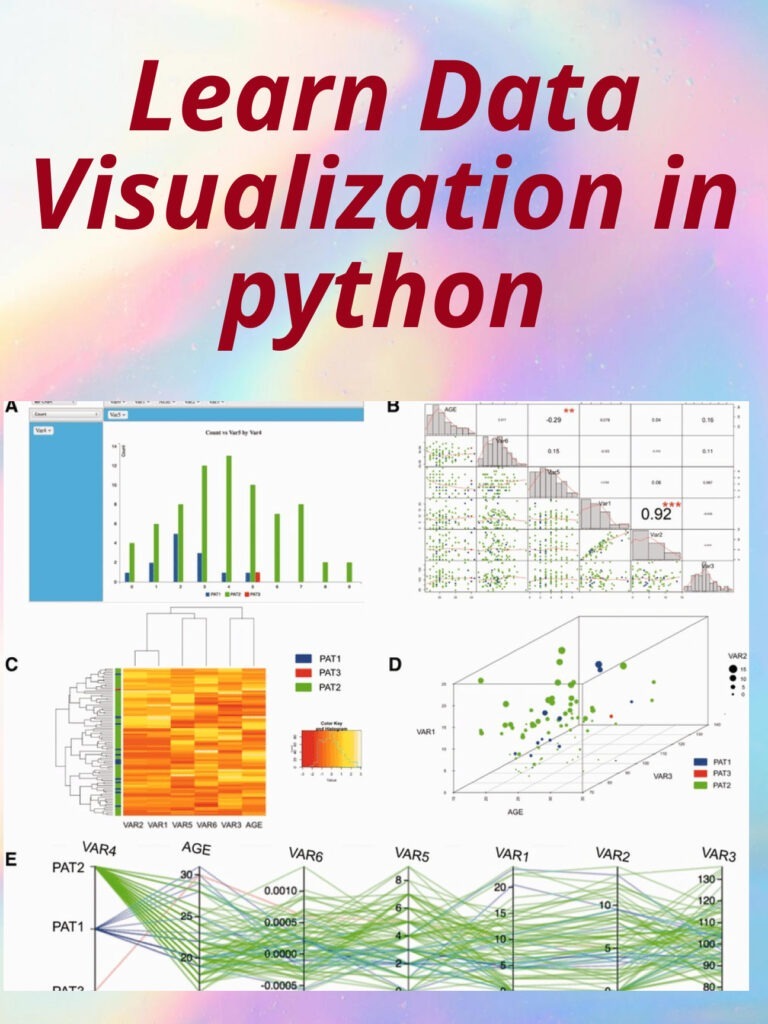
Learn Data Visualization in python

Certainly, I’d be happy to help you learn data visualization in Python! Data visualization is an essential skill for data analysis and communicating insights to others. Python offers many powerful libraries for data visualization, including Matplotlib, Seaborn, Plotly, and many more.

Learn Data Visualization in python

Here are some steps to get started:

  1. Install the necessary libraries. You can install the libraries using the pip command in the terminal or command prompt. For example, to install Matplotlib, you can type: pip install matplotlib. Similarly, you can install Seaborn, Plotly, and other libraries.
  2. Import the libraries. Once you have installed the libraries, you can import them into your Python code using the import statement. For example, to import Matplotlib, you can use the following code: import matplotlib.pyplot as plt.
  3. Load your data. Before you start visualizing your data, you need to load it into Python. You can load data from different file formats such as CSV, Excel, or JSON using libraries such as Pandas.
  4. Create your first plot. Once you have loaded your data, you can start creating visualizations. Matplotlib is a good place to start for basic plots. For example, to create a scatter plot, you can use the following code:
import matplotlib.pyplot as plt
import pandas as pd

df = pd.read_csv("mydata.csv")
plt.scatter(df["x"], df["y"])
plt.show()
  1. Customize your plot. You can customize your plot by adding labels, titles, changing colors, and more. For example, to add a title to your plot, you can use the following code:
import matplotlib.pyplot as plt
import pandas as pd

df = pd.read_csv("mydata.csv")
plt.scatter(df["x"], df["y"])
plt.title("My Scatter Plot")
plt.xlabel("X axis label")
plt.ylabel("Y axis label")
plt.show()
  1. Explore other libraries. Once you have mastered the basics of Matplotlib, you can explore other libraries such as Seaborn, Plotly, and Bokeh to create more advanced visualizations.
  2. Practice, practice, practice! The more you practice, the more comfortable you will become with data visualization in Python.

I hope this helps you get started with data visualization in Python. Good luck!

Download(PDF)

Time Series Analysis And Its Application With R

Time Series Analysis And Its Application With R: Time series analysis is a statistical technique used to analyze and model time-based data. It involves examining patterns and trends over time to identify underlying factors contributing to data changes. R is a popular programming language used for time series analysis, with numerous packages and tools available for analyzing, visualizing, and modeling time series data.

Time Series Analysis And Its Application With R

Here are some key concepts and examples of time series analysis in R:

  1. Time Series Data Time series data is a collection of observations recorded over time. It is represented by a sequence of values that are recorded at specific time intervals, such as daily, weekly, or monthly. Time series data can be univariate or multivariate, and can be analyzed using various statistical methods to identify patterns and trends.
  2. Time Series Plotting Time series data can be visualized using different types of charts such as line plots, scatter plots, and bar charts. The most common type of plot for time series data is a line plot, where the x-axis represents time and the y-axis represents the value of the data. In R, the “ggplot2” package is commonly used to create time series plots.

Here is an example of a time series plot using R:

library(ggplot2)
data <- read.csv("data.csv", header=TRUE)
ggplot(data, aes(x=Date, y=Value)) +
  geom_line()
  1. Time Series Decomposition Time series decomposition involves breaking down a time series data into its individual components: trend, seasonality, and noise. Trend is the long-term pattern of the data, seasonality refers to any periodic pattern in the data, and noise is any random variation or error. The “forecast” package in R provides a function called “decompose()” that can be used to decompose time series data.

Here is an example of time series decomposition using R:

library(forecast)
data <- read.csv("data.csv", header=TRUE)
ts_data <- ts(data$Value, start=c(2015, 1), end=c(2021, 12), frequency=12)
decomp <- decompose(ts_data)
plot(decomp)
  1. Time Series Forecasting Time series forecasting is the process of predicting future values of a time series based on its historical data. It is a crucial aspect of time series analysis and has numerous applications in finance, economics, and other fields. In R, the “forecast” package provides functions for time series forecasting, including ARIMA and exponential smoothing models.

Here is an example of time series forecasting using R:

library(forecast)
data <- read.csv("data.csv", header=TRUE)
ts_data <- ts(data$Value, start=c(2015, 1), end=c(2021, 12), frequency=12)
fit <- auto.arima(ts_data)
forecast <- forecast(fit, h=24)
plot(forecast)

In this example, we first read the data and created a time series object. We then used the “auto.arima()” function to fit an ARIMA model to the data and made a forecast for the next 24 time periods using the “forecast()” function. Finally, we plotted the forecast using the “plot()” function.

These are just a few examples of time series analysis in R. Other important topics include stationary and non-stationary time series, time series regression, and spectral analysis. R provides a wide range of tools and packages for time series analysis, making it a powerful tool for analyzing time-based data.

Download(PDF)

Data Structures Algorithms In Python


As a Python developer, you must be well-versed in data structures and algorithms. In this article, we will discuss various data structures and algorithms that you can use to improve the performance of your Python applications.

Data Structures Algorithms In Python
  1. Arrays

Arrays are a collection of items of the same data type. Python has built-in support for arrays with the array module. You can create an array by importing the array module and using the array() function. Arrays in Python are more efficient than lists because they use less memory.

  1. Linked Lists

Linked lists are data structures that consist of a collection of nodes. Each node has a value and a reference to the next node. In Python, you can implement a linked list using the LinkedList class.

  1. Stacks

Stacks are a collection of elements that are accessed in a last-in-first-out (LIFO) order. You can implement a stack in Python using a list. The append() function adds an element to the top of the stack, and the pop() function removes the top element.

  1. Queues

Queues are a collection of elements that are accessed in a first-in-first-out (FIFO) order. You can implement a queue in Python using a list. The append() function adds an element to the back of the queue, and the pop(0) function removes the front element.

  1. Trees

Trees are a collection of nodes that are connected by edges. In Python, you can implement a tree using the Tree class. Trees are used in many algorithms, such as binary search, and can be used to store hierarchical data.

  1. Binary Search

Binary search is a search algorithm that uses a divide-and-conquer approach to find a value in a sorted list. The algorithm repeatedly divides the list in half until the value is found or the list is empty.

  1. Sorting Algorithms

Sorting algorithms are used to sort a list of elements in a particular order. Python has built-in support for sorting lists with the sorted() function. There are many sorting algorithms, including bubble sort, selection sort, insertion sort, merge sort, and quicksort.

  1. Hash Tables

Hash tables are data structures that store key-value pairs. In Python, you can implement a hash table using the dict class. Hash tables are used to store data in a way that allows fast access and retrieval.

The above list is by no means exhaustive, and there are many more data structures and algorithms that you can use. It is crucial to understand the pros and cons of each data structure and algorithm to choose the right one for your application.

Download(PDF)

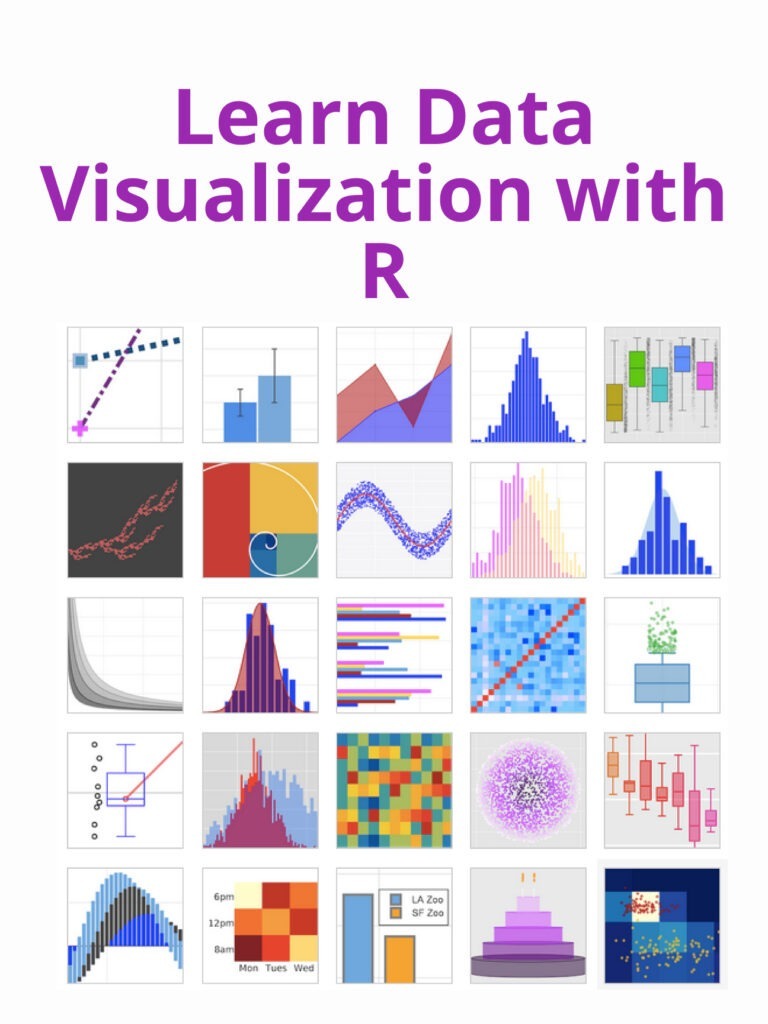
Learn Data Visualization with R

Learn Data Visualization with R: R is a popular programming language for data analysis and visualization. There are many more types of charts and graphs you can create, and R offers a wide range of tools for customizing your visualizations. Here are just a few examples of the types of data visualizations you can create with R.

Learn Data Visualization with R
  1. Scatter plot: A scatter plot is used to visualize the relationship between two variables. In R, you can create a scatter plot using the “plot” function. For example:
x <- c(1, 2, 3, 4, 5)
y <- c(2, 4, 6, 8, 10)
plot(x, y)
  1. Bar chart: A bar chart is used to compare the values of different categories. In R, you can create a bar chart using the “barplot” function. For example:
data <- c(10, 20, 30, 40, 50)
names <- c("A", "B", "C", "D", "E")
barplot(data, names.arg=names)
  1. Line chart: A line chart is used to show the trend of a variable over time. In R, you can create a line chart using the “plot” function with the “type” argument set to “l”. For example:
x <- c(1, 2, 3, 4, 5)
y <- c(2, 4, 6, 8, 10)
plot(x, y, type="l")
  1. Heat map: A heat map is used to visualize the intensity of a variable over a two-dimensional space. In R, you can create a heat map using the “heatmap” function. For example:
data <- matrix(c(1, 2, 3, 4, 5, 6, 7, 8, 9), nrow=3, ncol=3)
heatmap(data)
  1. Box plot: A box plot is used to show the distribution of a variable. In R, you can create a box plot using the “boxplot” function. For example:
data <- c(1, 2, 3, 4, 5)
boxplot(data)

Download(PDF)

Python Programming for the absolute beginner

Python Programming for the absolute beginner: If you are an absolute beginner to programming and would like to learn Python, here’s a great place to start:

Python Programming for the absolute beginner
  1. Understanding the basics: Before you start writing code in Python, it is important to understand some basic concepts of programming like data types, variables, and control structures.
  2. Setting up the environment: You need to have Python installed on your computer to start writing and executing code. You can download the latest version of Python from the official website (https://www.python.org/downloads/).
  3. Getting familiar with the syntax: Once you have Python set up, start by writing simple statements and learn the basic syntax of the language. You can use the interactive Python shell to experiment with different statements and see the results.
  4. Learning about data types: In Python, there are several built-in data types, such as numbers, strings, lists, and dictionaries. Understanding the basics of these data types is crucial for writing effective code.
  5. Working with variables: Variables are used to store values in your program. You can assign values to variables, perform operations with them, and use them in your code.
  6. Control structures: You need to understand the basics of control structures like loops and conditional statements to write effective code. Loops are used to repeat a section of code multiple times, while conditional statements allow you to specify the conditions under which a certain block of code should be executed.
  7. Functions: Functions are blocks of code that perform specific tasks. You can write your own functions and use them in your code.
  8. Modules and libraries: Python has a vast standard library and a large number of third-party modules and libraries. You can use these to add functionality to your programs and write more complex code.
  9. Practice, practice, practice: The key to becoming proficient in any programming language is practice. Write small programs, experiment with different features, and try to solve problems.
  10. Keep learning: Python is a vast and constantly evolving language. There is always something new to learn, so keep exploring and experimenting.
Python Programming for the absolute beginner

Download(PDF)

Multivariate time series analysis with R and financial applications

Multivariate time series analysis with R and financial applications: Multivariate time series analysis is the study of more than one time series over time and the relationships between them. In the context of finance, multivariate time series analysis is often used to model the relationships between different financial instruments, such as stocks, bonds, commodities, and currencies. This type of analysis is useful for identifying correlations and causal relationships between different assets, which can inform investment decisions.

Multivariate time series analysis with R and financial applications

In R, there are several packages available for multivariate time series analysis. Some popular ones include:

  • “tseries” – This package provides functions for time series analysis, including univariate and multivariate time series analysis.
  • “vars” – This package provides functions for estimating and analyzing vector autoregressive (VAR) models, which are commonly used in multivariate time series analysis.
  • “fUnitRoots” – This package provides functions for testing for unit roots in time series data, which is a necessary step in many multivariate time series analysis procedures.
  • “xts” – This package provides an extensible time series class for handling ordered observations and provides methods for time-based operations.

These packages can be used together to perform various multivariate time series analysis tasks, such as identifying relationships between financial instruments, testing for co-integration, and modeling dynamic relationships over time.

For example, you can use the “vars” package to estimate a VAR model of the returns of two stocks, and then use the “fUnitRoots” package to test for co-integration between the two stocks. If the stocks are co-integrated, you can use the VAR model to make inferences about the dynamics of the relationship between the stocks, such as the short-run and long-run effects of one stock on the other.

Download(PDF)

Introduction to computation and programming using python

Introduction to computation and programming using python: Web development, scientific computing, data analysis, artificial intelligence, and more use Python as a versatile programming language. Learning how to program with this program is easy because of its simplicity and ease of use. Here are some basic Python computation and programming tips:

Introduction to computation and programming using python
  1. Variables: In Python, you can store values in variables. For example, you can store your name in a variable named “name” like this:
name = "John Doe"
  1. Data types: Python has several built-in data types, such as integers (e.g. 1, 2, 3), floating-point numbers (e.g. 1.0, 2.5, 3.14), strings (e.g. “Hello, World!”), and more.
  2. Operators: Python supports various operators, such as arithmetic operators (+, -, *, /), comparison operators (==, !=, >, <, >=, <=), and more. For example, you can use the + operator to concatenate two strings:
first_name = "John"
last_name = "Doe"
full_name = first_name + " " + last_name
print(full_name) # Output: John Doe
  1. Control flow: In programming, control flow refers to the order in which the instructions are executed. Python provides control structures, such as if statements, for loops, and while loops, which allow you to make decisions and execute code multiple times based on certain conditions. For example, you can use a if statement to check if a number is positive or negative:
number = 10
if number > 0:
    print("Positive")
else:
    print("Negative") # Output: Positive
  1. Functions: Functions are reusable blocks of code that can accept inputs (arguments) and return outputs (results). In Python, you can define your own functions using the def keyword. For example, you can define a function that calculates the factorial of a number:
def factorial(n):
    if n == 0:
        return 1
    else:
        return n * factorial(n-1)

print(factorial(5)) # Output: 120

Thanks for checking out this brief introduction to Python computation and programming.

Download(PDF)