Mathematical Foundations of Data Science Using R

In the realm of data science, the use of mathematical foundations is paramount to extracting valuable insights and making informed decisions. R, a popular programming language for statistical computing and graphics, provides a powerful framework to explore and analyze data. This article delves into the mathematical foundations of data science using R, unraveling the key concepts and techniques that underpin this fascinating field. Whether you’re a beginner or an experienced data scientist, understanding the mathematical foundations will enhance your proficiency in using R to solve complex problems.

Understanding the Role of Mathematics in Data Science

Mathematics forms the backbone of data science, serving as the fundamental language to express, model, and analyze data. It provides a systematic approach to interpreting patterns, relationships, and trends in data. By leveraging mathematical concepts, data scientists can gain a deeper understanding of the underlying structure and behavior of datasets.

Mathematical Foundations of Data Science Using R

Mathematical Foundations of Data Science Using R: Exploring the Basics

Descriptive Statistics: Summarizing Data

Descriptive statistics offers a concise summary of data, providing key measures that capture central tendencies and variations. In R, you can easily compute descriptive statistics using functions like mean(), median(), and sd(). These functions enable you to extract valuable information about the distribution, central values, and spread of your data.

Probability Theory: Quantifying Uncertainty

Probability theory plays a crucial role in data science, as it quantifies uncertainty and enables statistical inference. With R, you can perform probability calculations, simulate random variables, and estimate probabilities using functions such as distrib() and rnorm(). Understanding probability distributions and their parameters empowers data scientists to make probabilistic predictions and assess the likelihood of specific outcomes.

Linear Algebra: Analyzing Relationships

Linear algebra provides a powerful toolkit to analyze relationships between variables in a dataset. In R, you can manipulate matrices and vectors effortlessly, facilitating operations such as matrix multiplication, transposition, and eigenvalue decomposition. By leveraging linear algebra, data scientists can uncover hidden patterns, perform dimensionality reduction, and build predictive models.

Statistical Modeling: Making Inferences

Statistical modeling allows data scientists to make inferences and draw conclusions based on observed data. R offers a wide array of functions and packages for statistical modelings, such as linear regression (lm()), logistic regression (glm()), and time series analysis (arima()). These tools enable you to fit models, assess their goodness-of-fit, and extract meaningful insights from your data.

Machine Learning: Unleashing the Power of Algorithms

Machine learning algorithms are at the forefront of modern data science, enabling the extraction of intricate patterns and predictive models from vast amounts of data. R provides an extensive collection of machine-learning libraries, including caret, randomForest, and xgboost, which encompass a wide range of algorithms such as decision trees, random forests, and gradient boosting. By combining mathematical foundations with machine learning techniques, data scientists can unlock the full potential of their datasets.

Mathematical Foundations of Data Science Using R: Frequently Asked Questions

1. What are the prerequisites for learning data science with R?

To embark on the journey of data science with R, having a basic understanding of mathematics, statistics, and programming concepts is beneficial. Familiarity with linear algebra, probability theory, and statistical inference will provide a solid foundation. Additionally, learning the basics of R programming, including data manipulation, visualization, and statistical modeling, is essential for effectively utilizing the mathematical foundations of data science.

2. How can I enhance my proficiency in R programming for data science?

To enhance your proficiency in R programming for data science, consider exploring online resources, such as tutorials, courses, and practice exercises. Engaging in hands-on projects and participating in data science communities can also broaden your knowledge and expose you to real-world applications. Moreover, actively applying the mathematical foundations of data science in practical scenarios will solidify your understanding and sharpen your skills.

3. Are there any recommended books for learning the mathematical foundations of data science using R?

Yes, several books offer comprehensive guidance on the mathematical foundations of data science using R. Some highly recommended titles include:

  • “Mathematical Foundations of Data Science” by John E. Hopcroft and Ravindran Kannan
  • “Hands-On Programming with R” by Garrett Grolemund
  • “Introduction to Statistical Learning with Applications in R” by Gareth James, Daniela Witten, Trevor Hastie, and Robert Tibshirani

These books delve into the mathematical concepts and techniques essential for data science, accompanied by practical examples and exercises in R.

4. How can I leverage R for data visualization and exploratory data analysis?

R provides a rich ecosystem of packages for data visualization and exploratory data analysis. Packages like ggplot2 and plotly offer powerful tools for creating visually appealing and informative plots. By leveraging these packages, you can generate histograms, scatter plots, bar charts, and more to gain insights into the underlying patterns and relationships within your data.

Conclusion

The mathematical foundations of data science using R are indispensable for extracting insights and making informed decisions from data. By understanding and leveraging concepts from descriptive statistics, probability theory, linear algebra, statistical modeling, and machine learning, data scientists can unlock the full potential of their datasets. Continuously expanding your knowledge, practicing your skills, and staying up to date with advancements in data science will pave the way for success in this exciting field.

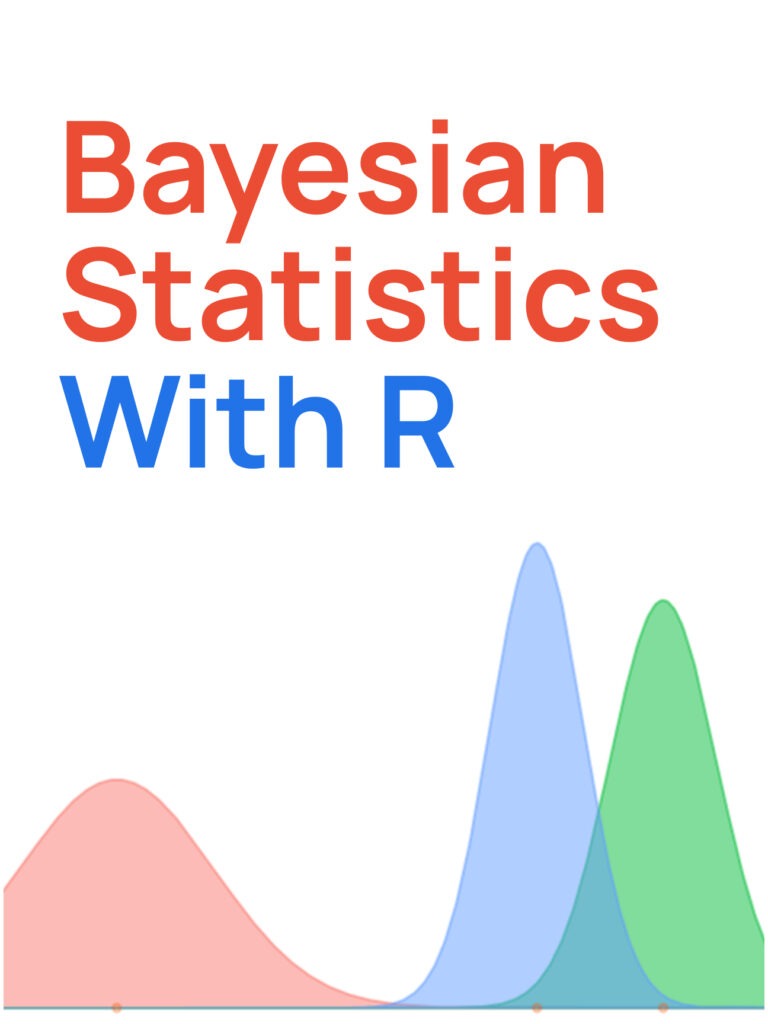
Bayesian Statistics With R

Bayesian statistics is a branch of statistics that uses Bayes’ theorem to update probabilities of hypotheses based on new data. R is a popular programming language for statistical computing and graphics, and it has many packages that make Bayesian statistics easy to use.

Bayesian Statistics With R

Here are some steps to get started with Bayesian statistics in R:

  1. Install the necessary packages: There are several R packages available for Bayesian statistics, including “rstan” and “brms”. To install these packages, run the following command in R console:
install.packages("rstan")
install.packages("brms")
  1. Load the packages: After installing the packages, load them into your R session using the following command:
library(rstan)
library(brms)
  1. Define your model: In Bayesian statistics, you need to define a prior distribution and a likelihood function to obtain the posterior distribution. For example, let’s say you want to estimate the mean of a normal distribution with unknown variance. You can define a prior distribution for the mean and the variance, and a likelihood function that is the product of the normal density functions for each observation. Here is an example model using the brms package:
my_model <- brm(
  data = my_data,
  formula = y ~ 1,
  prior = c(prior(normal(0, 1), class = Intercept), 
            prior(normal(0, 1), class = sigma)),
  family = gaussian()
)

In this model, “y” is the response variable, “my_data” is the data frame that contains the data, “Intercept” is the mean of the normal distribution, and “sigma” is the standard deviation of the normal distribution.

  1. Fit the model: To fit the model, use the following command:
fit <- sampling(my_model)

This command uses Markov chain Monte Carlo (MCMC) to obtain samples from the posterior distribution.

  1. Check the results: After fitting the model, you can check the results using the following commands:
summary(fit)
plot(fit)

These commands provide summary statistics and plots of the posterior distribution, which can help you understand the results of your analysis.

These are just the basic steps to get started with Bayesian statistics in R. There are many more options and techniques available, depending on the complexity of your problem and the specific package you are using. It’s recommended to refer to the documentation of the packages and seek help from a statistician or data scientist if needed.

Data Science Projects with Python

Data science is a rapidly growing field that combines statistics, mathematics, and computer science to extract insights and knowledge from large sets of data. Python, with its rich ecosystem of libraries and tools, has become the go-to programming language for data science projects. In this article, we will explore various data science projects that you can undertake using Python.

Introduction to Data Science

Data science is an interdisciplinary field that involves extracting meaningful insights and knowledge from data. It combines various techniques such as statistical analysis, machine learning, and data visualization to understand and interpret data. Python provides a powerful and flexible platform for data scientists to perform these tasks efficiently.

Data Science Projects with Python

Setting Up the Python Environment

Before diving into data science projects, it is essential to set up the Python environment. Install Python and popular libraries such as NumPy, Pandas, and Matplotlib. These libraries offer a wide range of functionalities for data manipulation, analysis, and visualization.

Exploratory Data Analysis

Exploratory Data Analysis (EDA) is a crucial step in any data science project. It involves understanding the data, identifying patterns, and discovering insights. Python provides libraries like Pandas and Seaborn, which offer various functions and visualizations to perform EDA effectively.

Data Visualization

Data visualization is a powerful tool for presenting complex data in a more accessible and understandable format. Python’s Matplotlib and Seaborn libraries allow you to create stunning visualizations, including bar plots, line graphs, scatter plots, and heatmaps, to explore and communicate data effectively.

Machine Learning Algorithms

Machine learning is a core component of data science. Python provides libraries like scikit-learn and TensorFlow, which offer a wide range of machine learning algorithms. You can use these libraries to build predictive models, perform classification, regression, and clustering tasks, and evaluate model performance.

Natural Language Processing

Natural Language Processing (NLP) deals with the interaction between computers and human language. Python’s NLTK and spaCy libraries provide tools and techniques to process and analyze textual data. NLP can be used for sentiment analysis, text classification, and information extraction tasks.

Deep Learning

Deep learning is a subset of machine learning that focuses on neural networks and their architectures. Python’s TensorFlow and Keras libraries are widely used for building and training deep learning models. Deep learning is employed in image recognition, natural language processing, and many other domains.

Time Series Analysis

Time series analysis involves studying data points collected over a specific time period. Python’s Pandas library offers functionalities for manipulating and analyzing time series data. You can use time series analysis to forecast future trends, detect anomalies, and make data-driven decisions.

Recommender Systems

Recommender systems are widely used in e-commerce, entertainment, and content platforms. Python’s Surprise library provides collaborative filtering algorithms for building recommender systems. These systems analyze user behavior and recommend items based on their preferences.

Big Data Analytics

As data sizes continue to grow, handling big data has become a significant challenge. Python’s PySpark library provides an interface for Apache Spark, a powerful distributed computing framework. With PySpark, you can process and analyze large-scale datasets efficiently.

Conclusion

Python is an excellent choice for data science projects due to its simplicity, versatility, and extensive library support. In this article, we explored various data science projects that can be undertaken using Python, including exploratory data analysis, data visualization, machine learning, natural language processing, deep learning, time series analysis, recommender systems, and big data analytics. By leveraging the power of Python and its associated libraries, you can unlock valuable insights from your data and make informed decisions.

FAQs

  1. What is data science? Data science is an interdisciplinary field that combines statistics, mathematics, and computer science to extract insights and knowledge from large sets of data.
  2. Why is Python widely used in data science? Python provides a rich ecosystem of libraries and tools specifically designed for data science, making it an ideal choice for data analysis and machine learning tasks.
  3. What are some popular Python libraries for data science? Popular Python libraries for data science include NumPy, Pandas, Matplotlib, scikit-learn, TensorFlow, NLTK, and PySpark.
  4. Can I perform deep learning tasks using Python? Yes, Python offers libraries like TensorFlow and Keras, which are widely used for building and training deep learning models.
  5. How can I get started with data science using Python? To get started with data science using Python, you can install Python and explore online tutorials and resources that cover topics such as data manipulation, visualization, and machine learning.

Download: Data Science With Python From Scratch

The R Software: Fundamentals of Programming and Statistical Analysis

The R software is a powerful tool widely used for programming and statistical analysis in various fields. Its extensive libraries and user-friendly interface make it the preferred choice for data scientists, statisticians, and researchers. In this article, we will delve into the fundamentals of R software, exploring its programming capabilities and highlighting its significance in statistical analysis.

What is R software?

R is a programming language and software environment designed for statistical computing and graphics. It was developed by Ross Ihaka and Robert Gentleman at the University of Auckland, New Zealand in the early 1990s. R provides a wide range of statistical and graphical techniques, making it an indispensable tool for data analysis and visualization.

The R Software Fundamentals of Programming and Statistical Analysis

Installing and setting up R

To get started with R, you need to install it on your computer. Visit the official R website (https://www.r-project.org/) and download the appropriate version for your operating system. Once installed, you can launch R and start working with its interactive console or use an integrated development environment (IDE) such as RStudio for a more comprehensive programming experience.

Basic syntax and data structures

Like most programming languages, R has its syntax and data structures. Understanding these fundamentals is crucial for writing effective R code. R uses a combination of functions, operators, and data types to perform computations and manipulate data. Some commonly used data structures in R include vectors, matrices, data frames, and lists.

Control structures and functions

Control structures allow you to control the flow of execution in your R programs. They include conditional statements (if-else, switch), loops (for, while), and functions. Functions are essential building blocks in R, enabling you to modularize your code and reuse it efficiently. R also has a vast collection of built-in functions, and you can create your own custom functions to meet specific requirements.

Data manipulation and visualization

R provides powerful tools for data manipulation and visualization. With libraries like dplyr and tidyr, you can efficiently clean, transform, and reshape your data. Additionally, R offers various packages for creating high-quality visualizations, including ggplot2 for static plots and plotly for interactive visualizations. These capabilities make R an excellent choice for exploratory data analysis and data visualization.

Statistical analysis with R

One of the primary strengths of R is its extensive support for statistical analysis. R provides a comprehensive suite of functions and packages for conducting various statistical tests, hypothesis testing, regression analysis, time series analysis, and much more. Whether you’re working with small datasets or big data, R offers efficient and reliable statistical tools to derive meaningful insights.

Advanced topics in R programming

Once you grasp the fundamentals of R programming, you can explore advanced topics to enhance your skills further. Some advanced areas include object-oriented programming in R, parallel computing, integrating R with other languages, such as C++ or Python, and developing packages for sharing your code with others. These advanced concepts enable you to tackle complex projects and push the boundaries of what you can achieve with R.

Conclusion

The R software is an invaluable asset for programming and statistical analysis. Its versatility, extensive libraries, and active user community make it a top choice for data scientists and statisticians worldwide. Mastering the fundamentals of R programming and statistical analysis can unlock a world of possibilities in data exploration, modeling, and inference.

FAQs

1. Is R software free to use? Yes, R is an open-source software released under the GNU General Public License. It is freely available for download and use.

2. Can I use R for machine learning? Absolutely! R provides various packages, such as caret and tensorflow, that support machine learning tasks, allowing you to build and train models efficiently.

3. Are there online resources to learn R programming? Yes, there are plenty of online tutorials, courses, and documentation available to learn R programming. Websites like DataCamp, Coursera, and RStudio provide comprehensive learning materials for beginners and advanced users.

4. Can I create interactive visualizations in R? Yes, R offers packages like plotly and shiny, which allow you to create interactive visualizations and build web applications with R.

5. How can I contribute to the R community? If you are passionate about R, you can donate by developing R packages, participating in forums and mailing lists, reporting bugs, or sharing your knowledge through blogs and tutorials.

Download: https://pyoflife.com/data-analysis-and-prediction-algorithms-with-r/

Text Mining With R

In the world of data analysis and information extraction, text mining has emerged as a powerful technique. It allows us to extract valuable insights and patterns from unstructured text data. When it comes to text mining, R is a popular programming language due to its extensive libraries and packages. In this article, we will explore the concept of text mining with R and focus on the tidy approach, which emphasizes simplicity and consistency in data processing.

The Basics of Text Mining

Text mining involves extracting meaningful information from text data. It enables us to uncover patterns, sentiments, and relationships that are hidden within large volumes of text. With the rise of the internet and social media, the amount of textual data generated has increased exponentially, making text mining an essential tool for businesses and researchers.

Text Mining With R
Text Mining With R

Preprocessing Text Data

Before we can perform text mining tasks, such as sentiment analysis or topic modeling, we need to preprocess the text data. Preprocessing involves transforming raw text into a format that is suitable for analysis. Common preprocessing steps include:

  1. Tokenization: Breaking the text into individual words or tokens.
  2. Normalization: Converting all text to lowercase and removing punctuation.
  3. Stopword Removal: Eliminating common words that do not carry significant meaning.
  4. Stemming and Lemmatization: Reducing words to their root form for better analysis.

By following these preprocessing steps, we can clean the text data and prepare it for further analysis.

The Tidy Approach in Text Mining

The tidy approach, popularized by the “tidyverse” ecosystem in R, emphasizes consistency and simplicity in the data processing. It provides a set of tools and techniques that enable efficient and structured data manipulation. When applied to text mining, the tidy approach offers several advantages:

1. Tidy Data Structure

The tidy data structure, introduced by Hadley Wickham, promotes a consistent format where each variable has its own column, each observation has its own row, and each value has its own cell. This structure facilitates easier data manipulation and analysis.

2. The “dplyr” Package

The “dplyr” package, a core component of the tidyverse, provides a grammar of data manipulation. It offers intuitive functions for filtering, selecting, arranging, and summarizing data. By leveraging the power of “dplyr,” we can efficiently handle large text datasets.

3. The “tidytext” Package

The “tidytext” package extends the tidy approach to text mining. It provides functions for transforming text data into a tidy format, making it easier to perform analysis and visualization. The package also includes a collection of text mining techniques, such as term frequency-inverse document frequency (TF-IDF) and sentiment analysis.

Text Mining Techniques

Once we have preprocessed the text data and adopted the tidy approach, we can apply various text mining techniques. Let’s explore some common techniques used in text mining:

1. Word Frequency Analysis

Word frequency analysis involves counting the occurrence of words in a text corpus. It helps us identify the most frequent words or terms, which can provide insights into the main themes or topics present in the text. R offers several packages, such as “tm” and “tidytext,” for conducting word frequency analysis.

2. Sentiment Analysis

Sentiment analysis aims to determine the sentiment or emotion expressed in a piece of text. By analyzing the sentiment of customer reviews, social media posts, or product feedback, businesses can gain valuable insights into customer opinions and preferences. The “tidytext” package provides functions for sentiment analysis, including sentiment lexicons and sentiment scoring.

3. Topic Modeling

Topic modeling is a technique used to discover latent topics or themes in a collection of documents. It helps us understand the underlying structure and patterns within the text data. The “topicmodels” package in R offers algorithms such as Latent Dirichlet Allocation (LDA) for performing topic modeling.

4. Named Entity Recognition

Named Entity Recognition (NER) is the process of identifying and classifying named entities, such as people, organizations, or locations, in text data. NER is useful in various applications, such as information extraction, question answering, and text summarization. The “openNLP” package in R provides tools for performing NER.

FAQs about Text Mining With R: A Tidy Approach

FAQ 1: What is text mining?

Text mining is a technique used to extract valuable insights and patterns from unstructured text data. It involves analyzing and processing large volumes of text to uncover hidden information.

FAQ 2: Why is R popular for text mining?

R is popular for text mining due to its extensive libraries and packages specifically designed for data analysis and text processing. The tidyverse ecosystem in R provides a consistent and efficient approach to text mining.

FAQ 3: What is the tidy approach in text mining?

The tidy approach emphasizes simplicity and consistency in data processing. It promotes a tidy data structure, leverages the “dplyr” package for efficient data manipulation, and utilizes the “tidytext” package for text-specific analysis.

FAQ 4: What are some common text mining techniques?

Common text mining techniques include word frequency analysis, sentiment analysis, topic modeling, and named entity recognition. These techniques help uncover patterns, sentiments, and themes within text data.

FAQ 5: How can text mining benefit businesses?

Text mining can benefit businesses by providing valuable insights into customer opinions, preferences, and trends. It enables businesses to make data-driven decisions, improve products and services, and enhance customer satisfaction.

FAQ 6: Are there any limitations to text mining?

Text mining has some limitations. It can be challenging to handle noisy or unstructured text data. Additionally, text mining techniques heavily rely on the quality and relevance of the text corpus.

Conclusion

Text mining with R using a tidy approach is a powerful method for extracting insights and patterns from text data. By following the preprocessing steps and leveraging the tools provided by the tidyverse ecosystem, analysts and researchers can efficiently process and analyze large volumes of text. Whether it’s understanding customer sentiments, identifying key topics, or extracting named entities, text mining with R: A Tidy Approach equips us with the necessary techniques to derive valuable insights from text.

Download: https://pyoflife.com/an-introduction-to-applied-multivariate-analysis-with-r/

Programming for Computations – Python

In today’s digital age, the ability to perform numerical simulations and computations is of utmost importance in various fields. From physics and engineering to finance and data analysis, professionals rely on numerical simulations to model complex systems and solve intricate problems. Python, a versatile programming language, provides a robust platform for performing such computations with ease and efficiency. In this article, we will delve into the world of numerical simulations with Python and explore its applications, features, and benefits.

What is Python?

Python is a high-level, interpreted programming language that was created by Guido van Rossum in the late 1980s. It is known for its simplicity and readability, making it an excellent choice for beginners and experienced programmers alike. Python’s syntax allows developers to write code that resembles plain English, enhancing the overall readability and reducing the time required to understand and maintain the code.

Programming for Computations - Python

Programming for Computations – Python Download:


Why Choose Python for Numerical Simulations?

Python’s extensive libraries and frameworks make it an ideal language for numerical simulations. Let’s explore some of the key reasons why Python is preferred for computational tasks:

1. Simplicity and Readability

Python’s clean and concise syntax makes it easy to write and understand complex numerical algorithms. The code readability allows researchers and scientists to focus more on the problem at hand rather than getting lost in intricate programming details.

2. Rich Ecosystem of Libraries

Python boasts a vast collection of libraries that cater specifically to numerical computing. Libraries such as NumPy, SciPy, and Pandas provide efficient data structures and algorithms for performing mathematical operations, statistical analysis, and data manipulation.

3. Interactive Development Environment

Python offers interactive development environments (IDEs) such as Jupyter Notebook and Spyder, which facilitate the exploration and visualization of data during the development process. These environments enable researchers to iteratively refine their simulations and gain deeper insights into the underlying phenomena.

4. Cross-Platform Compatibility

Python is a cross-platform language, meaning that the code written on one operating system can seamlessly run on another. This feature is particularly useful when collaborating with other researchers or deploying simulations on different systems.

5. Integration Capabilities

Python can easily integrate with other programming languages, allowing researchers to leverage existing codebases or utilize specialized libraries for specific tasks. This integration capability enhances the flexibility and extensibility of Python for numerical simulations.

Programming for Computations – Python: A Gentle Introduction

Programming for Computations – Python is a comprehensive guide that introduces readers to the world of numerical simulations using the Python programming language. The book, authored by Svein Linge and Hans Petter Langtangen, provides a hands-on approach to learning computational techniques and their applications.

The book covers various topics, including mathematical modeling, numerical differentiation, integration, solving linear and nonlinear equations, and more. Each topic is accompanied by practical examples and exercises to reinforce the concepts and enhance the reader’s understanding.

Programming for Computations – Python is an invaluable resource for students, researchers, and professionals seeking to develop their computational skills and apply them to real-world problems. The gentle introduction and comprehensive coverage make it suitable for both beginners and experienced programmers.

FAQs

1. What are the prerequisites for learning Programming for Computations – Python?

To effectively grasp the concepts covered in Programming for Computations – Python, a basic understanding of programming concepts and mathematics is recommended. Familiarity with Python syntax and operations will also be beneficial.

2. Can I use Programming for Computations – Python for self-study?

Absolutely! Programming for Computations – Python is designed to be a self-contained resource, allowing individuals to learn at their own pace. The book provides clear explanations and exercises, making it suitable for self-study.

3. Are there any online resources to supplement Programming for Computations – Python?

Yes, the authors provide additional resources, including code examples, supplementary materials, and a discussion forum, on the official website. These resources can further enhance the learning experience and provide a platform for engaging with the community.

4. Can Programming for Computations – Python be used in academic settings?

Yes, Programming for Computations – Python is widely adopted in academic settings, including universities and research institutions. Its comprehensive coverage and practical examples make it an excellent resource for students and researchers in various fields.

5. Does Programming for Computations – Python cover advanced topics?

While Programming for Computations – Python primarily focuses on introducing the fundamental concepts, it also touches upon more advanced topics such as partial differential equations and Monte Carlo methods. This allows readers to build a strong foundation and explore advanced techniques in the future.

Download(PDF)

Introduction to Statistical Learning with Applications in R

Introduction to Statistical Learning with Applications in R: In the world of data analysis and machine learning, statistical learning plays a crucial role in extracting insights and making predictions from data. One popular tool for statistical learning is the programming language R, which provides a wide range of powerful libraries and packages. In this article, we will delve into the concept of statistical learning and explore its applications using R.

What is Statistical Learning?

Statistical learning is a field that encompasses techniques and methodologies for extracting patterns, making predictions, and gaining insights from data. It involves using statistical models, algorithms, and computational tools to analyze and interpret data. The goal of statistical learning is to understand the relationship between the input variables (predictors) and the output variable (response) and to develop models that accurately predict the response from the predictors.

Introduction to Statistical Learning with Applications in R

Introduction to Statistical Learning with Applications in R


Download:

Types of Statistical Learning Techniques

There are two main types of statistical learning techniques: supervised learning and unsupervised learning.

Supervised Learning

Supervised learning involves training a model using labeled data, where the response variable is known. It aims to learn a mapping function from the input variables to the output variable. The two fundamental types of supervised learning are regression and classification.

Regression

Regression analysis is used when the response variable is continuous or numeric. It helps in understanding and predicting the relationship between the predictors and the continuous response variable. Regression models estimate the parameters that best fit the data, allowing us to make predictions for new observations.

Classification

Classification is applied when the response variable is categorical or discrete. It focuses on classifying observations into predefined categories or classes based on the predictor variables. Classification models learn decision boundaries to assign new observations to the correct class.

Unsupervised Learning

Unsupervised learning deals with unlabeled data, where the response variable is unknown. It aims to discover patterns, structures, and relationships in the data without any predefined categories. The two primary unsupervised learning techniques are clustering and dimensionality reduction.

Clustering

Clustering is the process of grouping similar observations based on their similarity or distance metrics. It helps in identifying natural clusters or segments within the data. Clustering algorithms assign data points to different clusters, enabling the exploration of underlying patterns and similarities.

Dimensionality Reduction

Dimensionality reduction is employed when the data has a high number of variables or features. It aims to reduce the dimensionality of the data while preserving its essential characteristics. Dimensionality reduction techniques transform the original features into a lower-dimensional space, making it easier to visualize and analyze the data.

Model Evaluation and Selection

After developing statistical learning models, it is essential to evaluate their performance and select the most appropriate one. Model evaluation techniques, such as cross-validation, help estimate the model’s predictive accuracy on unseen data. Cross-validation involves splitting the data into training and testing sets and repeatedly evaluating the model’s performance on different partitions.

Introduction to Statistical Learning with Applications in R Packages

R is a widely used programming language and environment for statistical computing and graphics. It offers a vast ecosystem of packages specifically designed for statistical learning and data analysis. Some popular R packages for statistical learning include:

  • caret: Provides a unified interface for training and evaluating various machine learning models.
  • glmnet: Implements regularization methods for linear regression and classification models.
  • randomForest: Constructs random forests, an ensemble learning technique for regression and classification.
  • cluster: Implements clustering algorithms for unsupervised learning.
  • pcaMethods: Offers methods for principal component analysis and other dimensionality reduction techniques.

These packages, along with many others, provide powerful tools for implementing statistical learning techniques in R.

Hands-on Example: Regression Analysis in R

To demonstrate the application of statistical learning in R, let’s consider a hands-on example of regression analysis. We will use a dataset that contains information about house prices and various predictors, such as the number of bedrooms, square footage, and location. The goal is to build a regression model that can predict house prices based on these predictors.

Hands-on Example: Classification in R

In another example, let’s explore the application of statistical learning in classification using R. Suppose we have a dataset with customer information, including their demographics, purchase history, and whether they churned or not. The objective is to develop a classification model that can predict whether a customer is likely to churn or not based on these variables.

Hands-on Example: Clustering in R

Next, we will delve into the application of clustering techniques in R. Suppose we have a dataset with customer transaction data, including their purchase history and spending patterns. We can use clustering algorithms in R to segment customers into distinct groups based on their purchasing behavior.

Hands-on Example: Dimensionality Reduction in R

Lastly, let’s explore dimensionality reduction techniques in R. Suppose we have a dataset with high-dimensional features, such as genetic data with thousands of variables. We can employ dimensionality reduction techniques in R to reduce the dimensionality of the data and extract the most important features.

Cross-Validation and Model Selection in R

In addition to building models, cross-validation plays a vital role in assessing the models’ performance and selecting the best one. R provides various cross-validation techniques, such as k-fold cross-validation and leave-one-out cross-validation, to estimate the model’s predictive accuracy. These techniques help in determining the optimal hyperparameters and selecting the most suitable model for the given data.

FAQs

  1. What is the difference between supervised and unsupervised learning?
    • Supervised learning uses labeled data, while unsupervised learning deals with unlabeled data.
  2. Can I perform statistical learning in R without prior programming experience?
    • Although programming experience is beneficial, R provides a user-friendly environment for statistical learning, making it accessible to beginners.
  3. How can I evaluate the performance of a statistical learning model?
    • Model evaluation techniques, such as cross-validation, help assess the model’s performance on unseen data.
  4. Are there any prerequisites for learning statistical learning with R?
    • Basic knowledge of statistics and familiarity with R programming concepts are helpful but not mandatory.
  5. Where can I access further resources to enhance my understanding of statistical learning in R?
    • There are numerous online tutorials, books, and courses available that cover statistical learning in R. You can also refer to the documentation and examples provided by R package authors.

Download (PDF)

Functional Programming in R

Functional Programming in R is a powerful approach that allows programmers to harness the full potential of data manipulation. By adopting functional programming principles, developers can write clean, concise, and scalable code that is easy to understand and maintain. In this article, we will explore the key concepts of functional programming in R, its benefits, and how it can revolutionize your data analysis and manipulation workflows.

What is Functional Programming in R?

Functional Programming is a programming paradigm that treats computation as the evaluation of mathematical functions and avoids changing state and mutable data. In the context of R, functional programming emphasizes the use of functions as first-class objects, allowing for higher-order functions, currying, and the composition of functions.

Functional Programming in R

Functional Programming in R

Download:

Why Choose Functional Programming?

Functional Programming in R offers several advantages over imperative programming paradigms. Firstly, it promotes code modularity and reusability by encapsulating logic within functions. This enables developers to write more maintainable and testable codebases. Additionally, functional programming encourages the use of pure functions, which do not have side effects and always produce the same output for a given set of inputs. This predictability simplifies debugging and enhances code reliability.

Exploring the Foundations of Functional Programming

Functional Programming Constructs in R

In R, functional programming can be achieved through various constructs and idioms. Let’s explore some of the key components:

Functions as First-Class Objects

In functional programming, functions are treated as first-class objects, meaning they can be assigned to variables, passed as arguments to other functions, and returned as values. This flexibility allows for the creation of higher-order functions, which accept other functions as arguments or return functions as results.

Anonymous Functions (Lambda Functions)

Anonymous functions, also known as lambda functions, are functions without a formal name. They can be defined on the fly and are particularly useful in situations where a function is required as an argument to another function or where a short, one-time function is needed.

Higher-Order Functions

Higher-order functions are functions that operate on other functions, either by taking them as arguments or by returning them as results. These functions provide a level of abstraction and enable developers to write more concise and expressive code.

Map, Filter, and Reduce

The trio of map, filter, and reduce functions are fundamental tools in functional programming. They allow for concise and elegant manipulation of data collections, such as lists or vectors. The map function applies a given function to each element of a collection, producing a new collection with the results. Filter, on the other hand, selects elements from a collection based on a given condition. Reduce combines the elements of a collection into a single value by applying a binary operation successively.

Conclusion

Functional Programming offers a paradigm shift in the way we approach data manipulation and analysis. By leveraging the power of functions, higher-order functions, and functional constructs, developers can unlock new levels of productivity and code quality.

Frequently Asked Questions

FAQ 1: What are the advantages of using functional programming with R?

It offers several advantages, including code modularity, reusability, and improved reliability. By leveraging pure functions and avoiding mutable data, developers can write more maintainable code that is easier to test and debug.

FAQ 2: Can I use functional programming in R for data analysis?

Absolutely! It is particularly well-suited for data analysis and manipulation tasks. Functional constructs like map, filter, and reduce provide powerful tools for transforming and summarizing data, making it easier to derive insights and perform complex calculations.

FAQ 3: Are there any performance implications when using functional programming in R?

While functional programming can introduce some overhead compared to imperative approaches, the performance impact is often negligible. R’s built-in optimization capabilities, combined with the vectorized nature of functional constructs, mitigate any potential performance drawbacks.

FAQ 4: Can I mix functional programming with other programming paradigms in R?

Certainly! R allows for a mix of programming paradigms, and it’s common to combine functional programming with imperative or object-oriented approaches. Leveraging the strengths of each paradigm can result in more flexible and efficient code.

Download(PDF)

Download: R for Data Analysis in easy steps: R Programming Essentials

The Statistics and Calculus with Python Workshop

Welcome to our comprehensive guide on “The Statistics and Calculus with Python Workshop.” In this workshop, we will delve into the fascinating world of statistics and calculus and explore how Python, a powerful programming language, can be used to analyze and solve complex mathematical problems. Whether you’re a beginner looking to develop your skills or an experienced programmer seeking to enhance your mathematical proficiency, this workshop will provide you with the knowledge and tools you need to excel. Let’s dive in!

The Statistics and Calculus with Python Workshop: An Overview

What is the Statistics and Calculus with Python Workshop?

The Statistics and Calculus with Python Workshop is an immersive learning experience designed to teach participants the fundamentals of statistics and calculus using the Python programming language. Through a combination of theoretical concepts, practical examples, and hands-on coding exercises, participants will gain a deep understanding of key statistical and calculus principles and develop the ability to apply them to real-world problems.

The Statistics and Calculus with Python Workshop

Download:

Who can benefit from this workshop?

This workshop is suitable for a wide range of individuals, including students, researchers, data analysts, and professionals from various fields. Whether you’re interested in data science, finance, engineering, or any other domain where mathematical analysis plays a crucial role, this workshop will equip you with the skills to leverage the power of Python for statistical and calculus computations.

Key Learning Objectives

During the Statistics and Calculus with Python Workshop, participants will:

  1. Understand the foundational concepts of statistics and calculus.
  2. Learn how to use Python libraries, such as NumPy and SciPy, for statistical analysis.
  3. Explore different calculus techniques, including differentiation and integration, using Python.
  4. Apply statistical and calculus principles to solve real-world problems.
  5. Gain hands-on experience through coding exercises and projects.

The Importance of Statistics and Calculus

Why are statistics and calculus important?

Statistics and calculus are fundamental branches of mathematics that have far-reaching applications in various fields. They provide tools and techniques for analyzing data, making predictions, and solving complex problems. Whether you’re analyzing market trends, designing experiments, modeling physical systems, or optimizing algorithms, a solid understanding of statistics and calculus is essential.

How can Python enhance statistical and calculus analysis?

Python is a versatile programming language that offers a rich ecosystem of libraries and tools for data analysis and scientific computing. By leveraging Python’s extensive libraries, such as NumPy, SciPy, and pandas, you can perform sophisticated statistical computations and visualize data with ease. Python’s intuitive syntax and vast community support make it an ideal choice for statistical and calculus analysis.

Workshop Curriculum

Part 1: Introduction to Statistics

In this section of the workshop, we will lay the foundation of statistical analysis and explore various concepts and techniques. Through a combination of theoretical explanations and practical examples, participants will gain a solid understanding of statistical measures, probability distributions, hypothesis testing, and more.

Descriptive Statistics

Descriptive statistics involves summarizing and describing data to gain insights and make informed decisions. We will cover measures such as mean, median, mode, variance, and standard deviation.

Probability Distributions

Probability distributions provide a mathematical representation of uncertain events. We will explore common distributions, such as the normal distribution, the binomial distribution, and the exponential distribution, and learn how to work with them in Python.

Hypothesis Testing

Hypothesis testing is a statistical method used to make inferences about a population based on sample data. We will discuss hypothesis formulation, significance levels, p-values, and conduct hypothesis tests using Python.

Part 2: Calculus Fundamentals

Calculus is a branch of mathematics that deals with continuous change and motion. In this section, we will dive into the principles of calculus and explore differentiation, integration, limits, and optimization.

Differentiation

Differentiation is the process of finding the rate of change of a function. We will learn how to compute derivatives using Python and understand their applications in various fields.

Integration

Integration is the reverse process of differentiation and involves finding the area under a curve. We will explore different integration techniques, including definite and indefinite integrals, and apply them to solve problems.

Limits and Optimization

Limits and optimization are essential concepts in calculus. We will examine the behavior of functions as they approach certain values, explore optimization problems, and use Python to find optimal solutions.

Part 3: Advanced Topics in Statistics and Calculus

In the final section of the workshop, we will delve into advanced topics that build upon the foundation laid in the previous sections. Participants will explore topics such as regression analysis, time series analysis, and multivariable calculus.

Regression Analysis

Regression analysis is a statistical method used to model the relationship between variables. We will cover linear regression, multiple regression, and polynomial regression, and learn how to implement them in Python.

Time Series Analysis

Time series analysis involves analyzing and forecasting data points collected over time. We will explore techniques such as moving averages, exponential smoothing, and autoregressive integrated moving averages (ARIMA) models.

Multivariable Calculus

Multivariable calculus extends calculus to functions with multiple variables. We will discuss partial derivatives, gradients, and optimization in multivariable settings using Python.

FAQs

Q1: Is prior programming experience required for attending the workshop?

No, prior programming experience is not mandatory. This workshop is designed to cater to participants with varying levels of programming knowledge. We will start with the basics and gradually progress to more advanced topics. However, familiarity with Python syntax will be beneficial.

Q2: Can I attend the workshop remotely?

Yes, the Statistics and Calculus with Python Workshop offers both in-person and remote attendance options. If you’re unable to attend in person, you can join the workshop virtually and participate in the sessions online.

Q3: What resources will be provided during the workshop?

Participants will receive comprehensive workshop materials, including lecture notes, coding examples, and reference guides. These resources will serve as valuable references even after the workshop concludes.

Q4: Will there be hands-on coding exercises?

Yes, the workshop includes hands-on coding exercises to reinforce the concepts taught during the sessions. Participants will have the opportunity to apply their knowledge through practical coding assignments.

Q5: Are there any prerequisites for the workshop?

While there are no strict prerequisites, a basic understanding of mathematics and algebraic concepts will be helpful. Additionally, having Python installed on your computer before the workshop will allow you to follow along with the coding exercises seamlessly.

Q6: Will there be a certificate provided upon completion?

Yes, participants who complete the workshop will receive a certificate of completion, highlighting their newly acquired skills in statistics and calculus with Python.

Download (PDF)

Download: An Introduction to Statistics with Python

Introductory Statistics with R

Statistics is a crucial field that allows us to make sense of data and draw meaningful conclusions. In today’s data-driven world, statistical analysis has become an essential skill across various domains. One popular tool used by statisticians and data analysts is R, a powerful programming language and environment for statistical computing and graphics. This article will serve as an introductory guide to statistics using R, exploring its capabilities and providing practical examples.

Why Use R for Introductory Statistics?

R offers several advantages for conducting introductory statistics. Firstly, it is an open-source language with a vast community of users and developers, which means you can access a wide range of resources, packages, and support. Additionally, R provides a flexible and extensible environment for data manipulation, visualization, and statistical modeling. Its syntax is intuitive and allows for efficient coding, making it an excellent choice for beginners and experienced statisticians alike.

Introductory Statistics with R

Introductory Statistics with R          Download:

Installing R and RStudio

Before we dive into the world of statistics with R, let’s first set up our environment. Start by downloading and installing R from the official R website (https://www.r-project.org/). Once R is installed, it is recommended to use RStudio, an integrated development environment (IDE) designed explicitly for R. RStudio provides a user-friendly interface and simplifies the process of writing, executing, and managing R code.

Basic Data Manipulation in R

In any statistical analysis, data manipulation is often the first step. R offers powerful tools for importing, cleaning, and transforming data. You can read data from various file formats such as CSV, Excel, or databases. R’s data manipulation packages, such as dplyr and tidyr, provide functions for filtering, sorting, aggregating, and reshaping data. These tools enable you to prepare your data for further analysis efficiently.

Descriptive Statistics with R

Descriptive statistics allow us to summarize and visualize the main characteristics of a dataset. R provides a rich set of functions and packages for calculating descriptive statistics. With R, you can compute measures such as mean, median, standard deviation, and percentiles. Furthermore, R’s visualization packages like ggplot2 enable the creation of insightful charts and graphs to visually represent the data distribution.

Probability Distributions in R

Probability distributions play a fundamental role in statistics, and R offers comprehensive support for working with them. Whether you need to generate random numbers from specific distributions or calculate probabilities, R has you covered. The stats package in R includes functions for common probability distributions like the normal distribution, the binomial distribution, and many more. You can utilize these functions to analyze and simulate data based on different probability distributions.

Hypothesis Testing in R

Hypothesis testing is a statistical method used to make inferences about a population based on sample data. R provides a wide range of functions and packages to perform hypothesis testing. You can conduct tests for means, proportions, variances, and more. The output of these tests includes p-values, confidence intervals, and test statistics, allowing you to assess the significance of your findings.

Regression Analysis in R

Regression analysis is a powerful statistical technique used to model and understand the relationship between variables. R offers robust tools for performing regression analysis, including linear regression, logistic regression, and more advanced techniques like multivariate regression. These methods allow you to analyze and interpret the effects of independent variables on a dependent variable, making predictions and drawing conclusions from your data.

Conclusion

In conclusion, learning introductory statistics with R opens up a world of possibilities for data analysis. R provides a comprehensive and versatile environment for statistical analysis, from basic data manipulation to advanced modeling techniques. By mastering R, you gain a valuable skill set that empowers you to explore and draw insights from data effectively.

FAQs

1. Can I use R for other types of data analysis besides statistics? Absolutely! R is widely used for various data analysis tasks, including machine learning, data visualization, and data mining.

2. Are there any prerequisites to learning statistics with R? While having a basic understanding of statistics is helpful, R itself does not require any prerequisites. It is accessible to beginners and provides ample resources for learning.

3. Can I create interactive visualizations with R? Yes, R offers packages like Shiny and Plotly that allows you to create interactive and dynamic visualizations for web applications or presentations.

4. Is R suitable for big data analysis? R has some limitations when it comes to big data analysis due to its in-memory nature. However, there are packages like dplyr and data.table that optimize performance for large datasets.

5. Where can I find additional resources to learn statistics with R? There are several online platforms, tutorials, and books available that provide comprehensive learning materials for statistics with R. Some recommended resources include Coursera, DataCamp, and the official R documentation.

Download(PDF)

Download: Introduction to Probability and Statistics Using R